Artwork
Icoana îi reprezintă pe cei trei sfinți ierarhi, Vasile cel Mare, Grigorie Teologul și Ioan Gură de Aur, pictați frontal, în picioare. Cei trei sfinți binecuvântează cu dreapta, iar în stânga țin Evanghelia. Sfinții sunt îmbrăcați în veșminte arhierești și cu mitre pe cap. Fizionomiile sunt asemănătoare, doar sfântul Vasile, pictat la mijloc, are barba mai lungă decât ceilalți doi sfinți. Compoziția e delimitată în partea superioară de un brâu ornat cu motivul torsadei. Cromatica icoanei se compune din tonuri de roșu vermillon, ocru galben, alb, verde, albastru, negru și gri. Rama icoanei e profilată, bicromă și e formată din îmbinarea a patru baghete de lemn. Sticla e spartă în mai multe fragmente, iar din partea inferioară lipsesc trei fragmente de mici dimensiuni.
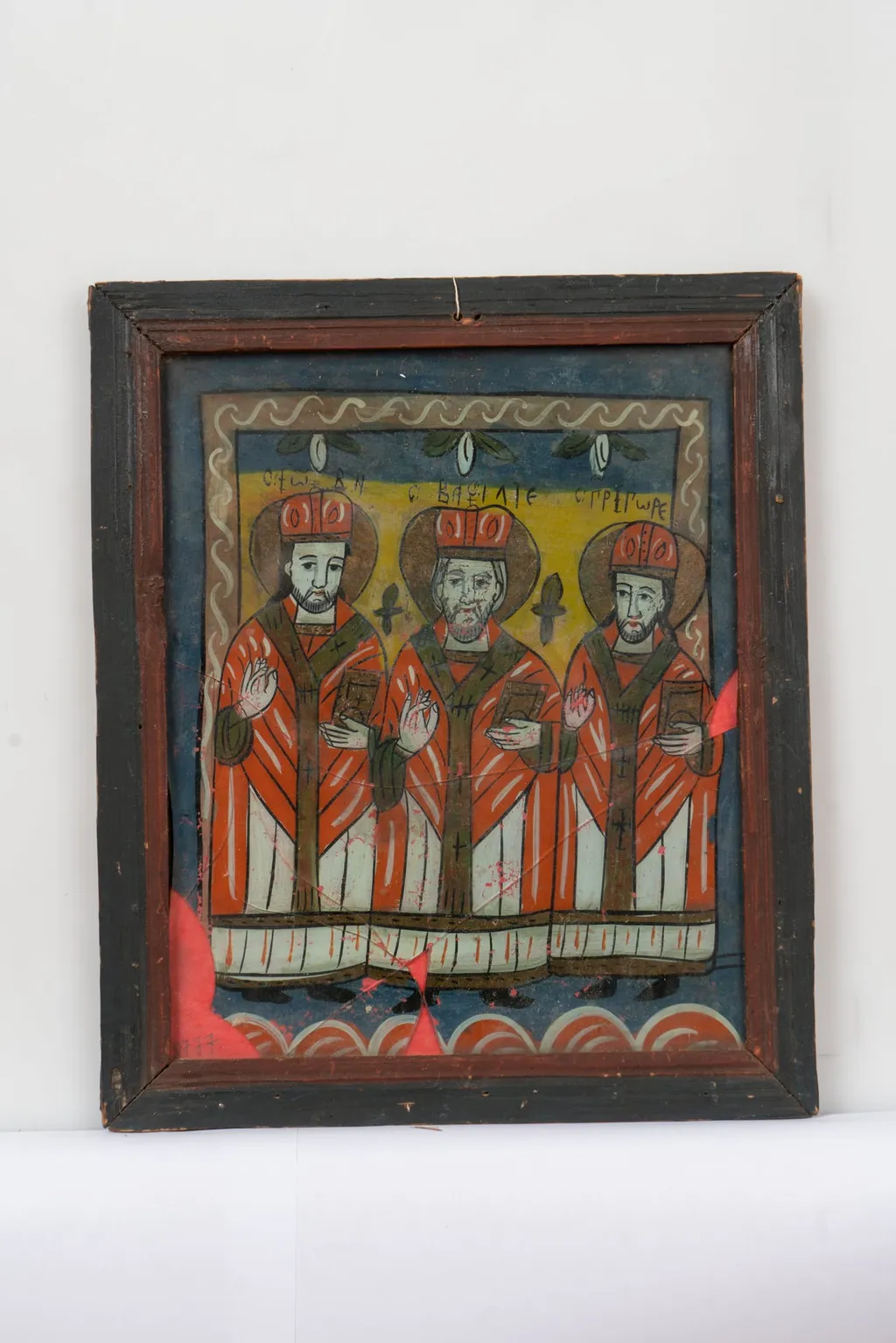
Icoana îi reprezintă pe cei trei sfinți ierarhi, Vasile cel Mare, Grigorie Teologul și Ioan Gură de Aur, pictați frontal, în picioare. Cei trei sfinți binecuvântează cu dreapta, iar în stânga țin Evanghelia. Sfinții sunt îmbrăcați în veșminte arhierești și cu mitre pe cap. Fizionomiile sunt asemănătoare, doar sfântul Vasile, pictat la mijloc, are barba mai lungă decât ceilalți doi sfinți. Compoziția e delimitată în partea superioară de un brâu ornat cu motivul torsadei. Cromatica icoanei se compune din tonuri de roșu vermillon, ocru galben, alb, verde, albastru, negru și gri. Rama icoanei e profilată, bicromă și e formată din îmbinarea a patru baghete de lemn. Sticla e spartă în mai multe fragmente, iar din partea inferioară lipsesc trei fragmente de mici dimensiuni. is a drawing by Unknown. It dates from 1850 and is held in the collection of the Ethnographical Museum of Transylvania.
About this work
Overview
Created circa 1850 by an unknown Romanian artist, this icon depicts the Three Hierarchs: Basil the Great, Gregory the Theologian, and John Chrysostom.
Created circa 1850 by an unknown Romanian artist, this icon depicts the Three Hierarchs: Basil the Great, Gregory the Theologian, and John Chrysostom. The composition arranges the saints frontally in a standing position, each holding a Gospel book in the left hand while raising the right hand in a gesture of blessing. They are clad in full episcopal vestments and mitres, rendered in a palette of vermillion red, yellow ochre, white, green, blue, black, and gray.
While the physiognomies of the three figures are largely similar, Basil the Great, positioned centrally, is distinguished by a longer beard. The upper section of the image is bounded by an ornamental band featuring a twisted rope motif. The work is housed in a profiled, bicolor wooden frame constructed from four joined strips.
The icon's glass cover is fragmented, with three small pieces missing from the lower edge, indicating physical deterioration over time. This piece exemplifies the traditional Eastern Orthodox iconographic style prevalent in 19th-century Romania, prioritizing theological representation over naturalistic depth.
Subject & Meaning
The trio represents the three great Cappadocian Fathers, revered for their theological contributions and leadership of the early Church. Their simultaneous blessing and presentation of the Gospel underscore their collective authority as teachers and guardians of the Christian doctrine.
Technique & Style
Executed in a flat, bright palette, the icon employs vermilion red, ochre yellow, white, green, blue, black, and gray. The composition is framed by an ornamental band featuring a twisted‑rope motif at the top. The painted surface shows no modeling or shading, adhering to the conventional Byzantine iconographic style.
Context
The wooden frame consists of four joined sticks, finished in a two‑tone profile. The glass covering the icon is fractured into numerous shards, and the lower edge is missing several small fragments, indicating damage to the protective glazing.
Artist & collection
Museum
Ethnographical Museum of Transylvania
Continue through works from the same source collection.








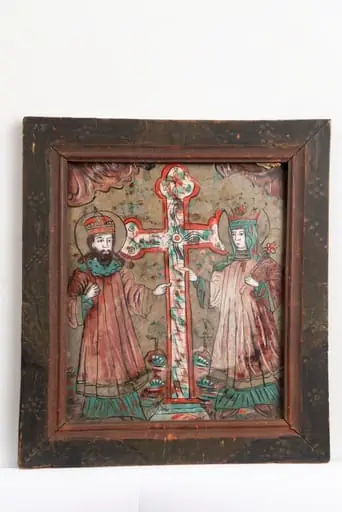
- Icoana îi reprezintă pe Sfinții Împărați Constantin și Elena, pictați frontal, în picioare, ținând împreună în mână Crucea Răstignirii, ce domină central compoziția. Împărăteasa Elena ține în mâna stângă o ramură, îar împăratul Constantin are în mâna dreaptă un sceptru. Fondul icoanei e pictat integral doar în partea superioară unde apar în colțuri două ornamente din registrul vegetal, în rest e pictat cu laviuri colorate și decorat cu flori realizate din puncte, fiind vizibil fondul din hârtie argintată. Cromatica icoanei se compune din tonuri de roșu, alb, albastru, maro și gri. Rama icoanei e profilată, bicromă (latura interioară roșie, iar cea exterioară verde, decorată cu motive florale și geometrice) și e formată din îmbinarea a patru baghete de lemn. Sticla are un fragment lipsă, de mici dimensiuni, în partea stângă-sus.
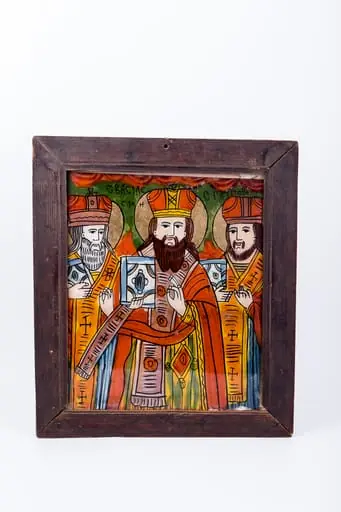 Cei Sfinți Trei Ierarhi Vasile cel Mare, Grigorie de Dumnezeu Cuvântătorul și Ioan Gură-de-Aur slujesc și săvârșesc Sfânta Liturghie împreună. Sunt înveșmântați în veșminte liturgice: sacos, felon și epitrahil mithră și aureolă. Cromatica veșmintelor este vie și luminoasă: roșu vermillon, verde spanac-avocado, galben-ocru și albastru bleu-ciel. Ceea ce este inedit este că în această icoană, cei trei sfinți ierarhi binecuvântează cu mâna stângă. Este o licență poetică picturală - pictura pe sticlă se realizează în oglindă. Fondul întregii tematici iconografice este format din alternanța de verde și roșu vermillon. Cromatica este luminoasă și armonioasă, vie și luminoasă: roșu vermillon, orange, verde spanac-avocado, galben-ocru, albastru bleu-ciel, alb și negru. Este o icoană specifică picturii de Țara Oltului, din centrul Șcheii Brașovului. Inscripiția din româno-chirilică se traduce: Vasile Ioan Grigorie
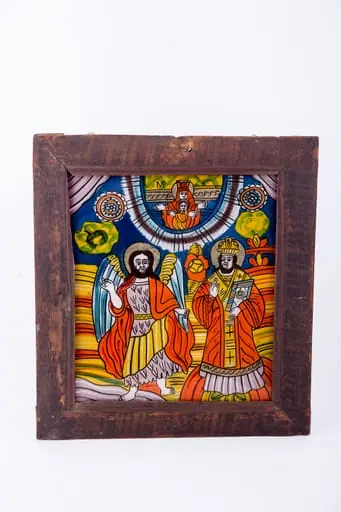 Icoana îi reprezintă pe Sfântul Ioan Botezătorul și Înaintemergătorul Mântuitorului Iisus Hristos și pe Sfântul Mare Ierarh Vasile cel Mare. Cel dintâi este simbolul pocăinței și cel de-al doilea este asprimea dezlegărilor. Sfântul Ioan Botezătorul este îmbrăcat cu o mantie roșie vermillon și ocru și un himation gri-brun sau o haină din păr de cămilă. Este desculț și are aripi de înger. Sfântul Mare Ierarh Vasile cel Mare este îmbrăcat în veșminte liturgice de arhiereu, cu mantie roșie vermillon, sacos alb-gri, epitrahil-patrafir galben, mithră mitopolitană și ține în mâna stânga Sfânta Evanghelie închisă și cu mâna dreaptă binecuvintează. În registrul superior, într-un semicerc de raze, asemenea unei mandorle de nouri, ca într-o deschidere de Ceruri, este Maica Domnului cu Pruncul Iisus Hristos în brațe, amândoi arătând Calea, ocrotind, păzind și binecuvântând. Maica Domnului este Orantă, adică rugătoare. Fondul icoanei este albastru ceruleum, pe care sunt câteva flori mari galben-verzi și doi aștri decorativi. Soarele, luna, stelele și florile adeseori se suprapun simbolic și semantic în icoanele din Țara Oltului. Cromatica este armonioasă, luminoasă și vie: roșu vermillon, galben, ocru, verde, albastru ceruleuum, alb, negru.
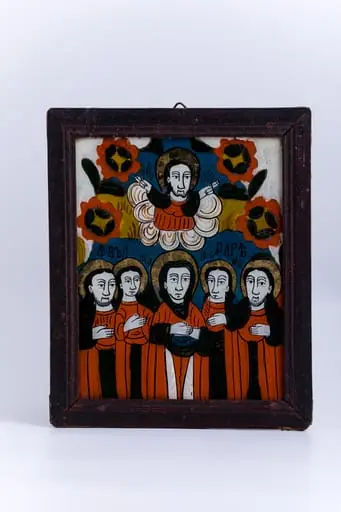 Icoana reprezintă Înălțarea Domnului Iisus Hristos, în a 40-a zi după Învierea Sa. Înălțarea are loc într-o zi de joi, asemenea ca și Cina cea de Taină, Cina Euharistiei. În registrul superior, este Mântuitorul Iisus Hristos cu mâinile ridicate în Binecuvântare și Ocrotire, fiind ridicat și Înălțat pe o mandorlă de nouri albi-gri-crem. În registrul inferior, este Maica Domnului dimpreună cu patru din cei 12 ucenici și apostoli ai Mântuitorului Iisus Hristos. Veșmintele sunt într-o combinație de roșu vermillon, gri, negru antracit. Fondul icoanei este cerul albastru cobalt-ceruleum, în registrul superior, iar în registrul mediu-lateral și inferior este un câmp luminos galben-chihlimbar. Întreaga compoziție iconografică este încadrată de un chenar decorativ fitomorf, format dintr-o ghirlandă de bujori-trandafiri - 4 ruje roșii mari. Cromatica este armonioasă și luminoasă: roșu vermillon, albastru cobalt și ceruleum, galben chihlimbar, crem-bej, gri, negru antracit, alb. Icoana este rară, datorită tematicii iconografice abordate și are o compoziție simetrică, echilibrată și armonioasă. Icoana este din Nicula.
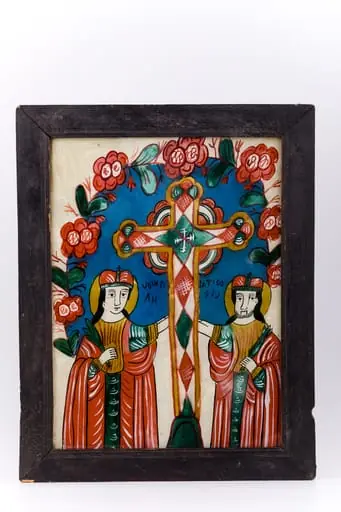 În centrul icoanei este Crucea, iar în dreapta crucii este Sfânta Împărăteasă Elena, și în stânga este Împăratul Constantin. Veșmintele sfinților împărați sunt pictate cu roșu vermillon și ocru-muștar și mânecile și epitrahile-patrafire vernil-gri. Poartă coroane împărătești și aureole de sfinți, mantiiile de împărați le au prinse la gât cu fibulă. Crucea este alb-crem cu elemente decorative geometrizante romboidale roșii-verzi și are capetele brațelor cu elemente decorative trilobate roșii vermillon-vernil. Fondul este cerul albastru ceruleum-regal foarte senin. Împrejurul Crucii este un spațiu luminos de alb-ivoriu Întreaga compoziție iconografică este încadrată de un chenar decorativ geometrizant alb-luminos și un chenar fitomorf, format dintr-o ghirlandă de 7 ruje - trandafiri și bujori roșii vermillon și 2 boboci de măceș - cu frunze gri-verzui. Cromatica este armonioasă: roșu vermillon-stacojiu-rose, albastru cobalt-regal, ocru-muștar, bronziu, brun, galben-chihlimbar, verde brad, vernil-gri, alb, negru. Inscripția în româno-chirilică se traduce Constantin și Elena. Icoana este din Nordul Transilvaniei, Nicula.
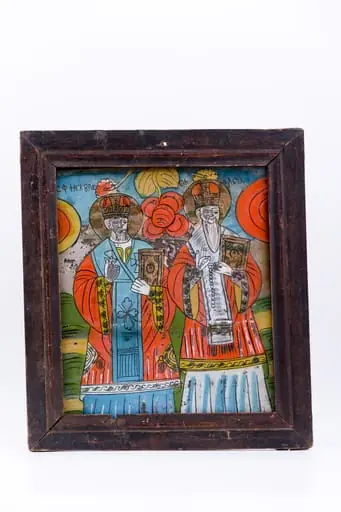 Icoana îi reprezintă pe Sfântul Ierarh Nicolae și Sfântul Vasile cel Mare, amândoi ierarhi, în veșminte liturgice arhierești, binecuvântând. Sfântul Mare Ierarh Nicolae, făcător de minuni, este îmbrăcat în veșminte liturgice, de ierarh, sacos roșu-vermillon, cu epitrahil-patrafir albastru bleu-ciel. Sfântul Nicolae are în mâna stângă Sfânta Evanghelie închisă și cu mâna dreaptă Binecuvântează. Este unul dintre cei mai populari și iubiți sfinți, ocrotitor al caselor, familiilor și copiilor. Are barbă sură, mithră arhierească și aureolă. Alături este Sfântul Ierarh Vasile cel Mare, în veșminte roșii vermillon, cu interiorul galben, sacos gri-albăstrui și epitrahil gri. Fondul este albastru bleu-ciel cu elemente decorative fitomorfe ruje galbene și roșii. Cromatica este armonioasă și pastelată: roșu vermillon, albastru bleu-ciel, verde, galben-ocru, negru, alb. Icoana este de Țara Oltului. Inscripția din româno-chirilică se traduce Sf Nicolae Sf Vasile.
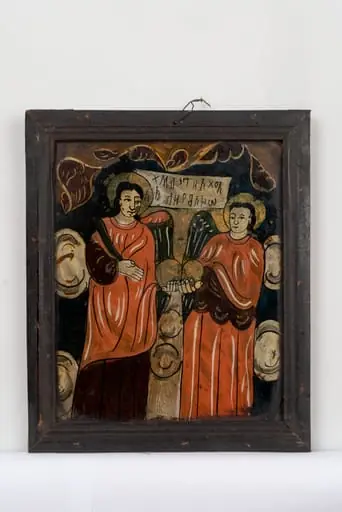 Icoana îi reprezintă pe Sfinții Arhangheli Mihail și Gavriil, pictați frontal, în picioare, în veșminte lungi și asemănători unul cu celălalt. Amândoi arhanghelii țin spre miljoc o sferă, iar sfântul arhanghel Mihail ține în mâna dreaptă o sabie. Fondul icoanei e compus din nori stilizați în partea inferioară a compoziției și ornamente din registrul vegetal în partea superioară. Cromatica icoanei se compune din tonuri de roșu, ocru, alb, verde, albastru, maro, negru și gri. Rama icoanei e profilată, băițuită și e formată din îmbinarea a patru baghete de lemn.
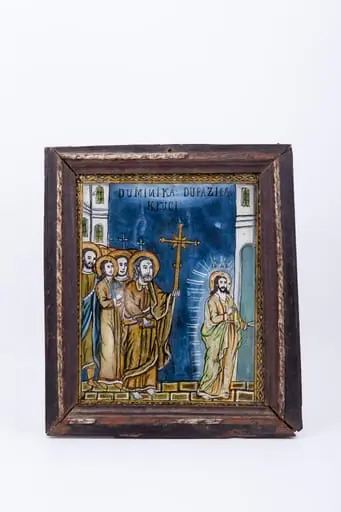 Icoana reprezintă Duminica după Înălțarea Sfintei Cruci - 14 septembrie. Mântuitorul Iisus Hristos este urmat de Apostoli și Sfinți Părinți ridicând Sfânta Cruce. Veșmintele sunt într-o combinație de verde, kaki, brun, olive, gri, ocru. Crucea înălțată este central pictată, iar Mântuitorul Iisus Hristos este înveșmântat și în razele de lumină ale Slavei Harului. Compoziția este foarte echilibrată, relația dintre personaje fiind încadrată de elemente de arhitectură, de o parte și de alta. În registrul inferior, este un caroiaj de kaki-ocru. Fondul este albastrul ceruleum al cerului. Pe lângă crucea aurie, cea mare și centrală, mai sunt încă trei cruci, aduse de cei care Îl urmează pe Mântuitorul Iisus Hristos. Tematica iconografică, mai rară, este încadrată de un chenar decorativ geormetrizant romboidal. Icoana este de Laz, Valea Sebeșului, cu o cromatică armonioasă: albastru ceruleum, verde, brun, kaki, ocru, olive, negru, alb. Icoana este datată 1903. Inscripția din româno-chirilică se traduce Duminica după Ziua Crucii IC XC Iius Hristos.
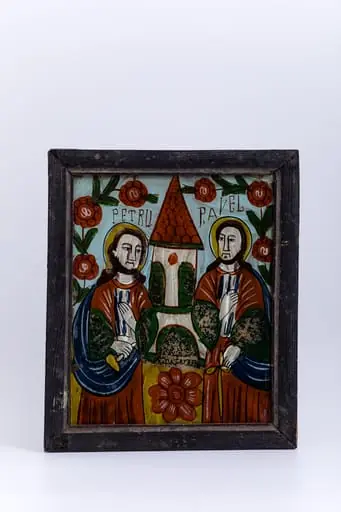 Icoana îi reprezintă pe cei doi Apostoli Sfinții Petru și Pavel, Petru cu cheile Împărăției Cerești în mână și pe Pavel cu sabia Cuvântului în mână, susținând împreună chivotul unei biserici, simbolul Bisericii sobornicești și apostolești. Biserica este situată în registrul îndepărtat, dar este redată în așa fel încât să fie înțeleasă ca și cum ar fi dusă pe umeri de Sfinții Apostoli. Au mantiile roșii vermillon, și veșmintele cu sacos-uri verzi și albastre cobalt. Fondul icoanei este cerul albastru bleu-ciel, în partea superioară, pe margini, și un câmp galben-chihlimbar, în spațiul de miez. În registrul inferior, fondul este un rând de galben chihlimbar-muștar, pe latura superioară. Cheile și crucea sunt simboluri puternice. Se creează astfel un triunghi de semnificații teologice: crucea-chivotul de biserică-cheile Raiului. Chipurile sunt foarte expresive, cu trăsături fine. Inscripția din româno-chirilică se traduce Petru Pavel. Compoziția este rezistentă și cromatica armonioasă: roșu vermillon-stacojiu, albastru cobalt, ultramarin și bleu-marin, verde văratic, galben chihlimbar, brun, gri, alb zinc, negru, auriu. Inscripția din româno-chirilică se traduce Petru Pavel. Icoana este din Nordul Transilvaniei, Nicula.
 Icoana este împărțită în 6 ferestre, de prăznicar, pe trei registre, două câte două: Sfinții Mari Ierarhi Spiridon Tămăduitor de boli, Vasile cel Mare, Grigorie de Dumnezeu Cuvântătorul, Ioan Gură-de-Aur, Nicolae făcător de minuni. Sfinții sunt încadrați de coloane și arcade de bolți de biserică. Au veșminte arhierești cu sacos, felon, mithră, aureolă și epitrahil-patrafir. Țin în mâna dreaptă Sfânta Scriptură închisă și Binecuvântează cu mâna stângă. Cromatica este armonioasă și vie, puternică, specifică Țării Oltului; roșu vermillon, albastru regal, bleu-ciel, verde spanac-avocado, galben-ocru, brun, bej, cafeniu, negru, alb, auriu. Inscripția din româno-chirilică se traduce Sf Spiridon Sf Vasile Sf Grigorie Sf Ioan Sf Nicolae. Icoana este de Șcheii Brașovului, Țara Oltului.