Artwork
Venus and Minerva
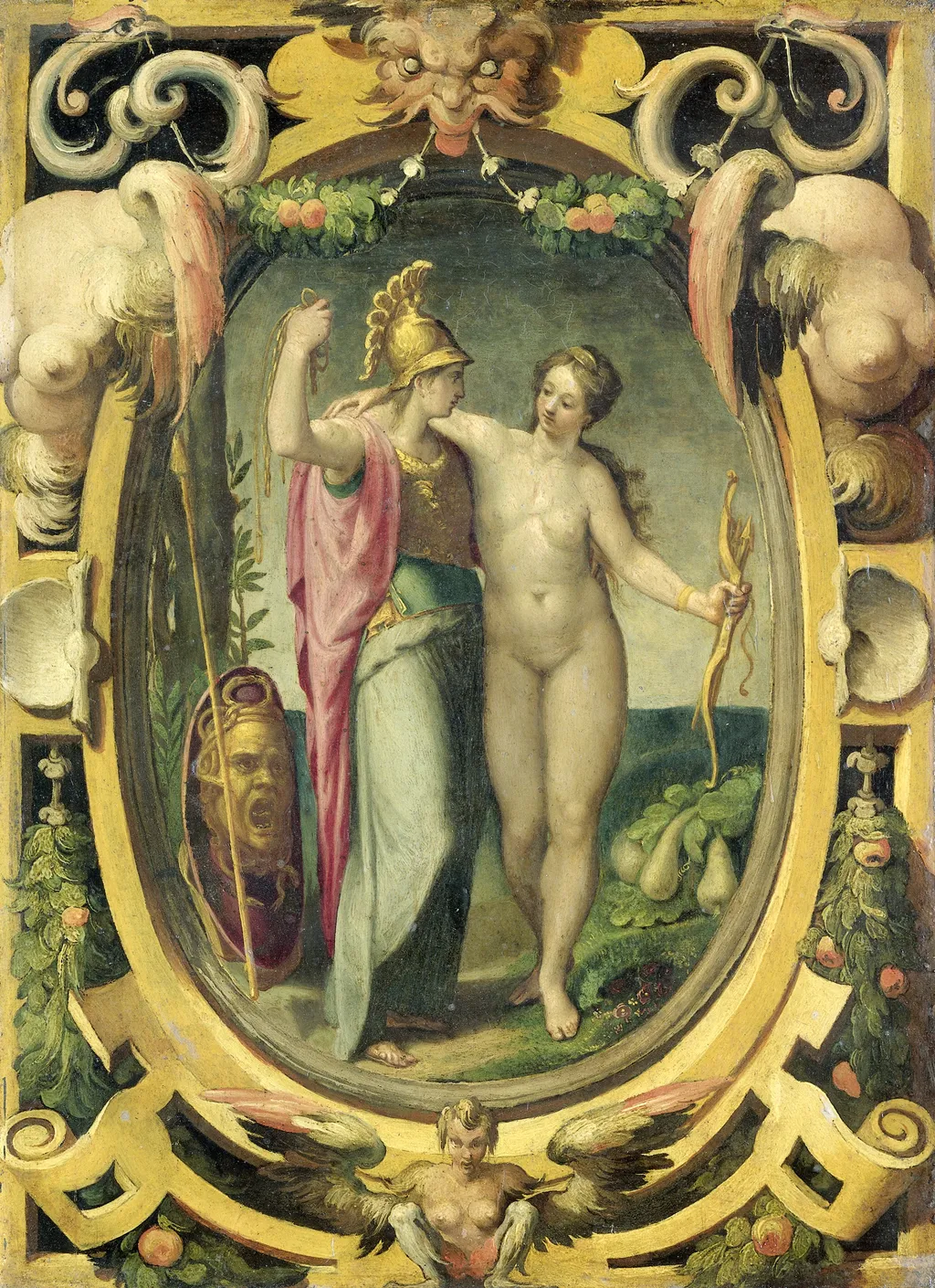
Venus and Minerva is an oil painting. It dates from 1605 and is held in the collection of the Rijksmuseum.
About this work
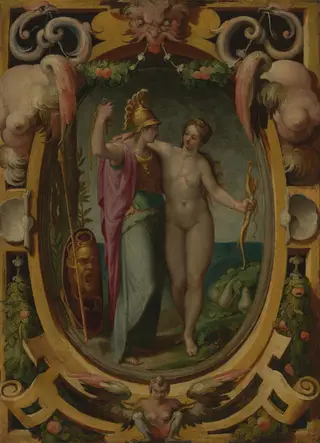
On a small oval copper panel at the Rijksmuseum, Venus and Minerva stand arm in arm in a green landscape. Minerva's shield and lance rest against a tree while Venus holds her bow and arrow, an odd pairing of love and wisdom. An anonymous hand painted it around 1605, close to the Italian Mannerist Pellegrino Tibaldi.
Subject & Meaning
The marked contrast between Venus's exposed nudity and Minerva's martial attire underscores the opposition between passion and intellect, beauty and strategy.
The painting depicts the Roman goddesses Venus (Aphrodite) and Minerva (Athena) in a rural setting. Venus appears nude, adorned with a diadem and garland, and holds a bow and arrow, symbolizing love and desire. Minerva is armored, wearing a cuirass, combat helmet, and sandals, and carries a shield and spear, representing wisdom and warfare.
The marked contrast between Venus's exposed nudity and Minerva's martial attire underscores the opposition between passion and intellect, beauty and strategy. Both figures make eye contact, suggesting a dialogue or confrontation. The work's mythological genre and inclusion of attributes such as the broad-leaved tree reinforce its classical narrative roots.
Technique & Style
This painting is executed in oil on a copper support, a medium that allows for fine detail and a smooth finish. The work is small-format, measuring 31 by 22.7 centimeters. Stylistically, the composition features a contrapposto stance in the female figures, with Venus depicted nude and Minerva clad in a cuirass and helmet, holding a shield and spear.
The scene includes elements such as sandals, a chiton, and a diadem, set in a rural landscape with a broad-leaved tree and sky. The figures maintain eye contact, and the handling emphasizes clear contours and a polished surface typical of the period.
Overview
This small oil painting on copper, titled Venus and Minerva, is held in the Rijksmuseum collection. Measuring just 31 by 22.7 centimeters, it depicts the Roman goddesses of love and wisdom in a landscape, an allegorical pairing attributed to a follower of the Italian Mannerist Pellegrino Tibaldi around 1605. The work showcases the detailed execution characteristic of small-scale copper panels from the period.
History & Provenance
The Rijksmuseum in Amsterdam holds this painting under inventory number SK-A-3952. It is attributed to an artist working within the circle of Pellegrino Tibaldi, an Italian Mannerist painter and architect active across Italy and Spain who died in 1596. While not by Tibaldi himself, the work, dated around 1605, reflects the widespread influence of his artistic style among his followers.
Artist & collection