Artwork
Reflections of Priest Foyen
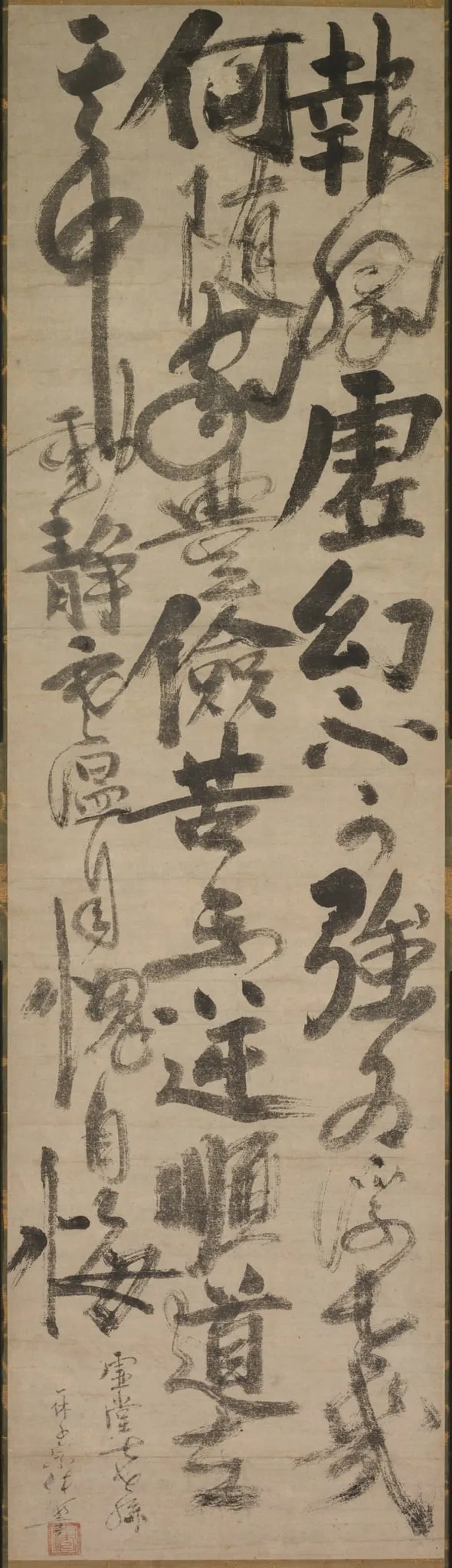
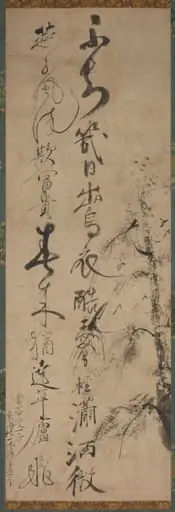
Reflections of Priest Foyen is an unspecified painting by the Joseon dynasty painting artist Ikkyū Sōjun. It dates from 1404 and is held in the collection of the Cleveland Museum of Art.
- Accession no.
- 2015.511
- Credit line
- Gift from the Collection of George Gund III
About this work
Overview
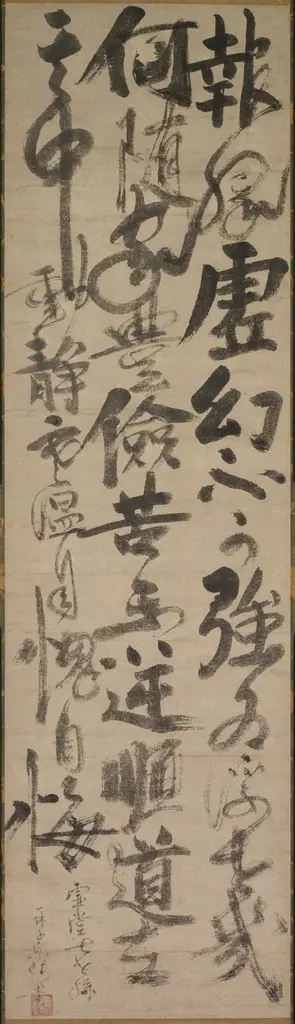
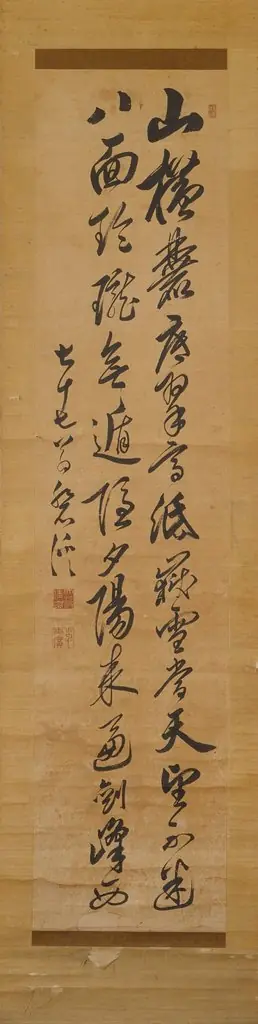
The work features a verse of eight four-character phrases, arranged in three vertical lines with bold, rapid brushwork.
This narrow ink-on-paper scroll is one of the few surviving examples of Ikkyū Sōjun’s early calligraphy. Created when he was six years old, it was left at a Zen temple in Kyoto after being placed there by his mother. The work features a verse of eight four-character phrases, arranged in three vertical lines with bold, rapid brushwork.
Two lines of running script in the lower left bear his signature, accompanied by small red seals affirming authorship.
Subject & Meaning
The text draws from a passage in the Chronicle of the Zen Sect, attributed to the Chinese monk Foyen Qingyuan. It opens with the phrase 'Life is a mirage,' reflecting core Zen themes of impermanence and illusion. Though the full verse is not reproduced here, its content aligns with teachings Ikkyū later expanded in his writings, suggesting an early engagement with doctrinal ideas that would shape his mature thought.
Technique & Style
The brushwork is forceful and unrefined, executed with swift, decisive strokes that convey urgency rather than polish. The characters vary slightly in size and pressure, emphasizing spontaneity over formal precision. The ink is dense and uneven, with visible dry brush effects.
This raw energy, typical of Ikkyū’s later style, already reveals a rejection of conventional calligraphic restraint in favor of expressive immediacy.
History & Provenance
Created in 1391 during Ikkyū’s childhood at the temple, the scroll remained in monastic custody for centuries. Its survival is exceptional, as few works from this period of his life endure. It entered the Cleveland Museum of Art’s collection in the 20th century, where it is now preserved as a rare artifact of his formative years, bridging his early exposure to Zen and his later literary output.
Context
In 14th-century Japan, child oblates were commonly placed in temples for religious training. Ikkyū’s early immersion in Zen practice, including exposure to Chinese classics and poetic traditions, laid the foundation for his later iconoclastic writings. This scroll reflects the cultural practice of integrating literary study with spiritual discipline, where calligraphy served as both devotion and intellectual exercise.
Legacy
As one of the earliest known works by Ikkyū, the scroll offers insight into the origins of his distinctive voice. Its unpolished vigor prefigures the rebellious spirit of his later poetry and teachings. Scholars view it not as a refined artistic product but as a direct trace of his youthful engagement with Zen principles, a tangible link between childhood ritual and lifelong philosophical inquiry.
Artist & collection