Artwork
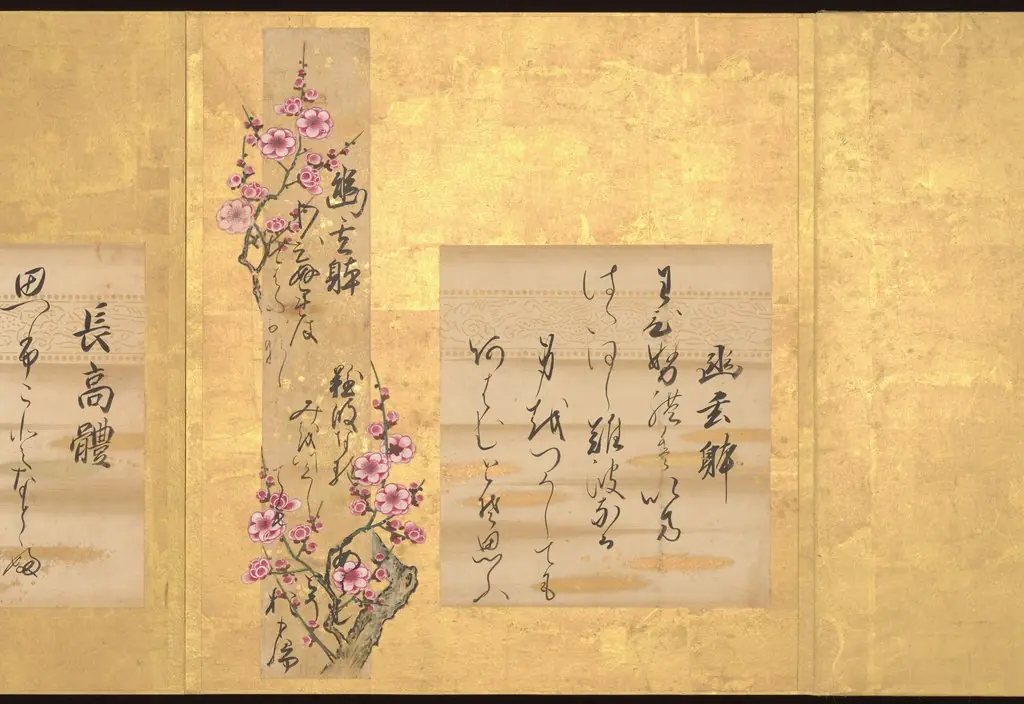
本阿弥光悦書 木版下絵和歌巻断簡|Twelve Poems from the New Collection of Poems Ancient and Modern
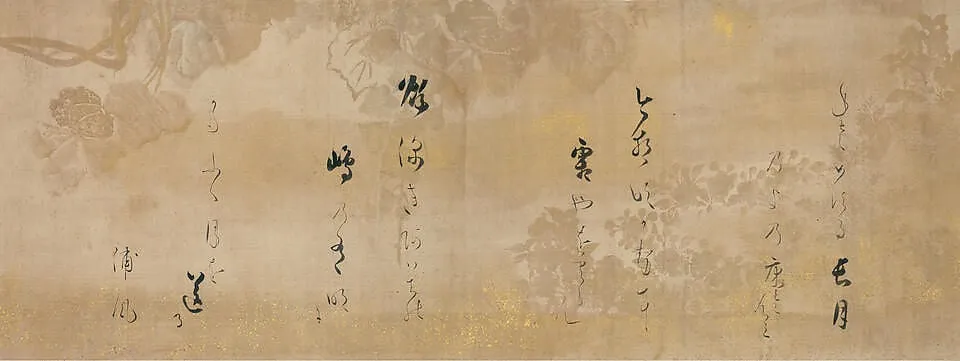
本阿弥光悦書 木版下絵和歌巻断簡|Twelve Poems from the New Collection of Poems Ancient and Modern is an ink painting by the Nihonga artist Tawaraya Sōtatsu. It dates from 1620 and is held in the collection of the Metropolitan Museum of Art.
About this work
Subject & Meaning
As a handscroll created in 1620, it serves as a visual and literary artifact where the calligraphy and design are inextricably linked to the poetic text.
The work depicts the subject of poetry, specifically representing a selection of verses. As a handscroll created in 1620, it serves as a visual and literary artifact where the calligraphy and design are inextricably linked to the poetic text. The piece is classified within the religious genre, suggesting that the selected poems or their presentation carry spiritual significance or were intended for a devotional context.
The integration of ink and gold on silk elevates the literary content, transforming the verses into a sacred or highly esteemed aesthetic object.
History & Provenance
The work, titled Twelve Poems from the New Collection of Poems Ancient and Modern, was created in 1620 in Japan. It is attributed to the artist Hon'ami Kōetsu, who executed the calligraphy for this piece. The artwork is currently held in the collection of the Metropolitan Museum of Art.
While the scroll features calligraphy by Hon'ami Kōetsu, the associated visual design is linked to Tawaraya Sōtatsu, a prominent figure of the period. The medium consists of ink and gold applied to silk, formatted as a handscroll. This specific fragment is recognized as a section of a larger original composition.
Twelve Poems from the New Collection of Poems Ancient and Modern is held in the collection of the Metropolitan Museum of Art. The handscroll, executed in ink and gold on silk by Hon'ami Kōetsu in 1620, is classified as a painting within the museum's holdings and was made in Japan.
No exhibition history is documented in the available sources.
Legacy
The handscroll 本阿弥光悦書 木版下絵和歌巻断簡|Twelve Poems from the New Collection of Poems Ancient and Modern, dated 1620, is part of the Metropolitan Museum of Art collection and is recognized as a seminal example of Edo‑period poetic illustration. Attributed to Hon'ami Kōetsu and associated with Tawaraya Sōtatsu, the work combines ink, gold on silk to visualize a sequence of poems, reflecting the religious and literary currents of its time. Its status as a religious painting and its focus on poetry have made it a reference point for scholars studying the intersection of text and image in early Japanese art.
Overview
Created around 1620 by the Japanese calligrapher and painter Hon'ami Kōetsu, this handscroll presents a series of twelve poems rendered in ink and gold on silk. The work combines textual and visual elements, arranging verses alongside delicate landscape motifs that frame each composition.
Technique & Style
Kōetsu employs monochrome ink lines accented by gold leaf, a technique that enhances the silk surface while preserving a restrained aesthetic. The brushwork is precise yet fluid, allowing the calligraphic characters to integrate seamlessly with the minimalistic depictions of foliage, water, and sky.
Context
During the early 1600s, Japanese artists often merged poetry and painting to create a unified visual‑literary experience. Kōetsu’s work reflects this tradition, aligning with the broader Zen‑inspired aesthetic that values simplicity, subtlety, and the harmonious coexistence of text and image.
Artist & collection

Artist
Tawaraya Sōtatsu (俵屋 宗達; c. 1570 – c. 1640) was a Japanese furniture designer and painter of the Rinpa school. Sōtatsu is best known for his decorations of calligraphic works by his partner Hon'ami Kōetsu (1558–1637),…

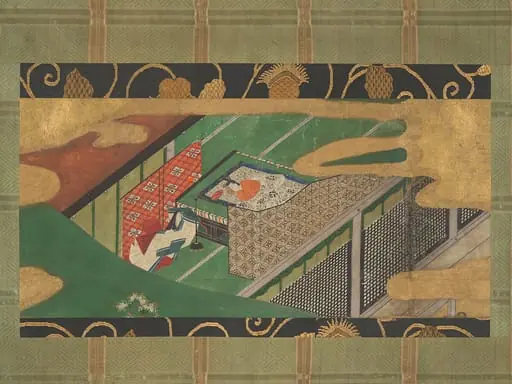 伝俵屋宗達筆 源氏物語図「宿木」 |“Trees Encoiled in Vines of Ivy” (Yadorigi)
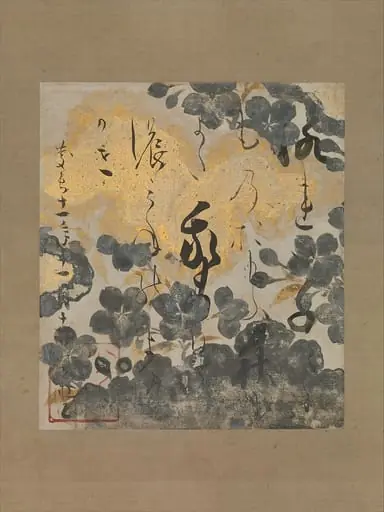 本阿見光悦書・俵屋宗達下絵 桜下絵和歌色紙 鴨長明|Poem by Kamo no Chōmei with Underpainting of Cherry Blossoms
- 本阿弥光悦書・俵屋宗達下絵 小倉百人一首和歌巻断簡|Two Poems from One Hundred Poems by One Hundred Poets
 Untitled
 Untitled
 Untitled
 Selections from the New Collection of Japanese Poems from Ancient and Modern Times (Shinkokin wakashū) with Printed Designs of Chinese Lions and Crab Finger Grass
 White Heron (Shirosagi zu)