Artwork
Ornament with Dance of the Lovers
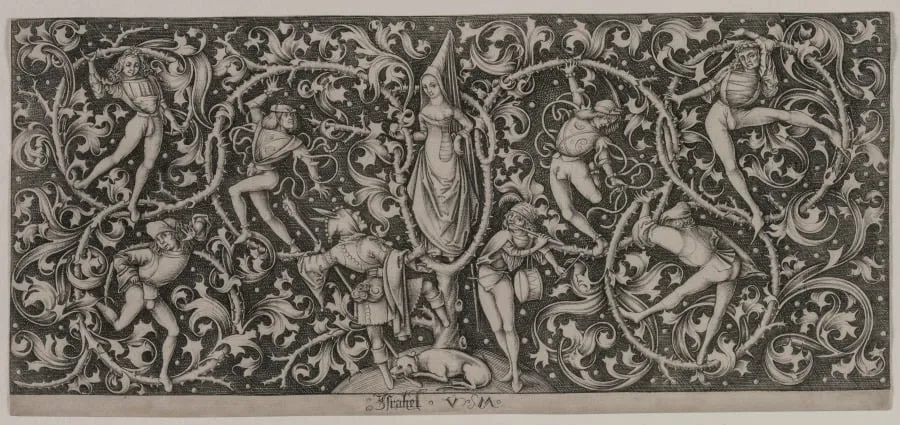
Ornament with Dance of the Lovers is a print by the Renaissance artist Israhel van Meckenem. It dates from 1490 and is held in the collection of the Cleveland Museum of Art.
- Accession no.
- 1952.532
- Credit line
- John L. Severance Fund
About this work
The thorns aren’t just decoration; they show how love could feel like a game with sharp rules.
You see two men dancing around a woman on a small metal plaque. Thorny vines twist between them, making every step risky. Musicians play in the background.
This was a fancy party trick, rich people in 1490s Germany wore these plaques like jewelry. The thorns aren’t just decoration; they show how love could feel like a game with sharp rules. The dance looks like a Morris dance, a style troubadours sang about in courts.
To see more of these tiny, detailed scenes, look up Israhel van Meckenem (German, c. 1440–1503).
Overview
The work is a small metal print titled Ornament with Dance of the Lovers. It depicts two male figures dancing around a centrally placed woman, while a pair of musicians perform in the background. Thorn‑laden vines weave through the scene, creating a sense of danger and restraint that frames the figures.
Subject & Meaning
The composition presents love as a competitive pursuit, with the thorny vines symbolising the obstacles and sharp rules governing courtly desire. The two men appear to be engaged in a folk dance, echoing the Morris dance tradition that was associated with medieval courtly love poetry recited by troubadours.
Technique & Style
Executed as a finely engraved metal plaque, the print showcases intricate line work that captures the movement of the dancers and the tangled vines. The stylised figures and rhythmic patterning reflect the late‑medieval German decorative tradition, where narrative scenes were rendered in compact, highly detailed formats.
History & Provenance
Produced in the 1490s in Germany, the plaque was intended as a wearable ornament for affluent patrons, functioning as both jewelry and a conversational object. Its attribution aligns with the output of Israhel van Meckenem, a prolific German printmaker active between circa 1440 and 1503, whose workshop produced numerous similarly detailed prints.
Context
During the late fifteenth century, portable metal prints served as status symbols among the wealthy, often depicting allegorical or courtly themes. The inclusion of a Morris‑type dance links the piece to broader European traditions of courtly performance, where music, poetry, and dance intertwined to celebrate ideals of love and chivalry.
Artist & collection
Artist
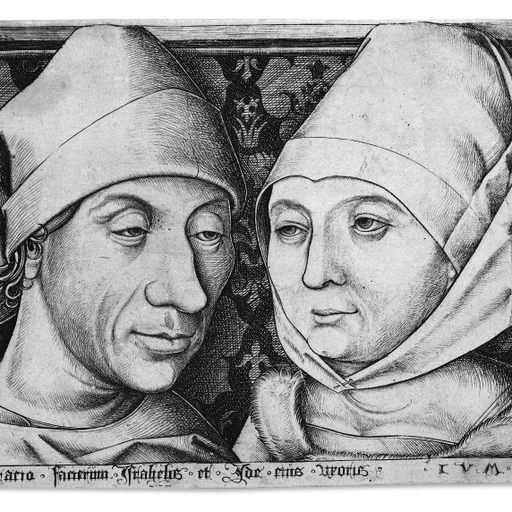
Israhel van Meckenem (c. 1445 – 10 November 1503), also known as Israhel van Meckenem the Younger, was a German printmaker and goldsmith, perhaps of a Dutch family origin. He was the most prolific engraver of the…

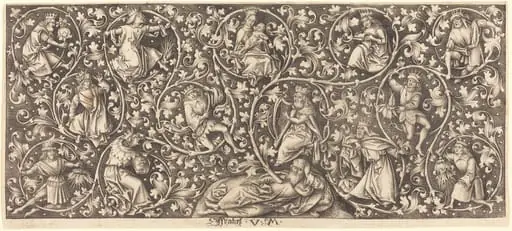 Ornament with the Tree of Jesse
 Ornament with Flower and Eight Wild Folk
 Ornament Panel with Two Lovers
 Ornamental Panel Inscribed "Victoria Augusta"
 The Dance at the Court of Herod
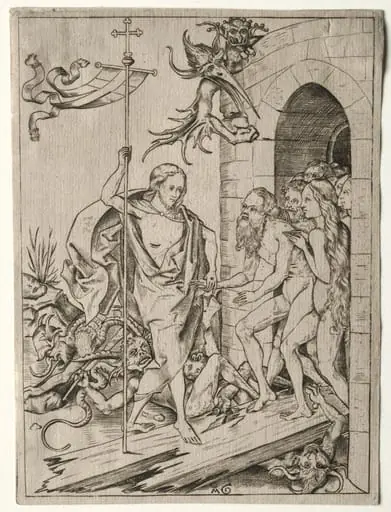 The Descent into Limbo
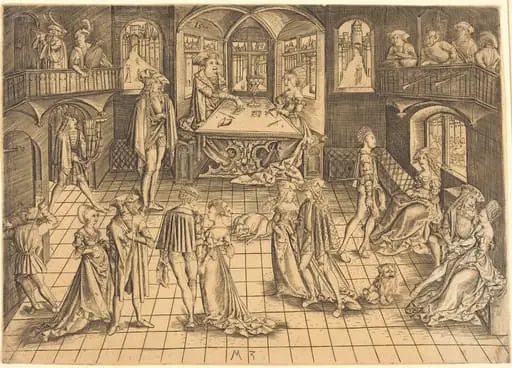 The Ball
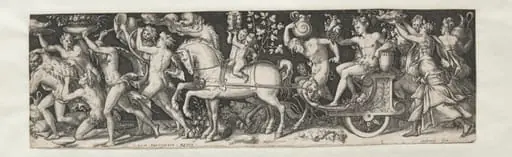 Combats and Triumphs No. 5: The Triumph of Bacchus
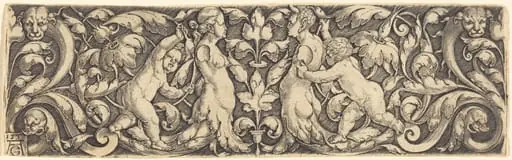 Cross Panel with Vine in Center and Tritons' Couple