Artwork
Horses at rest
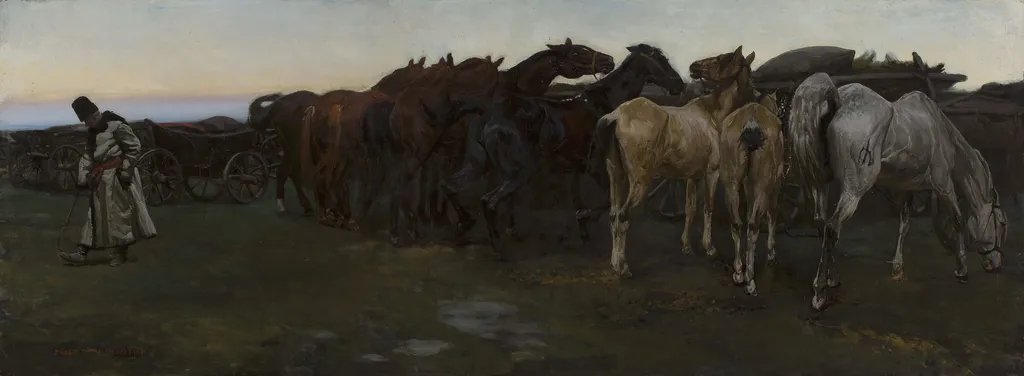
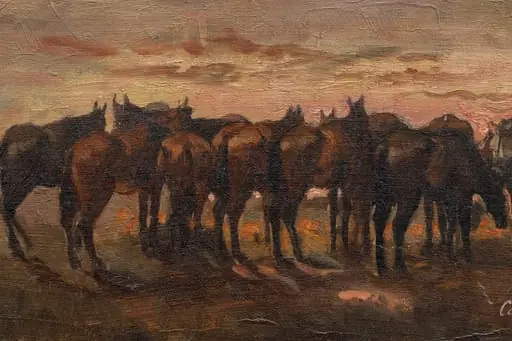
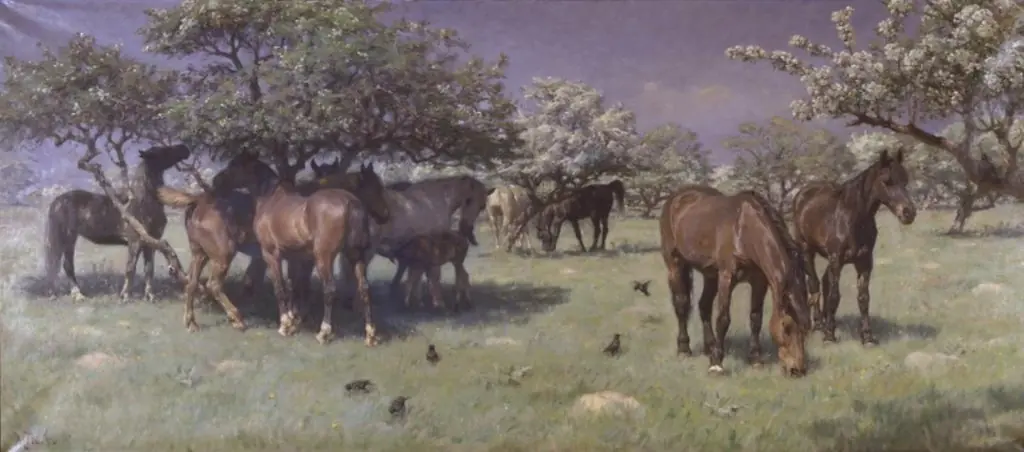
Horses at rest is an oil painting by the Realist artist Józef Chełmoński. It dates from 1890 and is held in the collection of the National Museum in Warsaw. Created in 1890, this oil on canvas presents a quiet rural tableau in which several horses pause within a meadow.
About this work
Overview
It stands as a significant example of Polish realist genre painting from the late 1870s, when the artist was at the height of his international recognition.
Horses at rest is an oil painting on canvas by the Polish artist Józef Marian Chełmoński, created in 1879 during the artist's Paris period. Measuring 58 by 152 centimeters, the horizontal composition depicts a line of horses with an attendant figure against a broad sky. The work is held in the collection of the National Museum in Warsaw under accession number MP 4605. As a product of Chełmoński's mature phase, the painting exemplifies his celebrated ability to render equine subjects with naturalistic observation while maintaining a distinctly painterly surface. It stands as a significant example of Polish realist genre painting from the late 1870s, when the artist was at the height of his international recognition.
Subject & Meaning
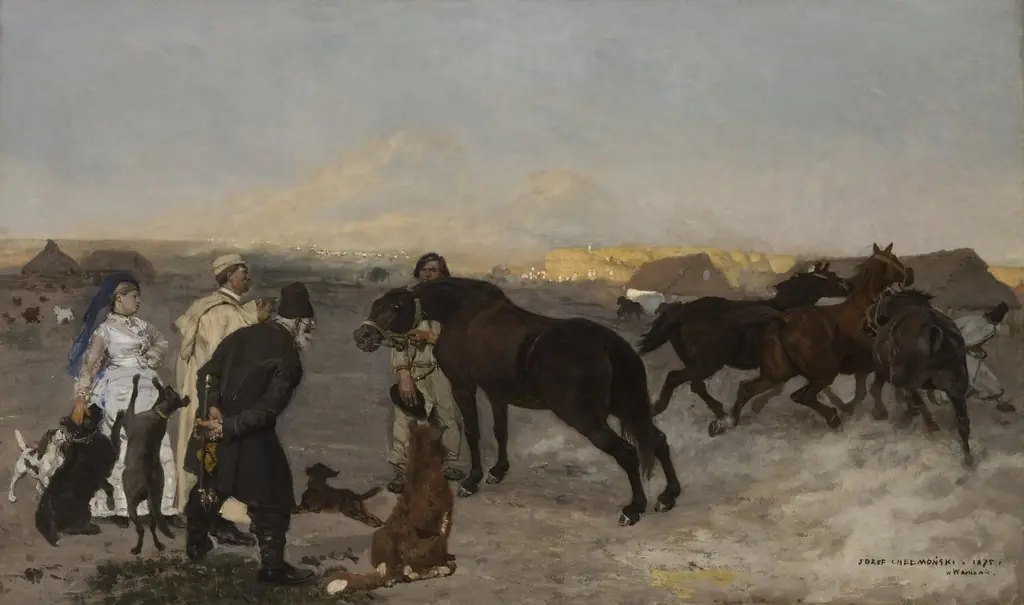
The painting presents eight horses of varying coloration, including dark brown, black, tan, and gray, standing in a horizontal row on dark ground. Some animals nuzzle one another, while a gray horse lowers its head to graze, suggesting a moment of repose in rural labor. To the left, a figure in a long coat and tall hat stands facing right, holding a rope or whip, apparently overseeing the animals. Behind the horses, wooden carts with large wheels indicate a working context, likely a break during agricultural or transport activity. The sky transitions from warm orange near the horizon to cool gray above, implying either dawn or dusk. The subject aligns with Chełmoński's lifelong commitment to depicting rural Polish life, which he rendered with what scholars have identified as a romantic nostalgia for his homeland during his years abroad. The horses function as both literal working animals and symbols of the Polish countryside, a recurrent motif in his oeuvre that resonated with international collectors who found such scenes exotic.
Technique & Style
Executed in oil on canvas, the painting displays the broad, expressive brushwork that characterizes Chełmoński's handling of animal subjects, with particular looseness visible in the horses' coats and the ground. The palette is dominated by earthy browns, muted greens, and soft blues, with even light and subtle shadows beneath the animals. The overall finish is deliberately painterly rather than highly polished, suggesting the influence of French Realist techniques absorbed during the artist's Paris residence. The low horizon line and expansive horizontal format emphasize the breadth of the landscape while allowing the animals to dominate the foreground, a compositional strategy consistent with Chełmoński's approach to monumentalizing rural subjects. The visible signature in the lower left corner confirms attribution. The handling of atmosphere, particularly in the gradated sky, demonstrates his capacity for tonal subtlety within a restrained color range.
History & Provenance
The painting was created in 1879, during Chełmoński's Paris phase (1875-1887), a period when he exhibited at the annual Salons and enjoyed significant popularity among European and American collectors. The work is now in the collection of the National Museum in Warsaw (Muzeum Narodowe w Warszawie), with the accession number MP 4605. The museum's digital infrastructure identifies the work with artwork ID 510080. The painting's provenance before institutional acquisition is not specified in available sources, though during this period Chełmoński worked with the leading art dealer Adolphe Goupil, who channeled many of his works to French and American collectors. The painting has been digitized and made available through the museum's digital collections, with photographic documentation by Krzysztof Wilczyński in 2012.
Context
Horses at rest belongs to a pivotal period in Chełmoński's career. Born in 1849 in Boczki near Łowicz in central Congress Poland under Russian control, he studied at the Warsaw Drawing Class (1867-1871) and with Wojciech Gerson before moving to Munich (1871-1874), where he associated with Polish painters around Józef Brandt and Maksymilian Gierymski. His 1875 departure for Paris marked the beginning of his most commercially successful period, when rural Polish subjects found eager audiences among collectors who regarded them as exotic. Polish Choices of subject matter were shaped by his memories of the Polish countryside, enriched by sketching trips. Polish art historians classify him within the Munich-Warsaw group of late positivism, though his work also carries strong late Romantic currents. Nineteenth-century Polish critics were often critical of his output during this period, noting that commercial success sometimes came at the expense of artistic quality, a tension that may inform evaluation of works from the late 1870s.
Legacy
While specific later reception of Horses at rest is not documented in available sources, the painting participates in the reputation that has made Chełmoński one of the most celebrated Polish painters of animals. His contemporaries and subsequent scholars have consistently singled out his exceptional ability to depict horses with expressive force and anatomical accuracy. The work remains in the permanent collection of the National Museum in Warsaw, among the approximately 400 paintings he produced, of which around 100 were sold to the United States and at least 108 were missing as of 2014. His broader legacy rests on monumental paintings now at the Sukiennice National Art Gallery in Kraków and the National Museum in Warsaw, including later works such as Storks (1900) created after his 1887 return to Poland. These late works, produced in increasing isolation at his estate in Kuklówka Zarzeczna, are often considered his most beloved, though the Paris-period paintings like Horses at rest secured his international reputation and established the visual vocabulary through which Polish rural life entered European art markets.
Artist & collection
Artist
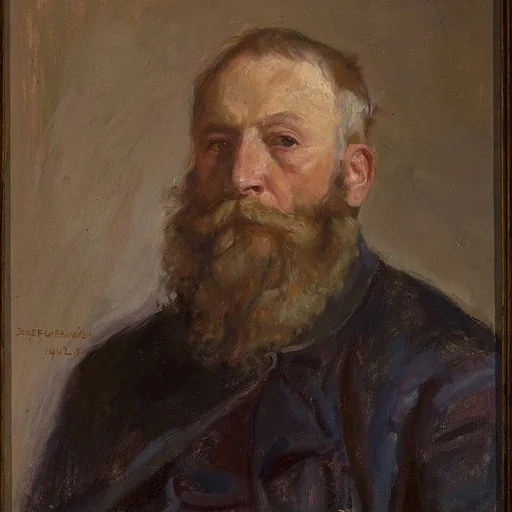
Józef Marian Chełmoński (7 November 1849 – 6 April 1914) was a Polish painter, known for his realistic paintings of landscapes, rural scenes and genre scenes presenting historical and social contexts of the late Romantic period in…