Artwork
Young Poland
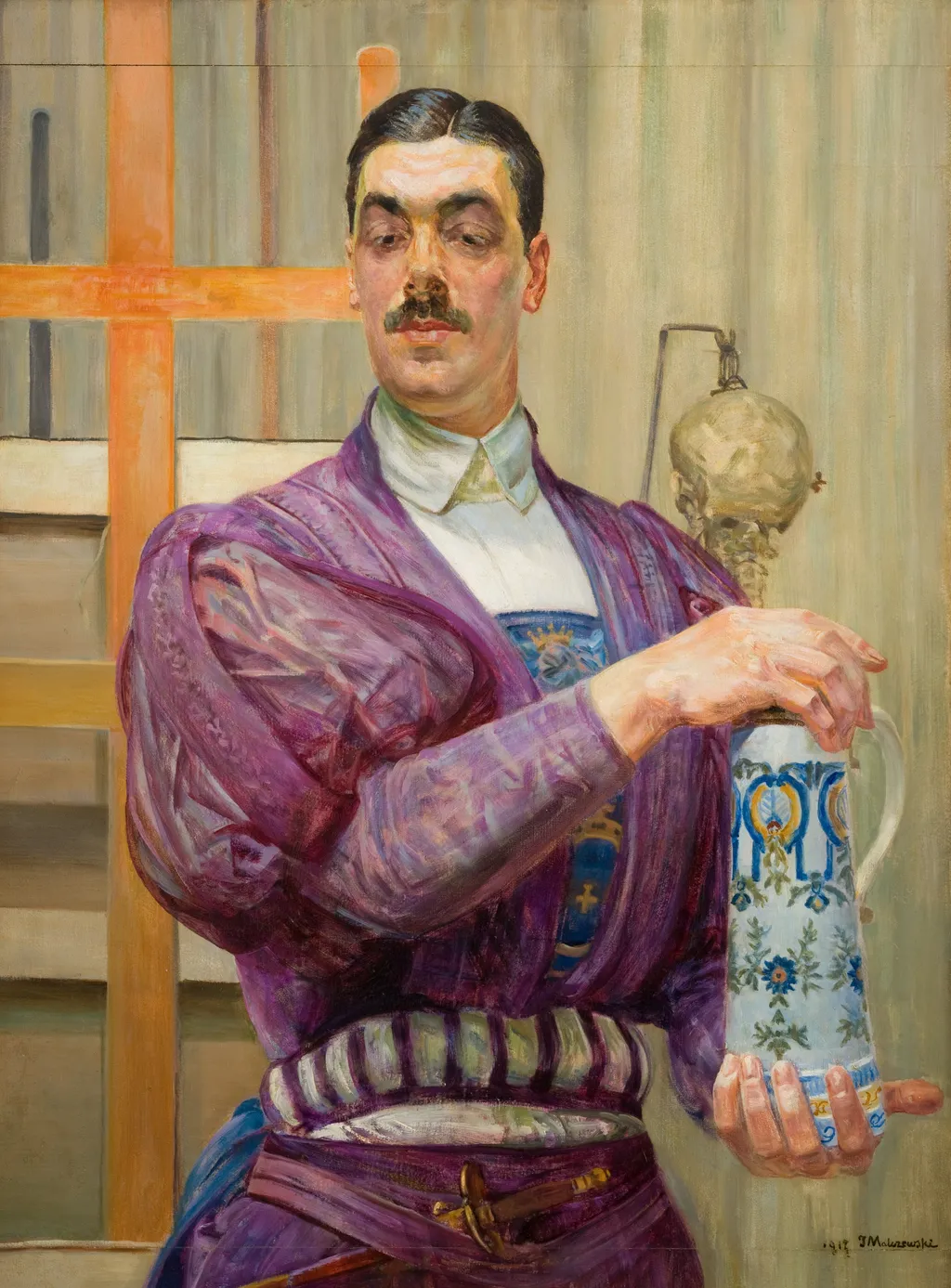
Young Poland is an oil painting by Jacek Malczewski. It dates from 1917 and is held in the collection of the National Museum in Kraków.
About this work
Overview
Young Poland is an oil-on-plank portrait painted in 1917 by Jacek Malczewski, the central figure of Poland's Symbolist movement and a leading proponent of the patriotic Young Poland (Młoda Polska) cultural revival. Measuring 87.5 by 65 centimeters, the work depicts a seated young man in three-quarter length, cradling a decorated ceramic jug against a studio backdrop that includes an easel and a suspended skull. The painting is held in the collection of the National Museum in Kraków, where it remains a key example of Malczewski's ability to fuse individual portraiture with national allegory during the final years of the First World War, when Polish independence appeared newly possible after more than a century of partition.
Subject & Meaning
The skull suspended nearby introduces a memento mori dimension, reminding viewers of mortality and the urgency of cultural renewal in wartime.
The sitter faces forward with his body turned slightly left, his gaze meeting the viewer with a contemplative directness that suggests both self-possession and historical responsibility. He holds a tall white faience vessel decorated with blue and yellow floral patterns, which functions as an emblem of Polish artisan tradition and communal craft. His costume, a voluminous purple robe with wide sleeves over a white high-collared shirt and blue undergarment, cinched with a striped fabric belt and leather buckle, evokes ecclesiastical and aristocratic associations of dignity and spiritual leadership. Behind him to the left, a wooden easel bears a canvas with abstract vertical strokes, signaling Artists tools of creation; to his right hangs a metal oil lamp with a rounded reservoir. The skull suspended nearby introduces a memento mori dimension, reminding viewers of mortality and the urgency of cultural renewal in wartime. The sitter's subtly turned posture, neither fully confrontational nor withdrawn, embodies a generation contemplating its inheritance while envisioning a national future.
Technique & Style
Malczewski executed Young Poland in oil paint on plank, a support that contributes to the work's intimate scale and solid physical presence先锋. The palette centers on purple, blue, white, and warm ochre, with the violet of the robe achieved through layered glazes that blend crimson undertones with cooler blue tones to create a velvety surface catching ambient light. Light falls evenly from the left, modeling the folds of the drapery and the sitter's hands while illuminating the jug's ceramic contours. The brushwork differentiates surfaces with precision: the face and hands receive smooth, blended treatment with delicate tonal transitions that impart sculptural solidity, while the robe's folds and the jug's patterns are articulated with more decisive, fluid gestures. The background's muted vertical stripes in beige and gray-green recede softly, establishing rhythmic counterpoint to the saturated foreground. This handling demonstrates Malczewski's synthesis of academic finish with Symbolist expressive freedom, a hallmark of his mature style.
History & Provenance
Malczewski painted Young Poland in 1917, a pivotal moment when the First World War was reshaping European borders and Polish patriots sensed the possibility of restored sovereignty after 123 years of partition among Russian, German, and Austro-Hungarian empires. The work entered the collection of the National Museum in Kraków, where it remains today. The artist's son, Rafał Malczewski, also a painter, later sold his father's remaining works to the National Museum in Warsaw before the Second World War. While specific exhibition history for this canvas is not documented in the available sources, the painting's place in the Kraków museum's holdings secures its public accessibility and institutional recognition.
Context
Malczewski was born in 1854 in Radom, Congress Poland, under Russian occupation, and trained at the Kraków School of Fine Arts under Jan Matejko before further study in Paris and Munich. By 1917 he had long been established as the foremost proponent of the Young Poland movement, which sought to revitalize Polish art through a synthesis of European modernism and native folklore. His works combined the predominant styles of his era with historical motifs of Polish martyrdom, Romantic aspirations for independence, Christian and Greek mythology, and folk tales. The movement operated under conditions of political suppression, where coded cultural expression served as a form of national resistance. Critics and scholars have consistently situated Malczewski as the father of Polish Symbolism, comparing his art to that of Gustave Moreau, Arnold Böcklin, and even Salvador Dalí in its imaginative density. Young Poland exemplifies his characteristic method of conflating individual portraiture with allegory, transforming a studio scene into a meditation on generational responsibility and cultural continuity.
Legacy
Young Poland endures as a defining image of the movement that shares its name, encapsulating the aspiration for national regeneration through artistic means. The painting's fusion of vibrant color, symbolic iconography, and masterful composition has secured its place in the canon of Polish modern art, representing how visual culture could sustain collective identity under foreign domination. Malczewski's broader legacy as a pioneer of Polish Symbolism, reinforced by his teaching at the Academy of Fine Arts in Kraków and his election as rector in 1912, established a model for subsequent generations of Polish artists. The work's residence in the National Museum in Kraków ensures its continued role in public understanding of the Young Poland era, while its reproduction in premium print editions attests to its persistent cultural resonance. The painting stands alongside Malczewski's other major canvases, including Błędne koło, Melancholia, and the Thanatos series, as evidence of a career devoted to translating national experience into enduring visual metaphor.
Own this work as a print
Artist & collection
Artist
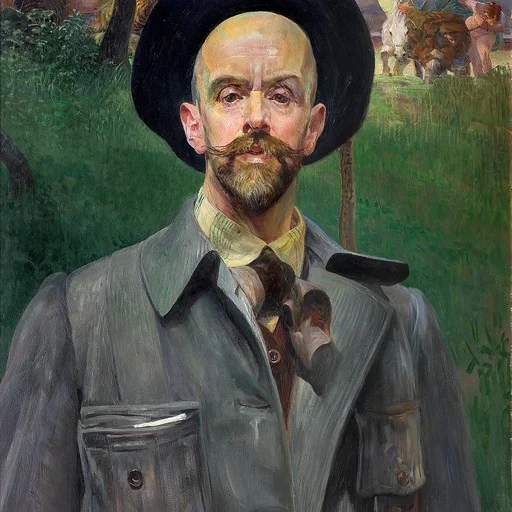
Jacek Malczewski (Polish:; 15 July 1854 – 8 October 1929) was a Polish symbolist painter who was one of the central figures of the patriotic Young Poland movement.