Artwork
A Painter's Apprentice
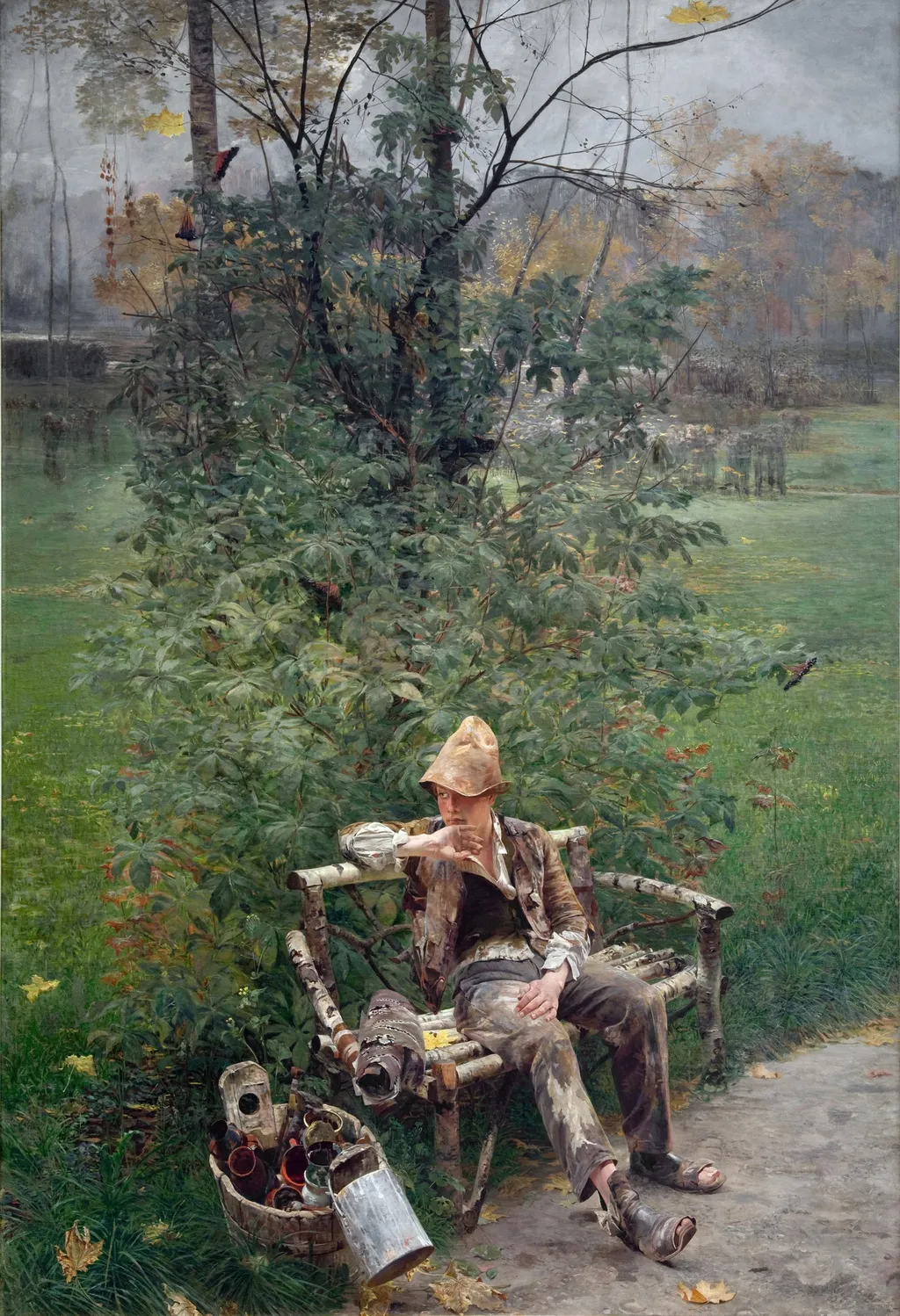
A Painter's Apprentice is an oil painting by the Post-Impressionist artist Jacek Malczewski. It dates from 1896 and is held in the collection of the National Museum in Kraków.
About this work
Overview
A Painter's Apprentice is an oil on canvas painting by the Polish artist Jacek Malczewski, dated to 1890.
A Painter's Apprentice is an oil on canvas painting by the Polish artist Jacek Malczewski, dated to 1890. Measuring 332 by 232 centimetres, it is held in the collection of the National Museum in Kraków. The work belongs to a pivotal period in Malczewski's career when he was transitioning from the realist training of his early years toward the symbolic vocabulary that would define his mature style and earn him recognition as the father of Polish Symbolism. The painting offers a rare, intimate glimpse into the artist's world through the figure of a young apprentice, bridging the domains of genre painting and symbolic portraiture.
Subject & Meaning
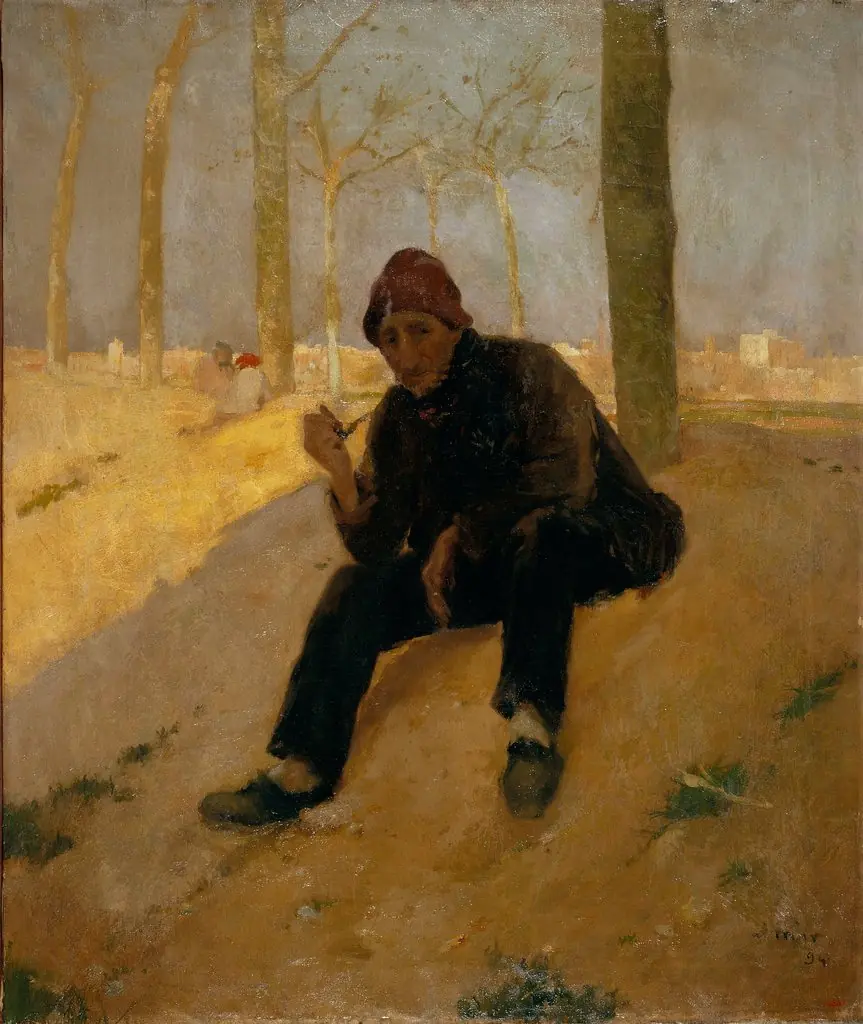
The painting depicts a young male figure seated on a rustic wooden bench in an outdoor setting, identified as a painter's apprentice by the attributes that surround him. He wears a conical paper hat, a loose white shirt with rolled sleeves, a dark vest, and worn brown trousers, one foot bare except for a broken shoe. His right hand touches his chin in a contemplative gesture, while his left hand rests on his thigh. Beside him on the bench lies a rolled canvas or portfolio, and at his feet a woven basket contains paint pots, brushes, and a metal container. The figure's slumped posture and resting gesture suggest fatigue or reflective pause rather than active labour, introducing a meditative quality that transcends mere genre documentation. The setting carries symbolic weight: the bench sits at the edge of dense green foliage, with a large leafy bush partially obscuring slender tree trunks behind him, and beyond that a misty parkland stretches toward faint figures in the distance. The scattered autumn leaves on the ground subtly evoke the passage of time and the cyclical nature of apprenticeship and artistic growth. The painting thus operates on multiple levels, as a realistic depiction of a labourer's rest, as a meditation on the condition of the young artist, and as an allegory of artistic vocation itself.
Technique & Style
Malczewski executed the work in oil paint on canvas, employing a nuanced handling that modulates between precise detail and atmospheric suggestion. The palette is dominated by greens, browns, and muted yellows, with touches of red in the foliage, creating a restrained but resonant colour harmony. The brushwork varies significantly across the picture plane: the figure and foreground objects are rendered with precise detail, while the distant background receives softer, more atmospheric treatment. Light appears diffused and overcast, with no strong shadows, contributing to the contemplative mood and unifying the composition through tonal subtlety rather than dramatic contrast. This technical approach reflects Malczewski's academic training under Jan Matejko and at the École des Beaux-Arts, yet also demonstrates his growing independence from strict realism. The compositional balance between the solid, earthbound figure and the vaporous, indistinct background anticipates the dreamlike atmospheres of his later Symbolist works, while the careful attention to textural details, the broken shoe, the woven basket, the metal container, grounds the image in tangible reality.
History & Provenance
The painting was created in 1890, a year that also saw Malczewski working on Melancholia (1890-1894), one of his most significant early Symbolist compositions. The work is now held by the National Museum in Kraków, which acquired it through standard institutional channels, the specific date of accession is not recorded in the available sources. The canvas has remained in Polish public collections, ensuring its preservation and accessibility for scholarly study. No detailed exhibition history is documented in the provided sources, though Malczewski's paintings were regularly shown internationally from 1885 onward, including at exhibitions in Berlin (1891), Munich (1892), and Paris (1900). The painting's substantial dimensions, 332 by 232 centimetres, suggest it was intended as a significant exhibition piece rather than a private study.
Context
A Painter's Apprentice emerges from a crucial juncture in Malczewski's biography and in Polish art history. Born in Radom in 1854, under Russian occupation, Malczewski had studied at the Kraków School of Fine Arts from 1873, completing master classes with Jan Matejko in 1875 and 1879, with an intervening year at the École des Beaux-Arts in Paris under Henri Lehmann. By 1890, he was synthesising this rigorous academic formation with the emerging patriotic and symbolic concerns of the Young Poland movement. The choice of a painter's apprentice as subject matter carries particular resonance in this context: it reflects both the artist's own memories of artistic training and the broader cultural project of cultivating Polish artistic identity under partition. The painting stands apart from Malczewski's more overtly symbolic and mythological works, such as Błędne koło (Vicious Circle, 1895-97) or the Thanatos series, yet it shares with them a concern with individual consciousness and national vocation. Critical reception of Malczewski's work during his lifetime was strongly positive, with numerous awards at international exhibitions, and his art has subsequently been compared to that of Gustave Moreau, Arnold Böcklin, and even Salvador Dalí. The painting occupies a significant place in Malczewski's oeuvre as a bridge between his realist roots and his Symbolist maturity, demonstrating how everyday subjects could be infused with deeper meaning without abandoning naturalistic observation.
Legacy
While A Painter's Apprentice does not command the same canonical status as Malczewski's explicitly symbolic masterworks, it remains an important document of his artistic evolution and of the social conditions of artistic training in partitioned Poland. The painting's afterlife is intertwined with the broader institutional preservation of Malczewski's legacy: his son Rafał Malczewski, also a painter, sold his father's remaining works to the National Museum in Warsaw before World War II, ensuring their survival and public accessibility. The work's presence in the National Museum in Kraków places it within one of Poland's most significant collections of national art, where it contributes to the narrative of Polish painting's development from realism through Symbolism. In contemporary culture, the image circulates through reproduction as an art print, testament to its continued visual appeal and its value as a representative work from Malczewski's transitional period. The painting's enduring interest lies in its quiet dignity, its unidealised portrayal of labour, and its implicit meditation on the nature of artistic vocation, themes that transcend its specific historical moment and continue to resonate with viewers.
Own this work as a print
Artist & collection
Artist
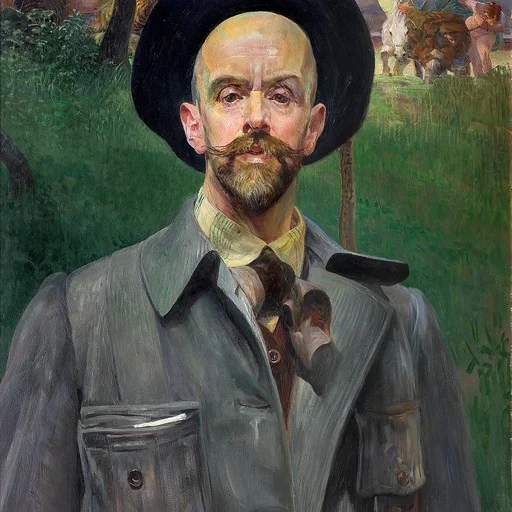
Jacek Malczewski (Polish:; 15 July 1854 – 8 October 1929) was a Polish symbolist painter who was one of the central figures of the patriotic Young Poland movement.