Artwork
The Windmill at Wijk bij Duurstede
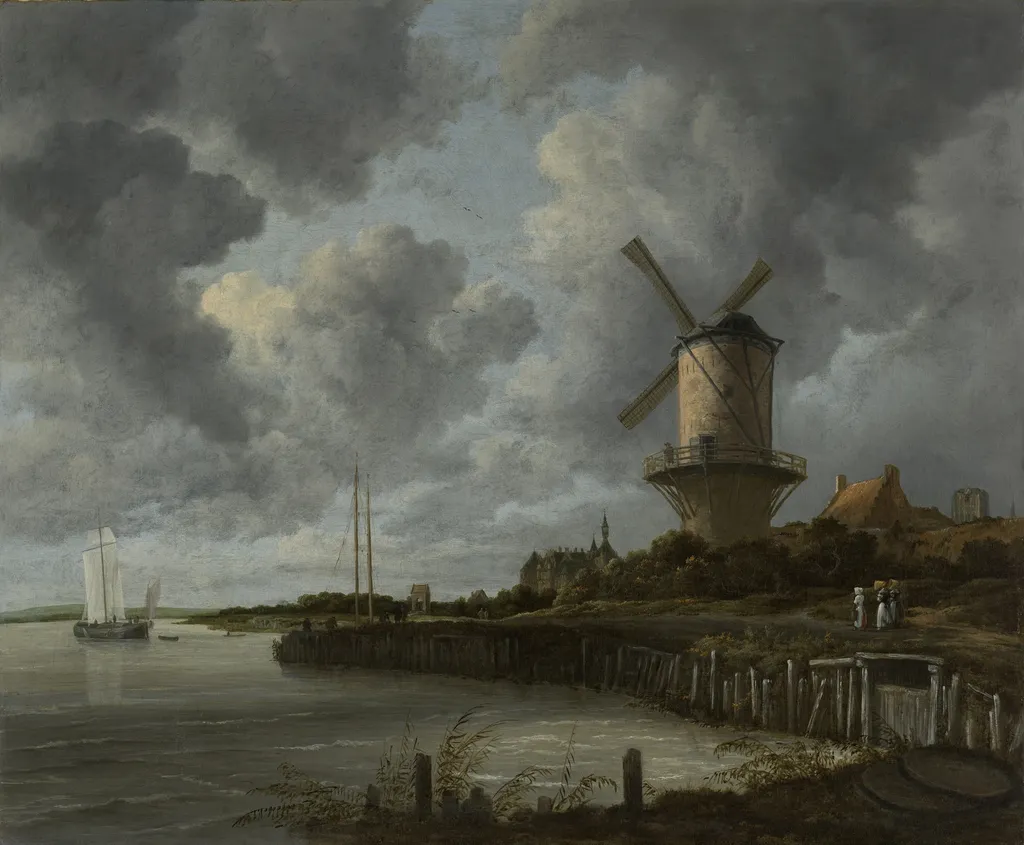
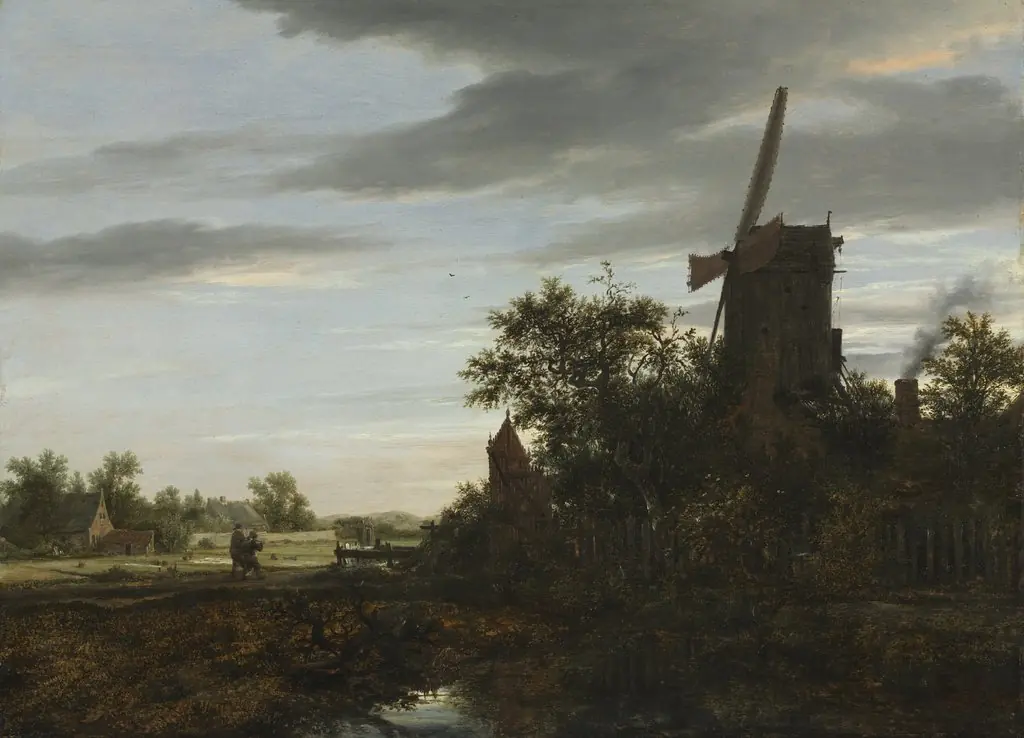
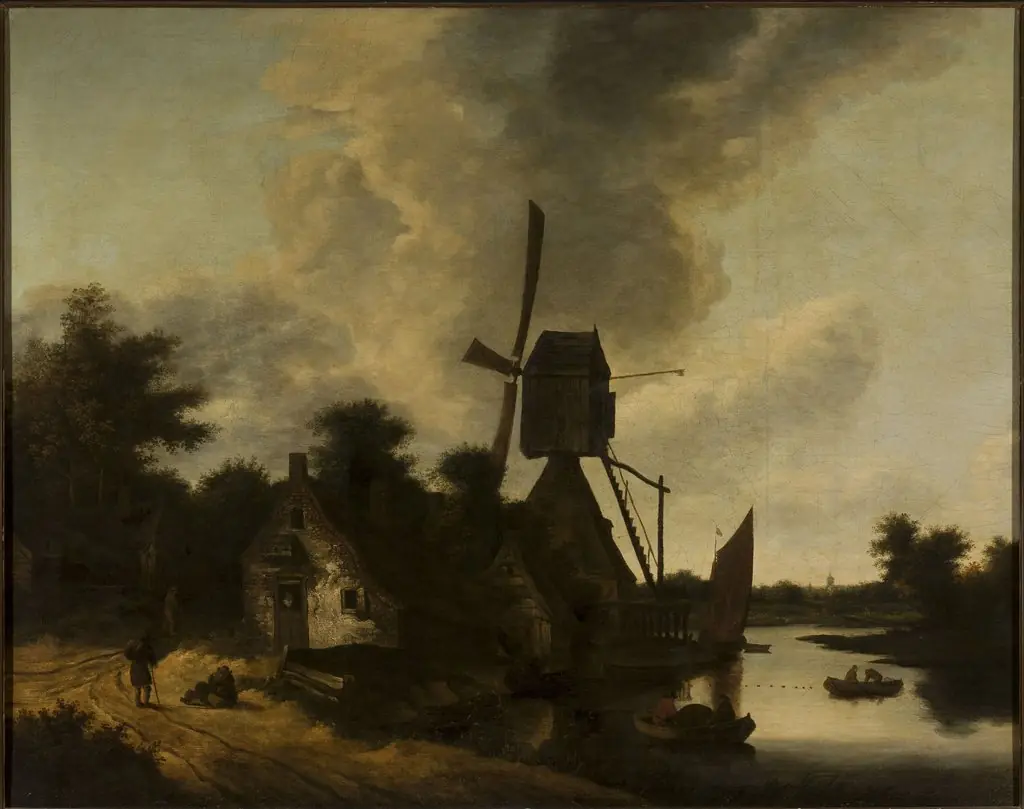
The Windmill at Wijk bij Duurstede is an oil painting by the Dutch Golden Age artist Jacob van Ruisdael. It dates from 1670 and is held in the collection of the Rijksmuseum.
About this work
Subject & Meaning
Painted circa 1670, the work depicts the riverside town of Wijk bij Duurstede, dominated by a cylindrical grain mill on the bank of the Lek river.
Painted circa 1670, the work depicts the riverside town of Wijk bij Duurstede, dominated by a cylindrical grain mill on the bank of the Lek river. Although rooted in topographical reality, including the unfinished tower of St. John's Church and Duurstede Castle, Ruisdael altered the scene for dramatic effect, omitting city gates and elevating the mill's perspective to create a monumental, hero-like presence. The composition balances the massive vertical structure against a low horizon and expansive, turbulent sky.
Symbolically, the windmill represents human dependence on natural forces; contemporary emblems associated still mills with the biblical concept that 'the spirit gives life,' implying that without divine breath, humanity remains motionless. The juxtaposition of tiny figures against the looming architecture and dark clouds underscores themes of nature's grandeur versus human fragility and the transience of life.
Technique & Style
The Windmill at Wijk bij Duurstede is an oil‑on‑canvas work measuring 83 × 101 cm, signed by Jacob van Ruisdael in the lower right corner. The painting is executed on a linen support and belongs to the Dutch Golden Age, exemplifying Ruisdael’s mature landscape style. Ruisdael renders the windmill with precise engineering detail, depicting its cylindrical stone base, rotating hood and correctly proportioned sails, a level of accuracy noted by art historian Seymour Slive.
The composition employs a low horizon, a dominant vertical mill, and a sky occupying most of the picture, creating dramatic contrast between light and shadow. Atmospheric effects are rendered through carefully observed cloud formations and subtle reflections on the water, emphasizing the interplay of light. The work’s condition is stable, having been on long‑term loan to the Rijksmuseum since 1885.
History & Provenance
Jacob van Ruisdael painted The Windmill at Wijk bij Duurstede around 1670, likely between 1668 and 1670, as indicated by the installation of a clock on the church tower (1668) and the construction of a sluice lock after October 1669. The work is an oil‑on‑canvas landscape measuring 83 × 101 cm, depicting the now‑vanished tower windmill and surrounding river scenery with precise engineering detail. After its creation the painting passed through several owners: it was sold in 1817 by J. Juriaans, then to John Smith, to Albertus Brondgeest, and acquired by banker‑collector Adriaan van der Hoop in 1833.
Van der Hoop bequeathed the work to the city of Amsterdam in 1854, and since 30 June 1885 it has been on long‑term loan to the Rijksmuseum.
The Windmill at Wijk bij Duurstede is owned by the City of Amsterdam and held within the collection of the Amsterdam Museum, specifically the Adriaan van der Hoop bequest. Since 30 June 1885, the painting has been on permanent loan to the Rijksmuseum in Amsterdam, where it is displayed in the Gallery of Honour. The work bears the Rijksmuseum inventory number SK-C-211.
Its exhibition history includes international presentations in Paris in 1921, London in 1929, and Amsterdam in 1945. The painting was acquired by Adriaan van der Hoop in 1833 and bequeathed to the city in 1854, establishing its long-term institutional presence in Amsterdam.
Context
The Windmill at Wijk bij Duurstede is celebrated as one of Ruisdael’s masterpieces, frequently highlighted in international exhibitions and ranked among the most reproduced Dutch paintings. Scholars such as Slive note its precise hydraulic and aerodynamic details and argue for a circa 1670 date based on architectural evidence. The work exemplifies the Dutch Golden Age focus on windmills as emblematic of national landscape, employing a low horizon, dramatic sky, and stark light‑shadow contrast that influenced Romantic artists like Constable.
Its technical accuracy, especially in depicting mill sails and water motion, underscores Ruisdael’s scientific approach, while provenance from the van der Hoop bequest and long‑term display at the Rijksmuseum cement its art‑historical significance.
Legacy
The Windmill at Wijk bij Duurstede is widely regarded as Jacob van Ruisdael's most famous work and a defining masterpiece of Dutch Golden Age landscape painting. Its enduring reputation is evidenced by its consistent ranking as the third most popular image in the Rijksmuseum, trailing only Rembrandt's The Night Watch and Vermeer's View of Delft in postcard sales. The painting's compositional innovations, particularly the low horizon and dramatic cloud formations, significantly influenced later Romantic landscape painters, most notably John Constable.
Prominent 19th and 20th-century artists, including Vincent van Gogh and writer Eugène Fromentin, explicitly praised the work, with Fromentin labeling it Ruisdael's most impressive painting. The artwork has maintained a prominent position in the public eye since its bequest to Amsterdam in 1854 and subsequent permanent loan to the Rijksmuseum in 1885, featuring in numerous international exhibitions throughout the 20th century.
Overview
Jacob van Ruisdael's painting, The Windmill at Wijk bij Duurstede, created around 1670, is a notable example of Dutch Golden Age art. Executed in oil paint, this work captures a distinctive landscape scene. It is currently held in the collection of the Amsterdam Museum and is exhibited at the Rijksmuseum through a loan arrangement, indicating its cultural importance.
Own this work as a print
Artist & collection
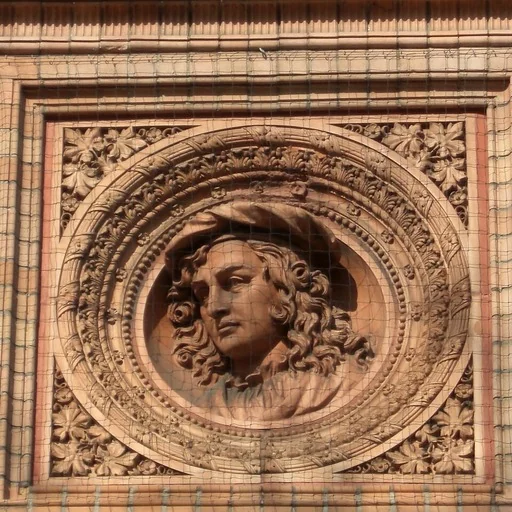
Artist
Jacob Isaackszoon van Ruisdael was a Dutch painter, draughtsman, and etcher. He is generally considered the pre-eminent landscape painter of the Dutch Golden Age, a period of great wealth and cultural achievement when…