Artwork
A Family Merrymaking
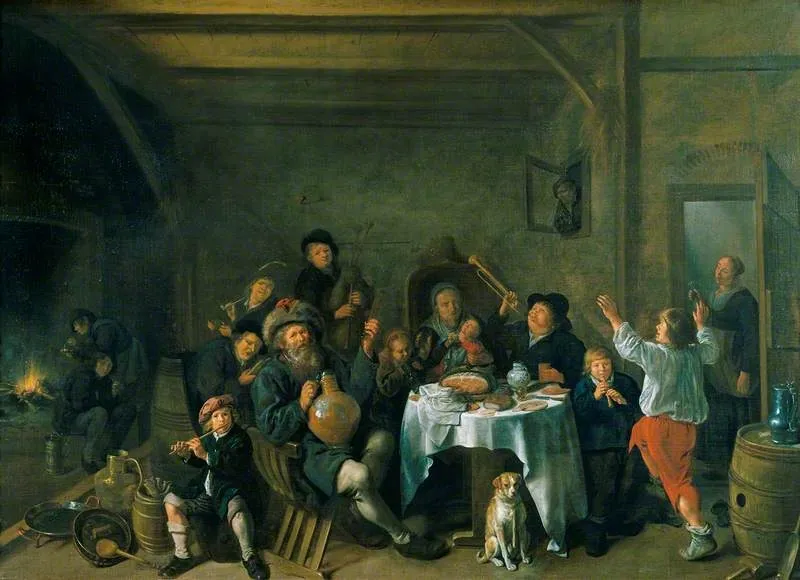
A Family Merrymaking is an oil painting by Jan Miense Molenaer. It dates from 1640 and is held in the collection of the Victoria and Albert Museum.
About this work
Overview
A Family Merrymaking is an oil on canvas painting by the Dutch Golden Age genre painter Jan Miense Molenaer, dated to approximately 1638-1642 and measuring 106.
A Family Merrymaking is an oil on canvas painting by the Dutch Golden Age genre painter Jan Miense Molenaer, dated to approximately 1638-1642 and measuring 106.6 by 152.4 cm. The work is held by the Victoria and Albert Museum in London, where it entered the collection in 1870 as part of a major bequest. It exemplifies the low-life genre scenes that occupied the latter half of Molenaer's career, after he moved from Haarlem to Amsterdam and shifted away from the more colourful, Hals-influenced manner of his early years. The painting offers a substantial, large-scale view of peasant merrymaking that aligns with the broader Dutch tradition of domestic genre imagery while revealing the particular earthy tonality and compositional habits that distinguish Molenaer's mature production.
Subject & Meaning
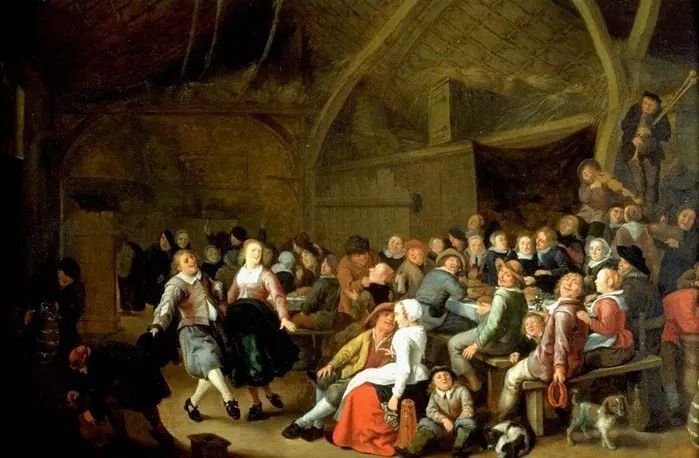
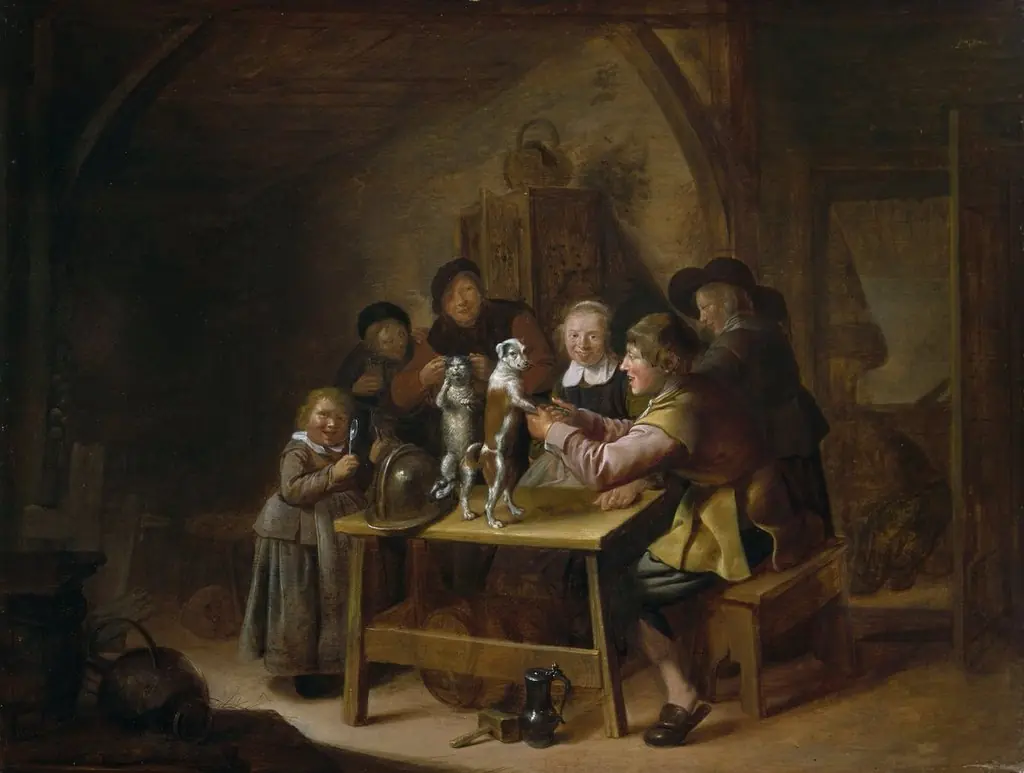
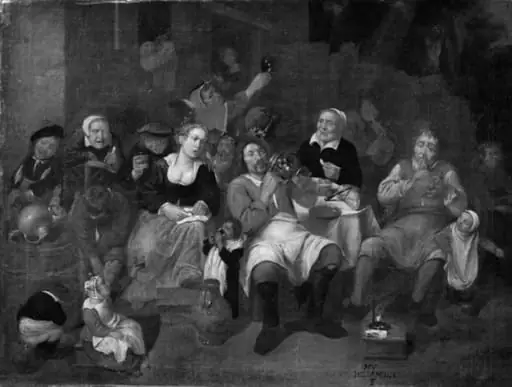
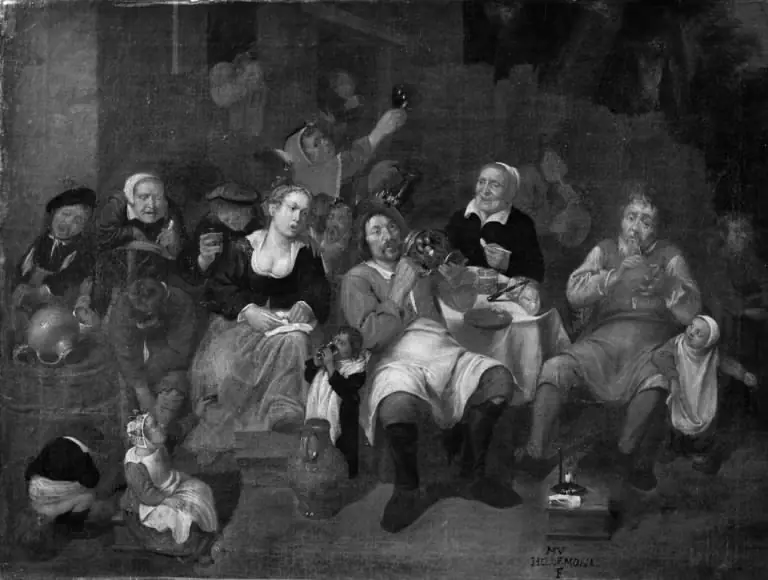
The scene depicts a domestic interior in which a peasant family drinks, eats, and entertains itself with music. At centre, a table covered with a white linen cloth holds various vessels, plates, and food items. Several adults sit and stand nearby, some holding drinking vessels, while one figure raises what appears to be a bone or similar object. A bearded man in the foreground grasps a large jug. Children populate the scene: one plays a flute at left, another stands with raised hands at right, and a small dog sits beneath the table. In the background left, figures huddle near a fireplace with visible flames, and two men there light their pipes. A doorway at right admits another standing figure, and a framed portrait hangs on the back wall. The iconography belongs to the merry company tradition, though here transposed to a rustic family setting rather than an aristocratic or urban tavern context. The raised bone, the musical performance, and the general atmosphere of consumption and leisure carry the ambiguous moral charge typical of Dutch genre painting, where merriment could imply either honest recreation or gentle satire of excess.
Technique & Style
The painting is executed in oil on canvas. Molenaer's handling shows careful detail in faces and objects, with looser brushwork in darker areas. Light falls selectively from the left, illuminating faces and the table while leaving corners in shadow. The palette runs to browns, grays, and muted greens, with warmer tones concentrated near the fire. The only vivid notes are the dancing boy's red trousers at right and the bearded man's hat at centre. This restrained, almost monochrome tonality is characteristic of Molenaer's second phase, when the influence of Frans Hals diminished and that of Adriaen van Ostade grew stronger. The artist reused this interior setting in other compositions, such as a merry company painting in the Rijksmuseum where card players occupy a nearly identical space. The signature 'J. Molenaer' appears on the barrel at lower right.
History & Provenance
The painting was created probably in Amsterdam between 1638 and 1642, during the period when Molenaer had settled there with his wife Judith Leyster after their marriage in 1636. The work was bequeathed to the Victoria and Albert Museum in 1870 by John M. Parsons (1798-1870), an art collector born in Newport, Shropshire, who later settled in London and worked as a member of the stock exchange. Parsons had offered his collection, consisting mainly of German and Dutch schools, first to the National Gallery, which selected only three works, and then to the Department of Science and Art at South Kensington, the V&A's predecessor. The South Kensington Museum acquired ninety-two oil paintings and forty-seven watercolours from the bequest; a number of engravings went to the British Museum. The accession number is 536-1870.
Context
Molenaer was born in Haarlem around 1610 and likely trained with Frans Hals, whose early influence is visible in his colourful genre paintings of the 1630s. After marrying Judith Leyster in 1636 and moving to Amsterdam, he gradually specialised in low-life genre scenes. His increasing output of such paintings responded to a local market opportunity: David Vinckboons, the leading Amsterdam painter of peasant and merry company themes, had died in 1632, while the Amsterdam scene was otherwise crowded with portrait and history painters associated with Rembrandt. The Victoria and Albert Museum's catalogue situates this painting within Haarlem's artistic specificity, which from the beginning of the seventeenth century developed a greater naturalism that proved foundational for Dutch genre painting as a whole. Molenaer's work stands as a precursor to Jan Steen's later developments in the genre, though with a more restrained and less overtly comic temperament.
Legacy
A Family Merrymaking remains a representative example of Molenaer's mature production and of the broader Dutch low-life genre tradition. Its value for scholars lies partly in its clear demonstration of how Molenaer recycled successful compositional formulas across multiple works, adapting the same interior setting to different narrative occasions. The painting's afterlife has been primarily institutional: it has remained in the Victoria and Albert Museum's collection since 1870, serving as a key work for understanding both Molenaer's own development and the broader migration of Haarlem genre painters to Amsterdam in the 1630s and 1640s. The image is now available for non-commercial research and private study under UK copyright exceptions, and photographic reproductions circulate through museum licensing channels.
Artist & collection

Artist
Jan Miense Molenaer (1610 – buried 19 September 1668) was a Dutch Golden Age genre painter whose style was a precursor to Jan Steen's work during Dutch Golden Age painting.