Artwork
Leaving the Oasis
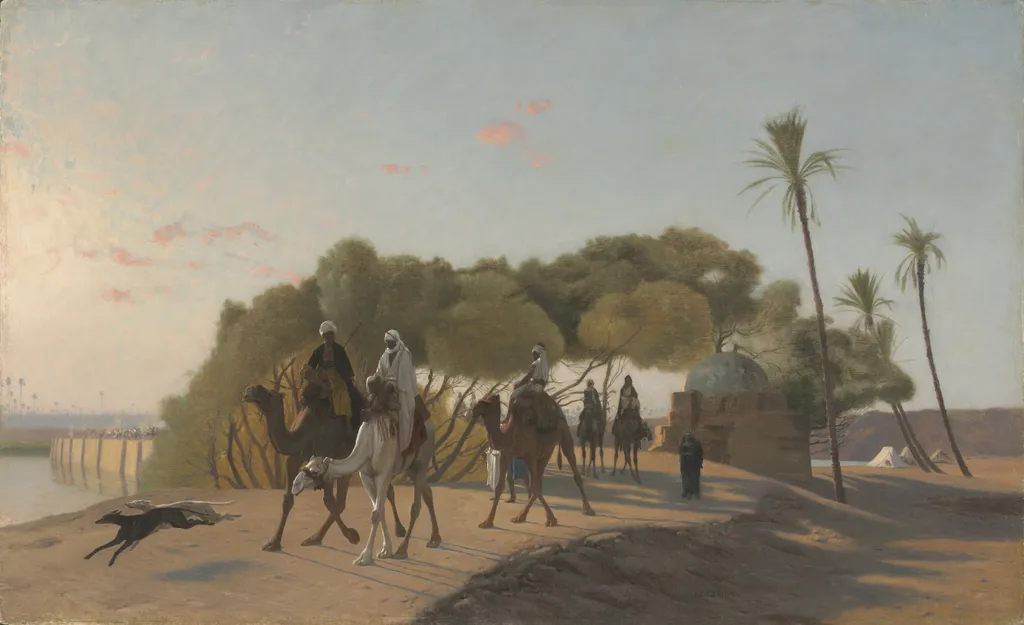
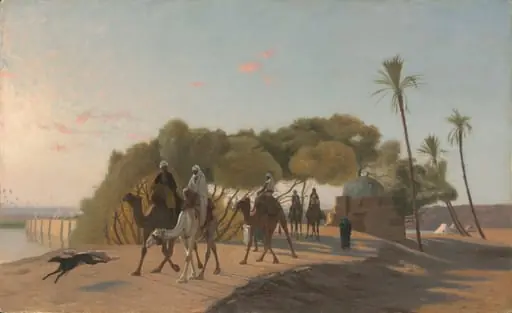
Leaving the Oasis is an oil painting by the Orientalist artist Jean Léon Gérôme. It dates from 1890 and is held in the collection of the Cleveland Museum of Art.
About this work
Technique & Style
The combination of oil media on a rigid panel surface reflects the technical choices typical of his studio practice during this era.
Jean-Léon Gérôme's Leaving the Oasis, executed in 1880, is an oil painting created on a panel support. The work measures 50 cm in height and 81.2 cm in width. As a product of the artist's mature period in France, the piece employs oil paint to render its subject with the precision characteristic of Gérôme's academic style.
The combination of oil media on a rigid panel surface reflects the technical choices typical of his studio practice during this era.
History & Provenance
The painting Leaving the Oasis was created by Jean Léon Gérôme in 1880, as documented in the artist’s catalogued works. The work is executed in oil on panel, measuring 50.0 cm in height and 81.2 cm in width, and is recorded as having been made in France.
By 1977, the painting entered the collection of the Cleveland Museum of Art, where it is currently held under accession number 1977.126. No documented commission or preparatory history beyond its creation date is recorded in the sources provided.
The painting Leaving the Oasis is held by the Cleveland Museum of Art, where it is accessioned under the inventory number 1977.126. It was created in France in 1880 using oil paint on panel, measuring 50.0 cm in height by 81.2 cm in width.
The work has been exhibited at the museum as part of its collection, reflecting its significance within the institution's holdings of 19th-century French art.
Context
Jean Léon Gérôme painted Leaving the Oasis in 1880, a large-scale oil painting measuring 50 cm by 81.2 cm, created in France and now housed in the Cleveland Museum of Art. This work exemplifies Gérôme's academic style and Orientalist themes, reflecting his broader artistic focus on exoticized landscapes and meticulous realism. It was exhibited at the Paris Salon and received contemporary attention for its technical precision and narrative detail, contributing to discussions of 19th-century European art movements.
Legacy
The painting's reputation has been shaped by its inclusion in major institutional collections and scholarly attention to Gérôme's Orientalist themes. Its presence in the Cleveland Museum of Art's holdings, documented since 1977, has facilitated focused exhibitions and academic discussion of Gérôme's technique and subject matter. This sustained institutional visibility has contributed to ongoing reassessment of the work within the broader context of 19th-century European art, particularly regarding its depiction of desert landscapes and cultural encounters.
Overview
Jean‑Léon Gérôme’s 1890 oil on canvas entitled Leaving the Oasis depicts a caravan traversing a barren landscape beside a modest oasis. A line of camels carries riders dressed in loose, head‑covering garments, while a small dog darts ahead. The composition balances the arid foreground with a faintly illuminated sky and distant architecture, creating a moment of departure from a tranquil refuge.
Subject & Meaning
The work captures a transient scene of travelers moving away from water and shade toward an uncertain desert expanse. The juxtaposition of the lush palm fringe against the dusty path suggests a fleeting respite, while the forward‑leaning motion of the animals and the dog conveys urgency and the relentless progression of journeying across hostile terrain.
Own this work as a print
Artist & collection

Artist
Jean-Léon Gérôme was a French painter and sculptor in the style now known as academicism.

 Cairo Seen from the Kasr-el-Nil Bridge
 Leaving the Oasis
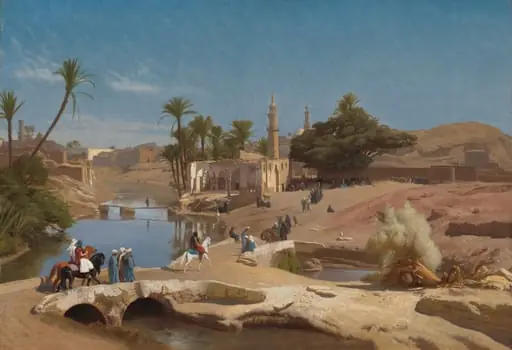 View of Medinet El-Fayoum
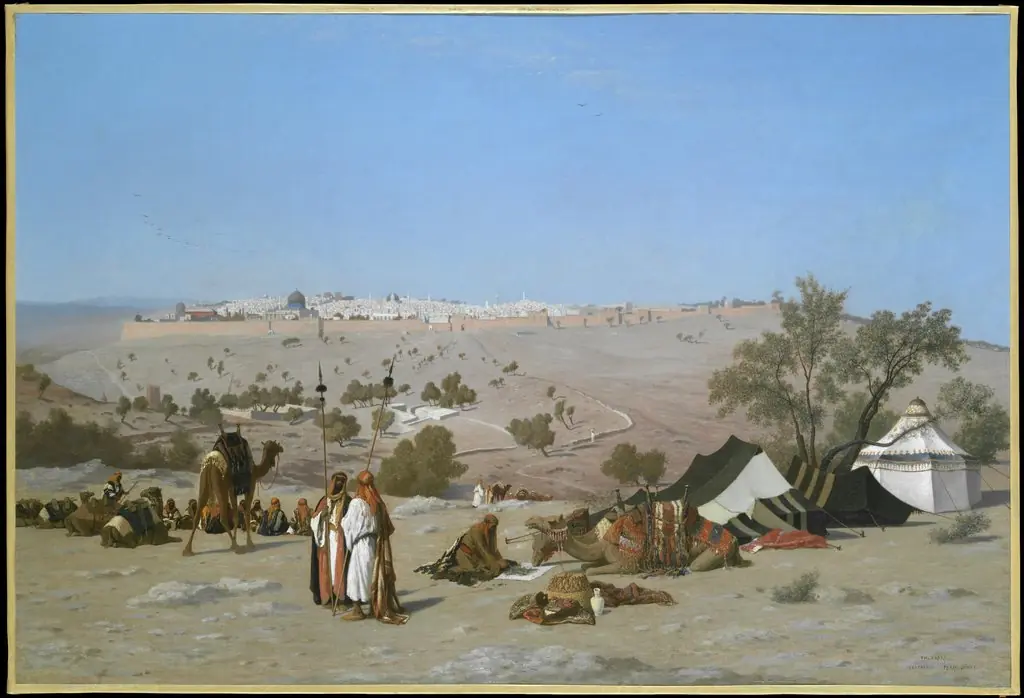 Jerusalem from the Mount of Olives
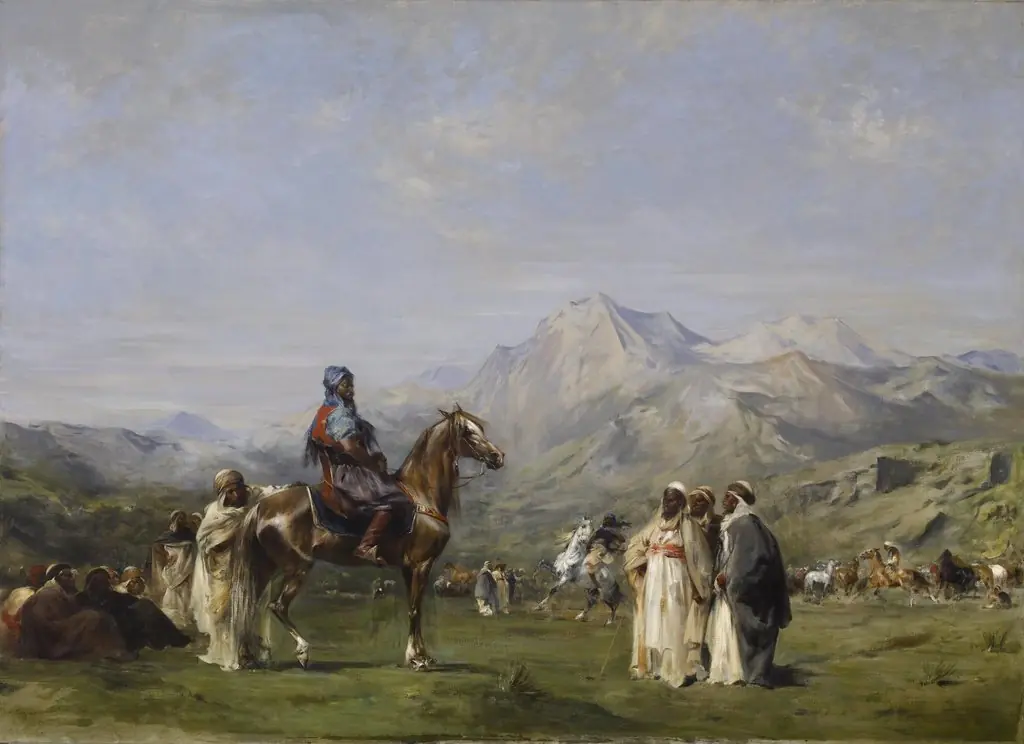 An Encampment in the Atlas Mountains
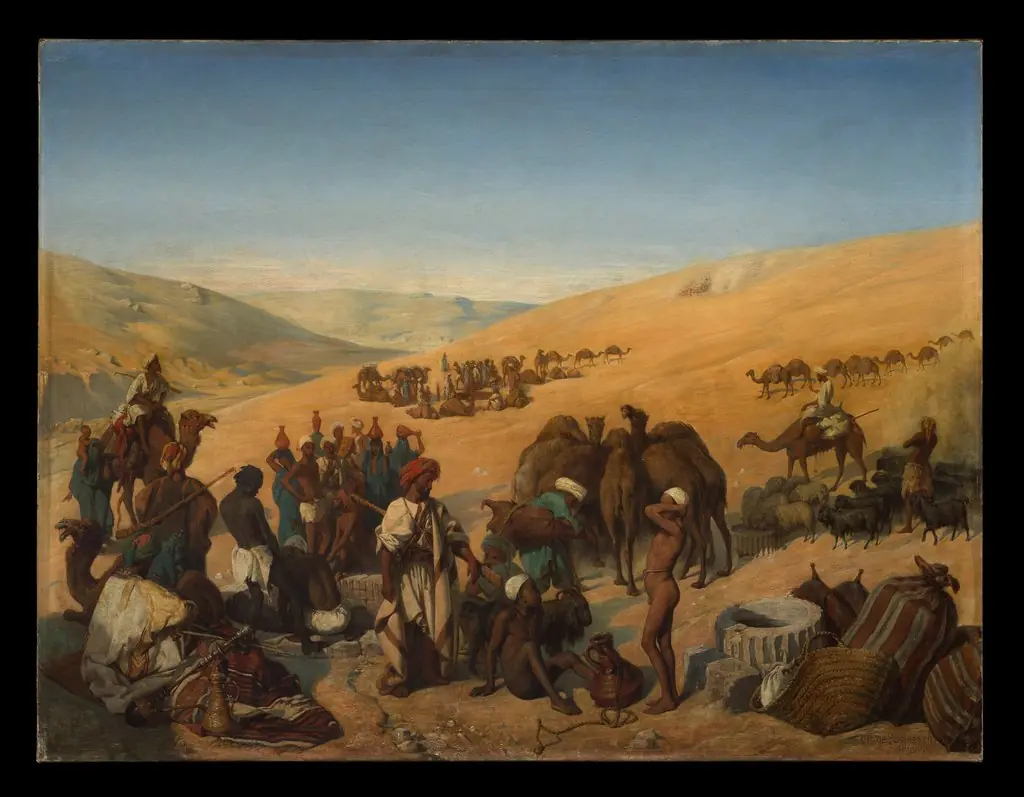 Halt of Caravans at the Wells of Saba (Beersheba) in the Desert South of Hebron
 A Caravan in the Desert
 Napoleon in Egypt
![Arabs and camels beside a Tomb, Algeria[?], by Victor-Pierre Huguet](https://artifactworldgallery.com/img/victor-pierre-huguet--arabs-and-camels-beside-a-tomb-algeria--d8831a130920c80b-w320.webp) Arabs and camels beside a Tomb, Algeria[?]
Arabs and camels beside a Tomb, Algeria[?] Arab in the desert
 Riders Crossing the Desert
- Oasis at Sunset