Artwork
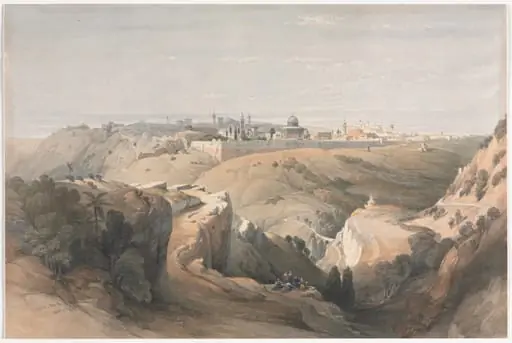
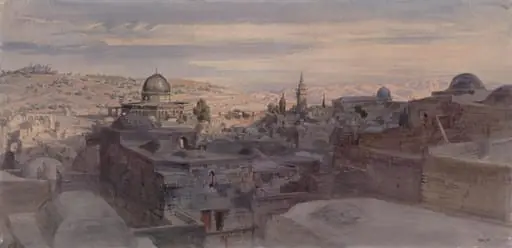
Jerusalem from the Mount of Olives
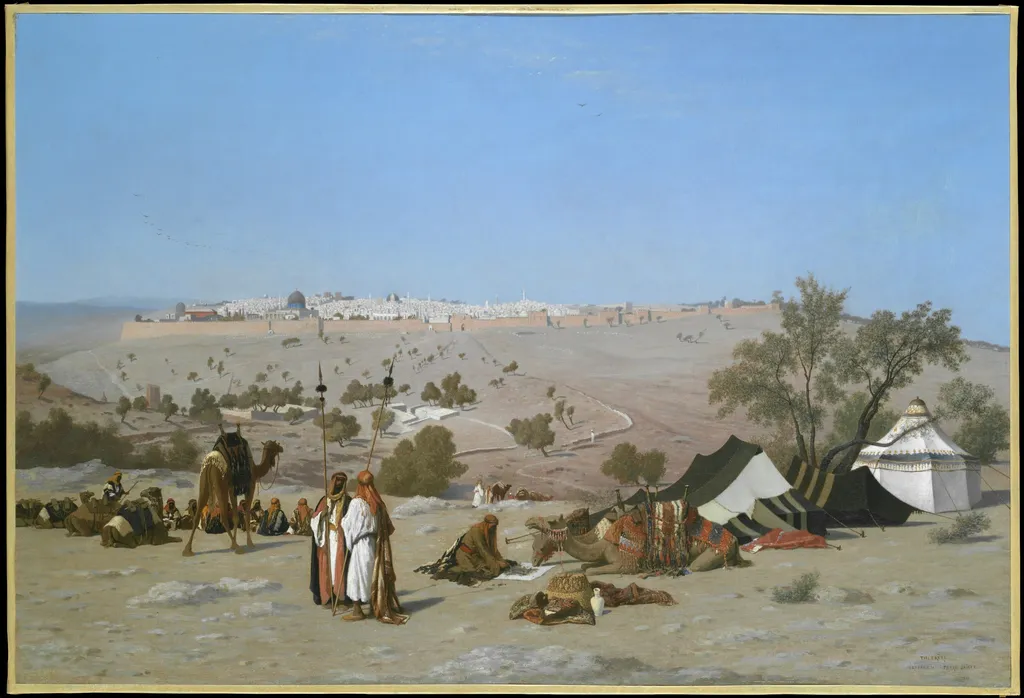
Jerusalem from the Mount of Olives is an oil painting by the Post-Impressionist artist Théodore Frère. It is held in the collection of the Metropolitan Museum of Art.
About this work
Technique & Style
Théodore Frère's Jerusalem from the Mount of Olives (1890) is an oil painting on canvas executed in a naturalistic yet idealized manner typical of 19th-century Orientalist landscape painting. The handling combines smooth, blended passages in the sky and distant cityscape with more textured brushwork in foreground details such as drapery and foliage, suggesting a layered technique over a prepared ground. The composition guides the viewer's eye from the sunlit foreground tents and camel toward the softened, luminous horizon where Jerusalem's walls and domes emerge in atmospheric perspective.
The palette is dominated by earth tones and sky blues, with localized accents of warm ochre and muted crimson, and architectural forms are rendered with topographical accuracy and a sense of tranquil reverie.
History & Provenance
The painting depicts an Orientalist scene featuring a man, a tent, a camel, and a desert landscape with Jerusalem in the distance.
Théodore Frère created Jerusalem from the Mount of Olives in 1890, executed in oil on canvas and measuring 74.9 cm in height and 110.5 cm in width. The painting depicts an Orientalist scene featuring a man, a tent, a camel, and a desert landscape with Jerusalem in the distance. It was acquired by Catharine Lorillard Wolfe and entered the Metropolitan Museum of Art in 1896 through her bequest, forming part of the institution's early acquisitions of Orientalist works.
Overview
Théodore Frère, a French artist associated with Orientalist painting, completed "Jerusalem from the Mount of Olives" in 1890. This oil painting captures a panoramic view of the ancient city, framed by a desert foreground populated with nomadic figures and their camels. The work is part of the collection at The Metropolitan Museum of Art, representing Frère's engagement with Middle Eastern subjects.
Subject & Meaning
The composition presents a sweeping vista of Jerusalem, depicted as a walled city crowned with domes and towers, set against a clear sky. In the foreground, a desert encampment unfolds, featuring robed figures gathered near tents and camels. Small details, such as an individual seated beside a camel and a flagpole bearing a black flag, contribute to the scene's ethnographic character, evoking a sense of daily life in the region.
Context
Théodore Frère was a prominent figure among French Orientalist painters, a group dedicated to depicting scenes from North Africa and the Middle East. His extensive travels to these regions informed his detailed and evocative works. Frère came from a family of artists, including his brother Pierre-Édouard and nephew Charles Édouard, contributing to a shared artistic legacy focused on diverse subjects.
Own this work as a print
Artist & collection
Artist
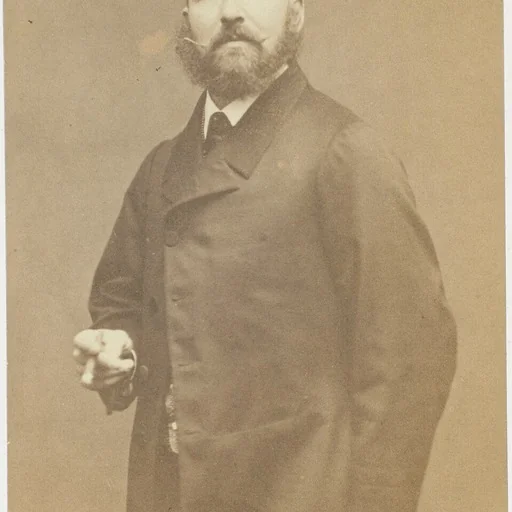
Charles-Théodore Frère (21 June 1814, Paris – 24 March 1888) was a French Orientalist painter. His younger brother, Pierre-Édouard, and his nephew and namesake, Charles Edouard Frère, were also painters.

![Arabs and camels beside a Tomb, Algeria[?], by Victor-Pierre Huguet](https://artifactworldgallery.com/img/victor-pierre-huguet--arabs-and-camels-beside-a-tomb-algeria--d8831a130920c80b-w320.webp)