Artwork
Pygmalion and Galatea
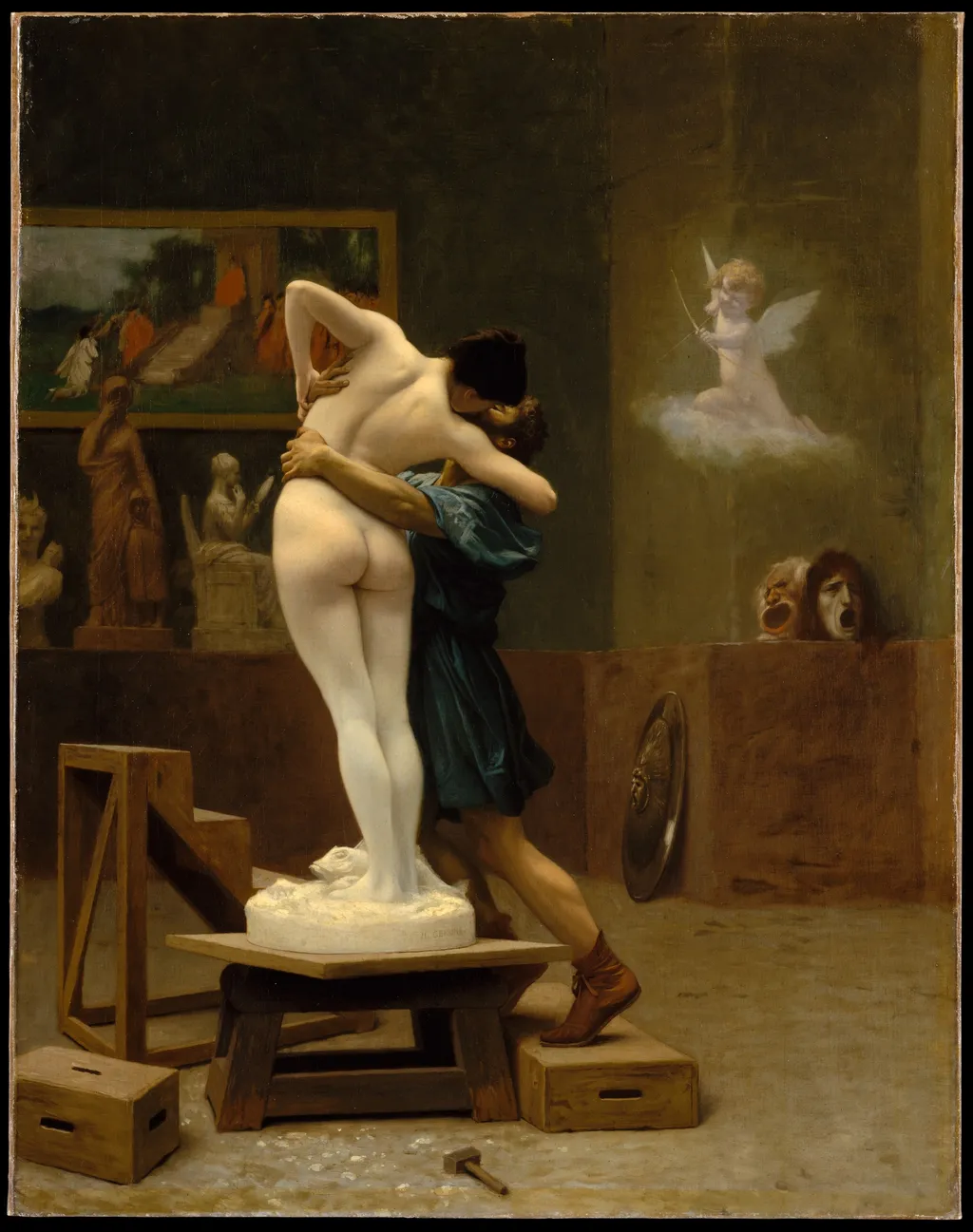
Pygmalion and Galatea is an oil painting by the Academic Art artist Jean Léon Gérôme. It dates from 1896 and is held in the collection of the Metropolitan Museum of Art.
About this work
Jean-Leon Gerome painted the scene around 1890, showing sculptor and living statue from behind to skirt the censors while Cupid watches with bow drawn.
In a studio crowded with antique props, Pygmalion presses his lips to Galatea's cheek at the moment Ovid's myth turns marble into flesh. Jean-Leon Gerome painted the scene around 1890, showing sculptor and living statue from behind to skirt the censors while Cupid watches with bow drawn. The Metropolitan Museum of Art holds the canvas, a 1927 gift of Louis C. Raegner, one of several painted and sculpted variations Gerome made between 1890 and 1892.
Subject & Meaning
The painting depicts the climactic moment from the myth of Pygmalion and Galatea, in which the sculptor's ivory statue comes to life through the intervention of Venus. Gérôme shows the newly animated Galatea kissing Pygmalion, while Cupid (Eros) hovers with bow and arrow, underscoring the divine origin of the transformation. The studio setting, with masks, a shield, and tools, highlights the act of artistic creation.
The work’s subject thus symbolizes the power of art to animate the ideal, blending classical mythology with the academic tradition of the idealized nude. The kiss signifies the artist’s desire merging with his creation, making the painting a meditation on the relationship between maker and muse.
Technique & Style
Executed in oil on canvas, the painting measures 88.9 by 68.6 cm. Its formal qualities reflect Gérôme's academic training: smooth, highly finished brushwork, precise modeling of figures, and a meticulously arranged composition. The scene depicts the mythological moment when Pygmalion’s statue, Galatea, comes to life and is kissed by her creator, with Cupid present. The studio setting, including a sculptor’s tools and classical sculptures, reinforces the academic interest in realism and narrative clarity.
The treatment of flesh, drapery, and marble surfaces demonstrates Gérôme's commitment to optical verisimilitude within a staged, almost theatrical tableau.
History & Provenance
Painted by Jean-Léon Gérôme in 1890, Pygmalion and Galatea was first owned by financier Charles Yerkes before passing to collector Emilie Grigsby. The painting later entered the collection of the Metropolitan Museum of Art, where it was assigned accession number 27.200. No specific commission has been recorded; the work appears to have been a independent mythological subject by the artist.
Overview
Jean-Léon Gérôme completed Pygmalion and Galatea in oil in 1890, drawing inspiration from Ovid's ancient narrative. The painting illustrates the climactic moment when the Cypriot sculptor Pygmalion's ivory creation, Galatea, is granted life by the goddess Venus. Gérôme captures the instant of her metamorphosis from inert material to living form, with the sculptor embracing his now-animate statue within his cluttered studio.
This work is a notable example of Gérôme's fascination with classical mythology and the interplay between art and reality.
Context
Gérôme explored the Pygmalion theme extensively, creating at least two other painted versions and a tinted-marble sculpture in 1891, now housed at Hearst Castle. He further integrated the image into his artistic identity by featuring versions of Pygmalion and Galatea in the backgrounds of his later self-portraits, notably while sculpting his own Tanagra. This recurring motif underscored Gérôme's philosophical stance on the inherent connection between painting and sculpture, and the indistinguishable boundaries between reality and artistic illusion.
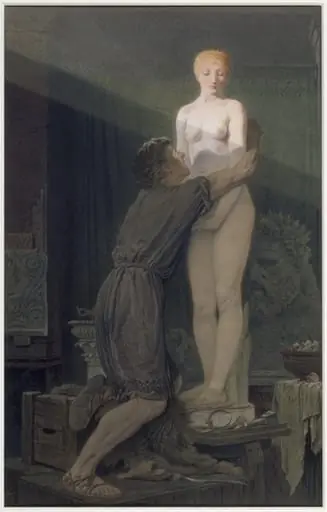
Own this work as a print
Artist & collection

Artist
Jean-Léon Gérôme was a French painter and sculptor in the style now known as academicism.

 Studied in the Mythology in Art course