Artwork
Pool in a Harem
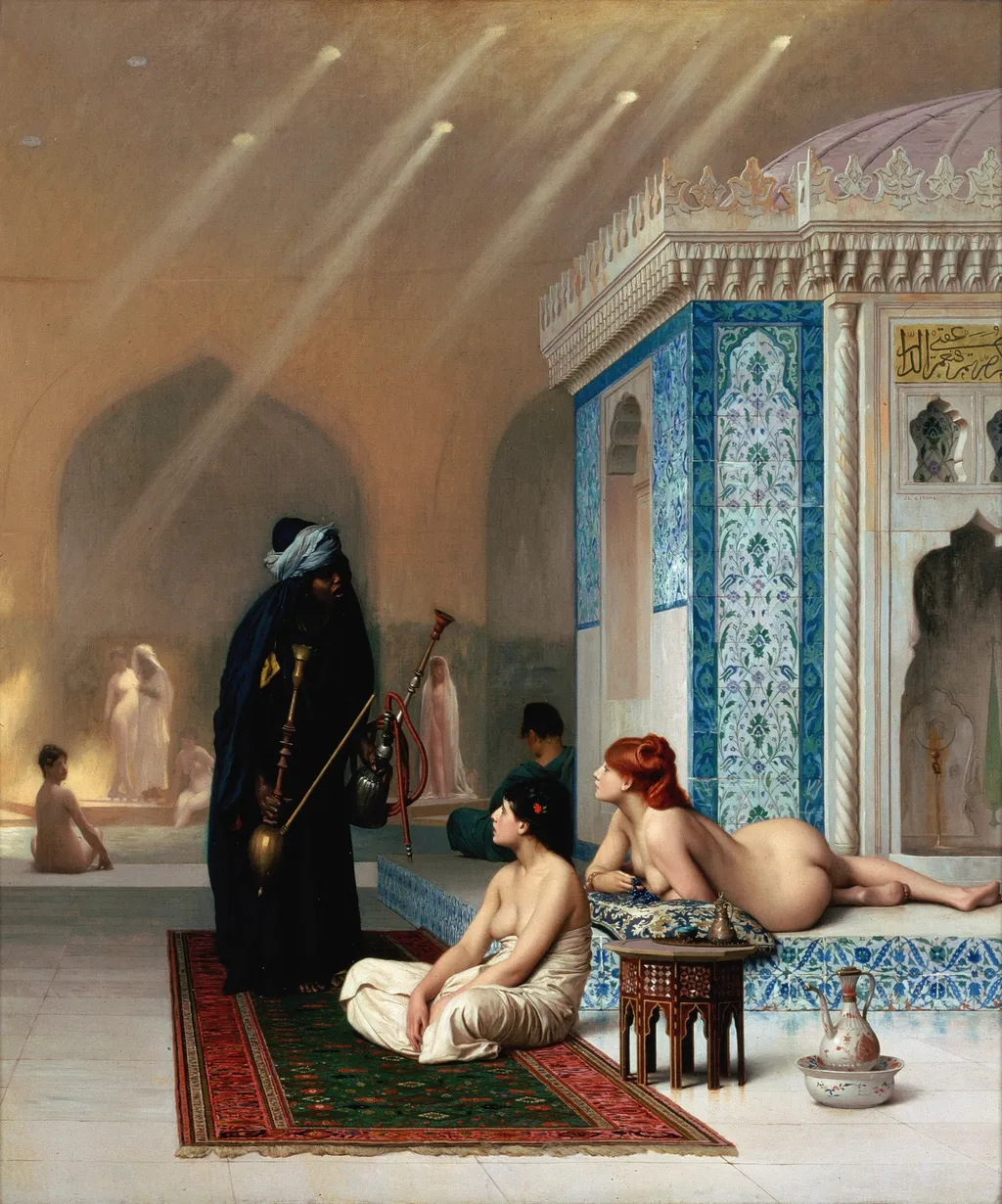
Pool in a Harem is an oil painting by the Academic Art artist Jean Léon Gérôme. It dates from 1888 and is held in the collection of the Hermitage Museum.
About this work
Subject & Meaning
In the background, other nude women gather near a pool, while the foreground features a pavilion adorned with floral tiles and Arabic script.
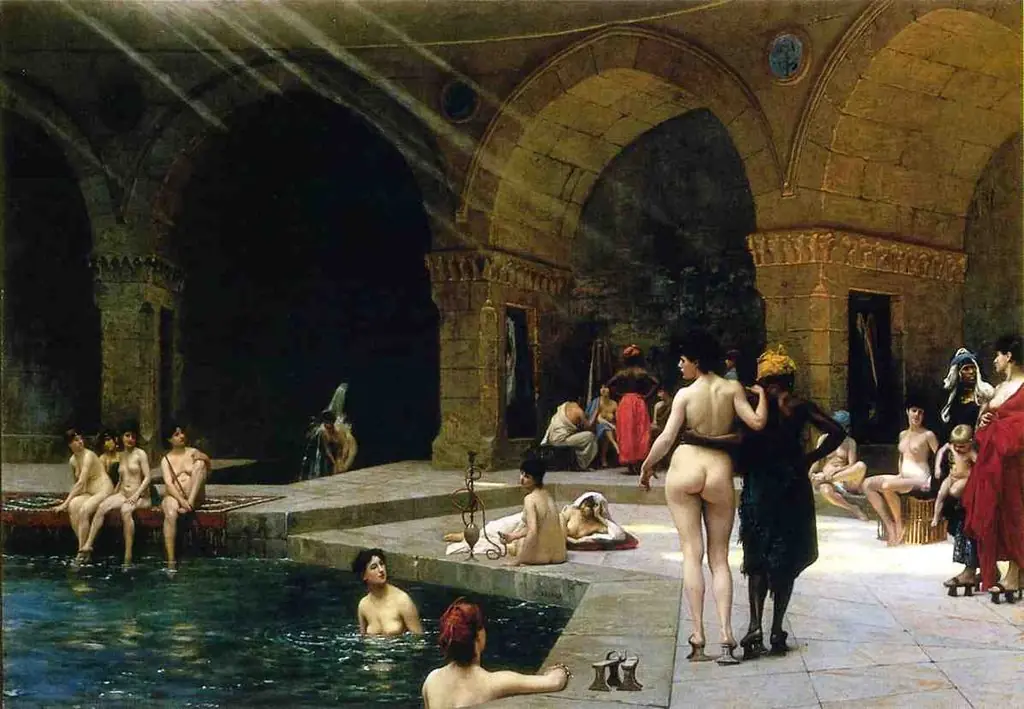
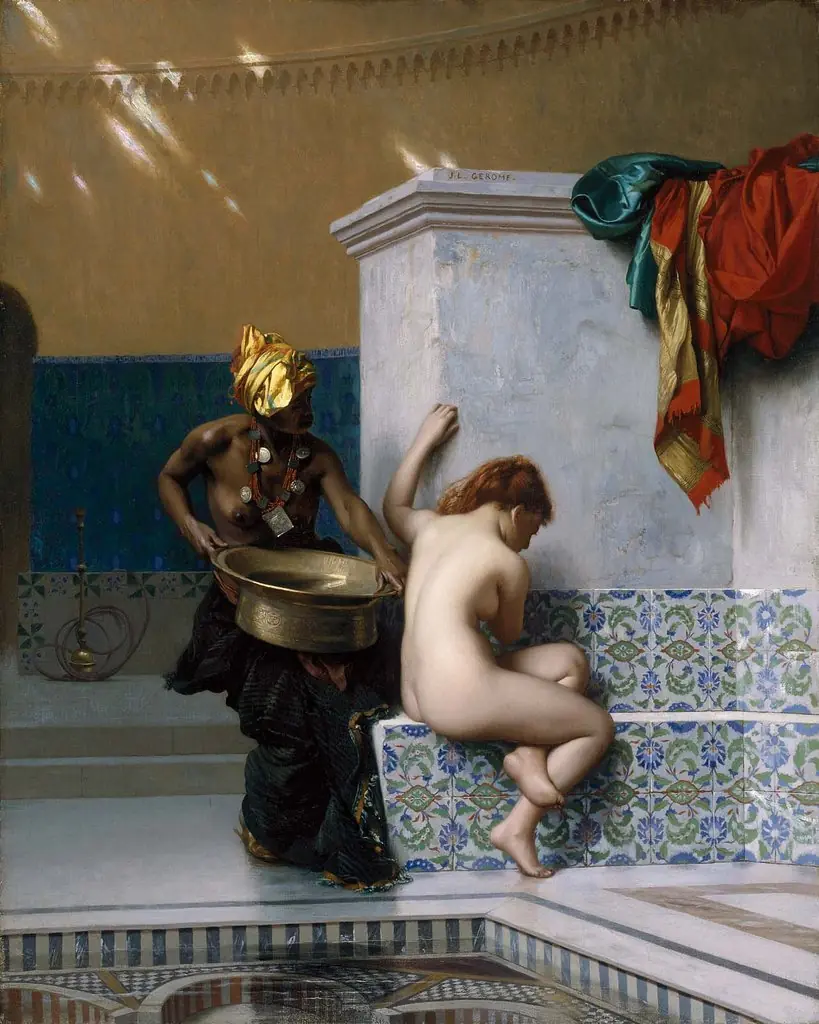
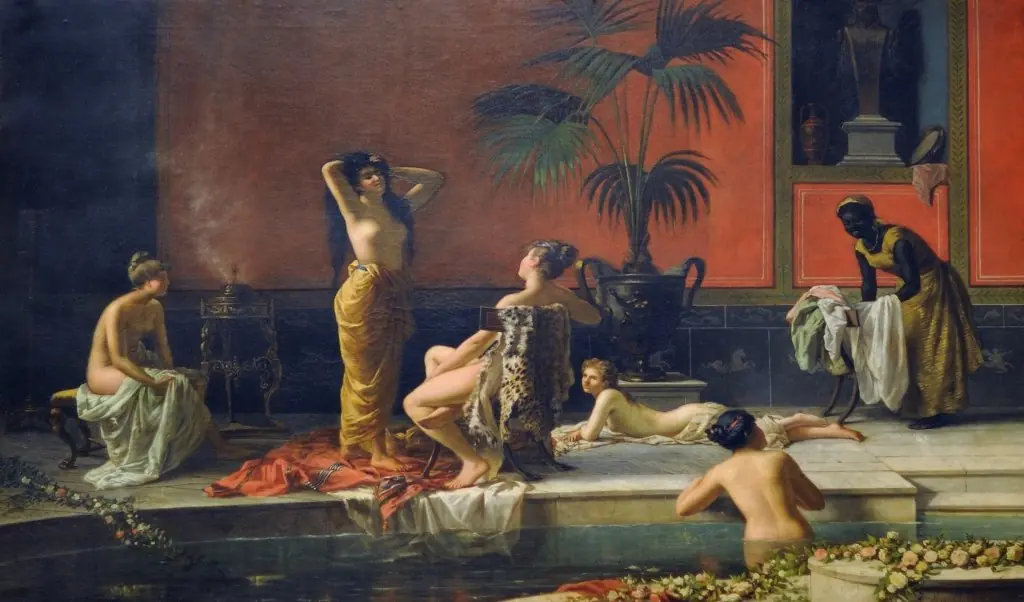
The work depicts a scene within a Middle Eastern harem, specifically a bathhouse or hammam illuminated by roof openings. At the center, a dark-skinned servant offers a hookah to two light-skinned women: one with black hair seated cross-legged on a rug, and another with red hair lying nude on a marble step. In the background, other nude women gather near a pool, while the foreground features a pavilion adorned with floral tiles and Arabic script.
These figures represent odalisques, or sultan's concubines, portrayed in voluptuous poses amidst elegant, inlaid interiors. The painting functions as an Orientalist genre scene, blending academic nude art with exoticized imagery intended to evoke a sensual, forbidden atmosphere for the Western viewer. The depiction reflects the artist's interpretation of the harem as a secluded space derived from the Arabic term for "forbidden," often populated by captured prisoners or enslaved women, though filtered through European artistic conventions regarding the human body.
Technique & Style
Pool in a Harem is an oil painting on canvas, exemplifying Gérôme’s academic Orientalist technique with a smooth, polished brushwork that renders flesh, fabrics, and architectural details with precise gradation. The work depicts a hammam lit by roof openings: a dark‑skinned servant offers a hookah to a black‑haired woman seated on a carpet and a red‑haired woman reclining on a mirror‑smooth marble step, while other nude figures gather near a tiled pavilion inscribed with Arabic script. After being stolen in 2001 and folded into four sections, the canvas suffered creases and paint‑layer cracks; a meticulous restoration (2007‑2009) re‑joined the fragments and repaired the surface, and the painting returned to view in 2011 behind protective glass.
History & Provenance
Pool in a Harem was produced between 1875 and 1876 on commission from the Russian Grand Duke Alexander Alexandrovich, the future Tsar Alexander III, who was noted for his passion for collecting art. The oil on canvas was exhibited at the 1876 Paris Salon under the title Femmes turques au bain, where art critic Lucy Hooper reviewed it negatively in The Art Journal. In 1878 the image was reused for an advertising poster for the American spirits firm Belle of Nelson.
The painting was held at the Anichkov Palace until 1918, when it was transferred to the Hermitage Museum in Petrograd, where it remains.
Pool in a Harem is held in the collection of the State Hermitage Museum, Saint Petersburg, under inventory number 7678. Painted in 1876, it was commissioned by Grand Duke Alexander Alexandrovich (later Tsar Alexander III) and first exhibited at the Salon in Paris that same year under the title Femmes turques au bain. Following the Russian Revolution, the work was transferred from the Anichkov Palace to the Hermitage in Petrograd in 1918.
It was stolen from the museum’s Room 330 in 2001, recovered in 2006, and restored between 2007 and 2009. After reinstallation, it was shown again beginning 1 November 2011 in a dedicated Gérôme display with protective glazing and an alarm system.
Context
Executed between 1875 and 1876 for Grand Duke Alexander Alexandrovich, this work exemplifies Jean-Léon Gérôme's academic style and his prominent role in Orientalism. Exhibited at the 1876 Paris Salon under the title 'Femmes turques au bain,' the painting initially drew negative criticism from art critic Lucy Hooper in The Art Journal. Its cultural impact extended beyond fine art when, in 1878, the image was appropriated for a Belle of Nelson whiskey advertisement, sparking controversy with the Women's Christian Temperance Union due to its nude subject matter.
The painting is frequently analyzed alongside Gérôme's later work, 'The Great Bath at Bursa' (1883), which explores similar themes of Ottoman bathhouses. Scholars note that while Gérôme aimed for ethnographic precision, his depiction of odalisques reflects a European interpretation of Islamic spaces, blending masterful nude study with imagined harem atmospheres.
Legacy
The 1876 genre painting was shown at the Paris Salon and subsequently entered the Hermitage collection, where it became a reference point for discussions of Orientalist imagery. Its profile rose sharply after the 2001 theft from the museum’s western European paintings wing, a high‑profile loss that was only resolved in 2006 when the work resurfaced in Moscow and was returned. A multi‑year restoration completed in 2009 repaired damage from the forced folding, and the canvas was reinstalled in the Hermitage in 2011 with new protective measures.
Scholarship on the piece now cites it as emblematic of 19th‑century academic Orientalism and as an example of how politically charged artworks can acquire a complex restitution history.
Overview
Jean-Léon Gérôme's 1876 oil painting, Pool in a Harem, depicts an intimate scene within a Middle Eastern bathhouse. This genre piece exemplifies the academic style prevalent during its creation, merging the representation of the nude figure with the popular artistic current of Orientalism. The work was first presented to the public at the prestigious Paris Salon. It remains a notable example of Gérôme's engagement with exotic subjects and classical figuration.
Own this work as a print
Artist & collection

Artist
Jean-Léon Gérôme was a French painter and sculptor in the style now known as academicism.