Artwork
Slave Market in Rome
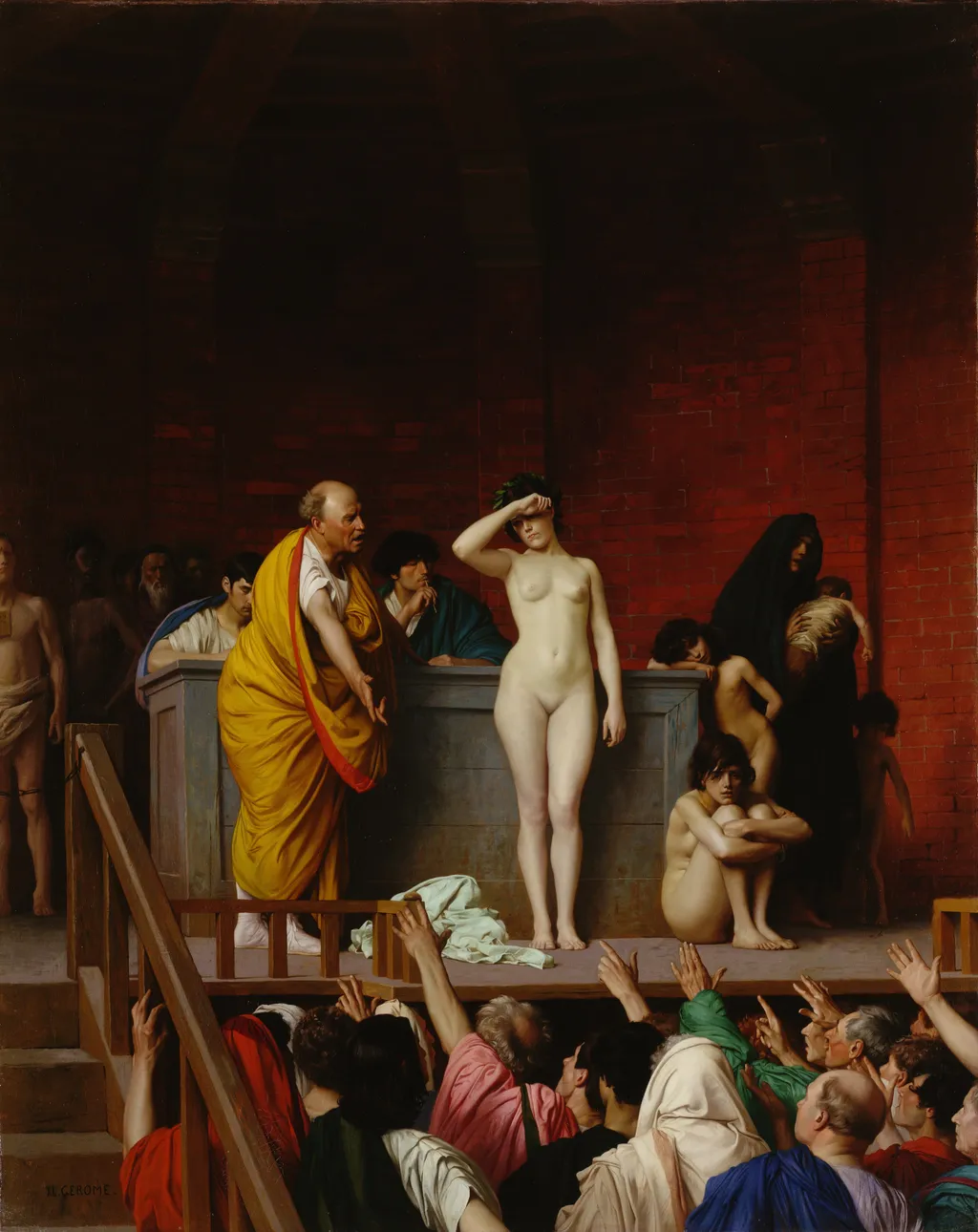
Slave Market in Rome is an oil painting by the Academic Art artist Jean Léon Gérôme. It dates from 1892 and is held in the collection of the Hermitage Museum.
About this work
Subject & Meaning
Behind them, an older clothed woman holding an infant, likely her child, exhibits dread of imminent separation from her family.
The painting depicts an ancient Roman slave auction, focusing on the dehumanizing commerce in human lives. At center, a completely nude woman shields her eyes in humiliation as the dealer displays her to the crowd. A second nude woman sits fearfully at her feet, attempting to cover herself.
Behind them, an older clothed woman holding an infant, likely her child, exhibits dread of imminent separation from her family. Two men record sales while enslaved men look on. The work belongs to Gérôme's series of six slave-market scenes, contrasting classical setting with realistic detail.
The iconography of nudity and vulnerable poses emphasizes the sexual objectification and emotional trauma of slavery, while the accounted transactions underscore its cold-blooded mercantilism.
Technique & Style
Executed in oil on canvas, Slave Market in Rome measures 92 by 74 cm (S2, S4). The medium and support are typical of Gérôme's academic practice (S1, S2, S4, S6). Stylistically, the work exemplifies his synthesis of classical idealism, romantic drama, and meticulous realism (S3).
Gérôme prepared the composition through pencil sketches (S5). The central female figure's pose was adapted from his earlier Phryne before the Areopagus, for which he had commissioned a photograph from Nadar (S5). This painting is one of six slave-market scenes Gérôme produced, all rendered with the polished academic finish characteristic of his historical genre works (S3, S4).
History & Provenance
Jean-Léon Gérôme painted Slave Market in Rome (also titled Slave Market in Ancient Rome) in 1884. Before the painting's debut at the Salon of 1884, Gérôme sold it to Grand Duke Sergei Alexandrovich of Russia. The Grand Duke subsequently gave the work to his wife, Grand Duchess Elizabeth Feodorovna.
In 1930, it entered the collection of the Hermitage Museum in Saint Petersburg via the Soviet organization Antiquariat. Gérôme based the central figure on a photograph of model Marie-Christine Ledoux (or Christine Roux), reprising a pose from his 1861 painting Phryne Before the Areopagus. He also produced preparatory drawings for the composition.
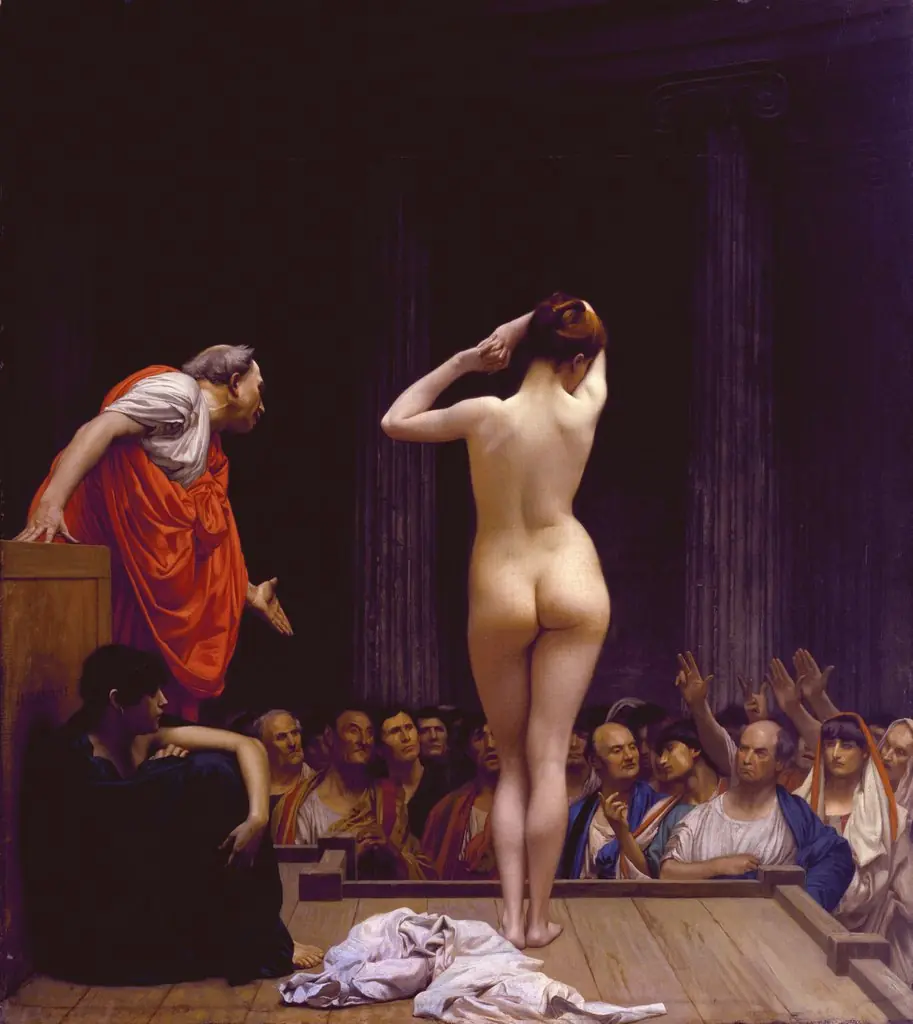
A pendant canvas, A Roman Slave Market (now at the Walters Art Museum), was painted concurrently and also exhibited at the 1884 Salon.
The painting is held in the collection of the Hermitage Museum in Saint Petersburg, Russia. It entered the museum in 1930 via the state organization Antiquariat, having previously belonged to Grand Duke Sergei Alexandrovich and his wife Grand Duchess Elisabeth Feodorovna. No inventory or accession number is provided in the available sources. The work was exhibited at the Paris Salon of 1884, alongside Gérôme's La Nuit au désert.
Context
Gérôme, a leading figure of 19th-century academic art, produced several slave-market scenes set in ancient Rome or contemporary Istanbul. Slave Market in Rome and its companion A Roman Slave Market were both exhibited at the Salon of 1884. His work was highly popular in its time, but later critics have been less favorable; Carel Peeters dismissed it as 'kunst voor in het depot' (art for storage).
Gérôme's interest in Roman antiquity was sparked by a trip to Pompeii and Herculaneum in 1843. For this painting, he reused a pose from his earlier Phryne before the Areopagus and drew on a photograph of Christine Roux. The painting was sold before the Salon opened to Grand Duke Sergei Alexandrovich.
Legacy
Though Gérôme's academic salon painting was highly popular in his own era, later critical reception of 'Slave Market in Rome' has been far less favorable. The Dutch critic Carel Peeters dismissed the work as 'art for the depot,' reflecting a broader shift in taste against such Orientalist and academic nudes. The painting now resides in the Hermitage, part of a legacy of declining esteem for Gérôme's once-celebrated genre scenes.
Overview
Jean-Léon Gérôme's Slave Market in Rome, painted around 1884, depicts a scene from antiquity with a blend of historical detail and academic precision. This oil painting, also known as Vente d’esclaves à Rome, presents a nude woman on a stone platform, surrounded by potential buyers. Gérôme, a French artist, was recognized for his ability to integrate classical themes with a realistic approach, a characteristic evident in this work which captures a specific moment of transaction.
Own this work as a print
Artist & collection

Artist
Jean-Léon Gérôme was a French painter and sculptor in the style now known as academicism.