Artwork
Ophelia
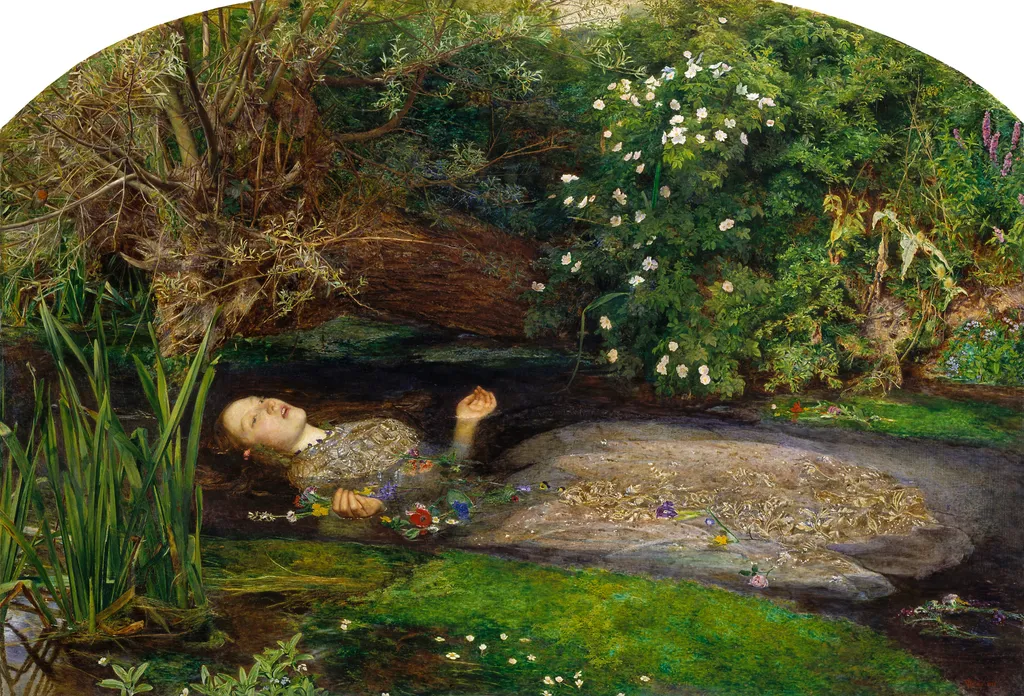
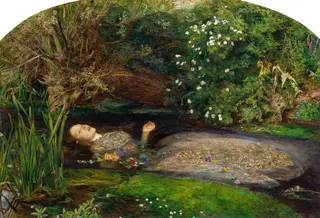
Ophelia is an oil painting by the Pre-Raphaelite artist John Everett Millais. It dates from 1851 and is held in the collection of the National Gallery.
About this work
Subject & Meaning
The riverbank is rendered with botanical precision, each plant chosen to align with Shakespeare’s text and the Victorian "language of flowers.
Millais’s Ophelia depicts the drowning of Shakespeare’s Danish noblewoman as recounted by Queen Gertrude in Hamlet (Act IV, Scene vii), showing her floating in a brook after a willow branch breaks beneath her. Her open arms and upward gaze echo traditional images of saints or martyrs yet also carry an erotic charge, while her submerged body blurs the boundary between sleep and death.
The riverbank is rendered with botanical precision, each plant chosen to align with Shakespeare’s text and the Victorian "language of flowers." Daisies signify innocence, roses youth and beauty, pansies unfulfilled love, and violets fidelity or early death; the poppy, though not in Shakespeare, stands for sleep and death. These emblems weave a web of meaning around Ophelia’s innocence, betrayal, and fatal sorrow, underscoring the Pre-Raphaelite ambition to fuse literary narrative with meticulous natural observation.
Technique & Style
John Everett Millais executed Ophelia between 1851 and 1852 using oil paint on canvas. The work measures 111.8 cm in height and 76.2 cm in width. Adhering to the Pre-Raphaelite Brotherhood's tenets, the artist employed bright, intense colors and pursued faithful truth to nature through meticulous botanical detail.
The composition was created in two distinct stages: the landscape background was painted outdoors along the banks of the Hogsmill River in Surrey, while the figure of Ophelia was added later in the studio. To achieve the floating pose, the model Elizabeth Siddal lay fully clothed in a bathtub warmed by oil lamps, a process that resulted in her contracting a severe cold when the lamps failed. The painting features a vivid array of flora, including poppies, violets, and nettles, each rendered with precise attention to symbolic meaning and natural growth patterns.
History & Provenance
John Everett Millais created Ophelia between 1851 and 1852. The work was executed in two distinct stages: the landscape was painted outdoors along the banks of the Hogsmill River in Surrey during 1851, while the figure of Ophelia was added later in his London studio at 7 Gower Street during the winter of 1851–1852. The model for the figure was Elizabeth Siddal, who posed fully clothed in a bathtub heated by oil lamps.
Millais first exhibited the painting at the Royal Academy in 1852. Shortly after, the art dealer Henry Farrer purchased the work from the artist. The painting subsequently changed hands several times before being acquired by Henry Tate in 1892.
It was presented to the nation by Tate in 1894 and has remained in the collection of the Tate Gallery since that date.
Completed in 1852, John Everett Millais's Ophelia is held in the collection of Tate Britain in London. The work entered the national collection as part of the original gift from Sir Henry Tate in 1894 and is registered under the accession number N01506.
The painting was first exhibited at the Royal Academy in 1852, where it received mixed critical responses. It was subsequently shown at the Salon of 1855 in Paris. In more recent history, the artwork featured in a major touring retrospective of Millais's work between 2007 and 2008, with venues including the Tate Gallery in London, the Van Gogh Museum in Amsterdam, and the Kitakyushu and Bunkamura museums in Japan.
Context
When Ophelia debuted at the Royal Academy in 1852, the response was mixed, yet dealer Henry Farrer purchased it almost immediately from Millais. The work subsequently passed through several owners before entering Henry Tate's collection; he presented it to the nation in 1894, and it has since been a centerpiece of Tate Britain. Today it is widely regarded as one of the most important mid-nineteenth-century paintings, renowned for its beauty and meticulous natural detail, and is considered the most famous work in Millais's oeuvre and an icon of Pre-Raphaelite painting.
The picture embodies core Pre-Raphaelite principles: bright colour, close attention to detail, and fidelity to nature, while its subject, the vulnerable woman on the threshold of death, typifies themes favoured by the Brotherhood. Its influence has extended to later artists including John William Waterhouse, Peter Blake, Ed Ruscha, and Friedrich Heyser. A major retrospective toured Tate London, the Van Gogh Museum in Amsterdam, and two Japanese venues between 2007 and 2008.
Legacy
Millais’s Ophelia has evolved from a divisive Salon debut to a canonical emblem of Victorian art and Pre-Raphaelite style. Initially met with mixed reviews at the Royal Academy in 1852 and the Salon of 1855, it is now widely regarded as one of the most important mid-nineteenth-century works, celebrated for its naturalistic detail and poetic fusion of beauty with mortality.
The painting’s image has transcended its origins, recurring across media and genres. It appears in Lars von Trier’s 2011 film Melancholia and in the Season 3 ending of the anime Jujutsu Kaisen, while musicians from Nolwenn Leroy to Red Velvet have invoked its iconography. Its visual lexicon, floating figure, floral surround, bridal white, has become a shorthand for tragic femininity, repeatedly referenced in fashion, manga, and gaming.
Since its acquisition by the Tate in 1894, Ophelia has remained a centerpiece of the collection, touring internationally in 2007–08 to Amsterdam and Japan, reinforcing its status as an enduring cultural touchstone.
Overview
John Everett Millais completed Ophelia between 1851 and 1852. The oil painting, now held by Tate Britain in London, portrays the tragic figure from Shakespeare’s Hamlet as she lies floating in a river, surrounded by a lush, detailed natural setting.
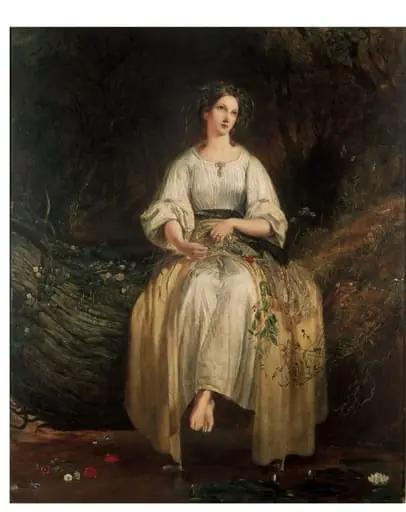
Own this work as a print
Artist & collection
Artist
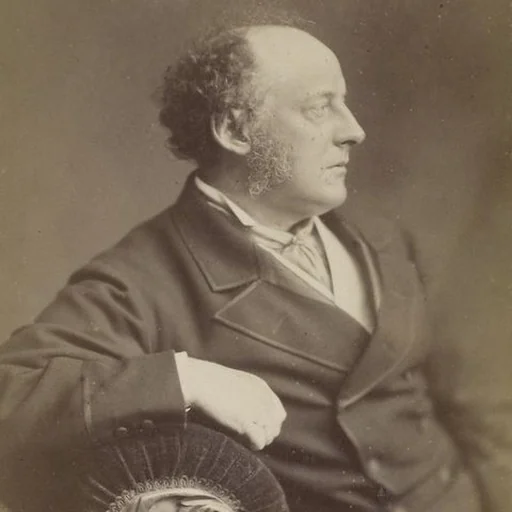
Sir John Everett Millais, 1st Baronet ( MIL-ay; 8 June 1829 – 13 August 1896) was an English painter and illustrator who was one of the founders of the Pre-Raphaelite Brotherhood.

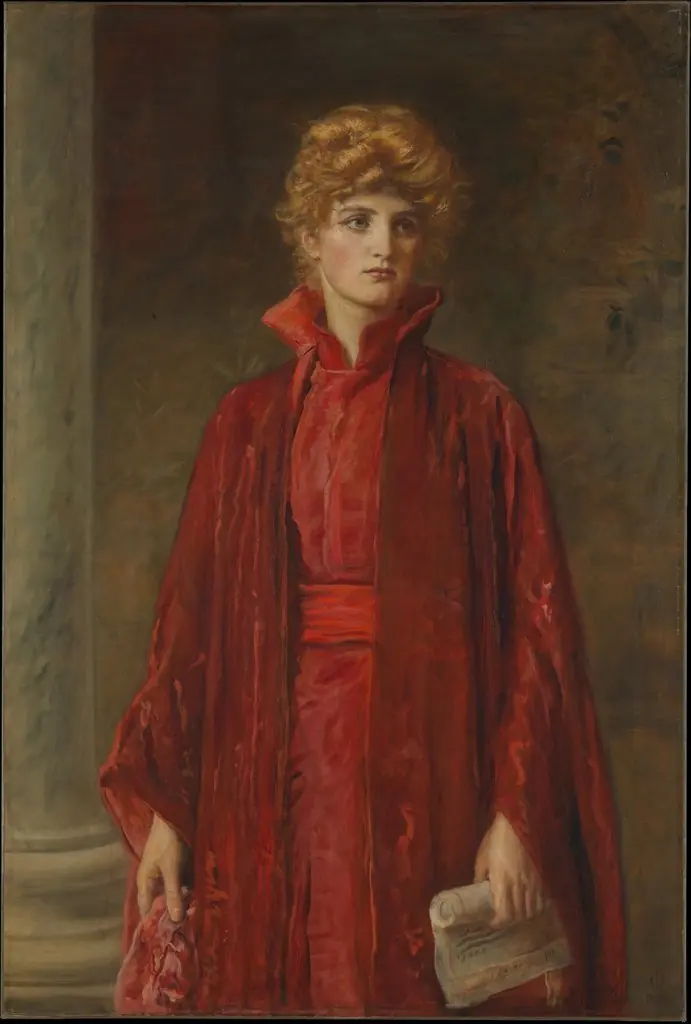
 Compared in the Pre-Raphaelites course