Artwork
The Island of Moorea Looking across the Strait from Tahiti, January 1891
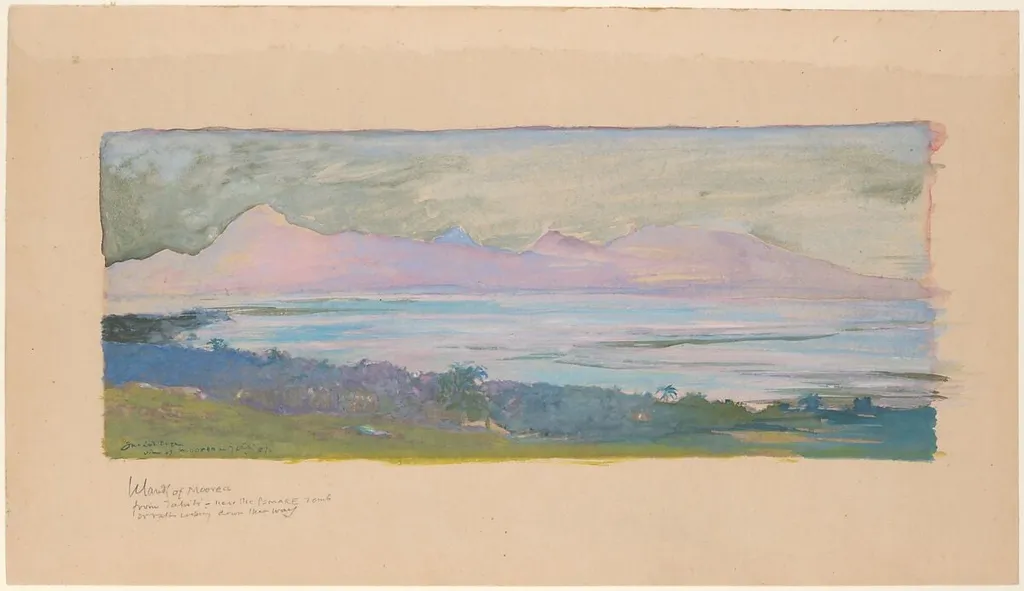
The Island of Moorea Looking across the Strait from Tahiti, January 1891 is a watercolor work on paper by the American Impressionist artist John La Farge. It dates from 1891 and is held in the collection of the Metropolitan Museum of Art.
About this work
Subject & Meaning
As a landscape genre piece, the artwork represents a direct visual record of the specific site visited by the artist during his travels.
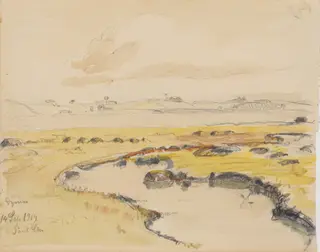
The work depicts a landscape view of the island of Moorea as seen from across the strait in Tahiti. Created in January 1891, the composition features the mountainous terrain of Moorea rising against the backdrop of the Pacific Ocean. The iconography is strictly topographical, focusing on the natural geography of these South Pacific locations rather than incorporating allegorical figures or complex symbolic narratives.
As a landscape genre piece, the artwork represents a direct visual record of the specific site visited by the artist during his travels.
Technique & Style
The work is executed in watercolor and gouache with graphite underdrawing on heavy tan wove paper. This combination allows La Farge to build translucent washes for atmospheric effects while using opaque gouache to define forms and highlights. The support is a sturdy, textured paper that accommodates both wet and dry media.
As a landscape, the piece captures the tropical vista of Moorea across the strait from Tahiti, emphasizing light, color, and the layered topography of the islands through delicate handling of the medium.
History & Provenance
Created in January 1891, the watercolor The Island of Moorea Looking across the Strait from Tahiti was executed by John La Farge using watercolor, gouache, and graphite on heavy tan wove paper. The work depicts the landscape of Moorea and Tahiti, capturing the Pacific Ocean scenery viewed across the strait. It is currently held within the collection of the Metropolitan Museum of Art, where it is classified under the American Wing. The painting measures 17.8 cm in height and 31.4 cm in width.
Legacy
The painting is part of The American Wing at the Metropolitan Museum of Art, where it is catalogued as a watercolor, gouache, and graphite work on heavy tan wove paper created in January 1891. Its depiction of Moorea, the Pacific Ocean, and surrounding mountains aligns with La Farge's interest in tropical landscapes and contributes to his standing as a pioneering American artist of the region. The work's inclusion in a major American art collection has helped shape scholarly views of nineteenth-century American depictions of the Pacific and continues to inform discussions of these subjects in art history.
Overview
John La Farge's 1891 work, "The Island of Moorea Looking across the Strait from Tahiti," captures a Pacific landscape. This piece, rendered in watercolor, gouache, and graphite on heavy tan wove paper, exemplifies American Impressionism. It presents a distant view of Moorea from the vantage point of Tahiti, showcasing the artist's engagement with light and atmosphere in a natural setting.
Context
While recognized for this landscape, John La Farge maintained a diverse artistic practice. He was also a significant figure in American art for his contributions to illustration, large-scale murals, and interior design. Notably, his innovative work in stained glass design established new standards for the medium, reflecting a broader commitment to exploring light and color across various artistic forms.
![Tahitian Shore [verso]](https://artifactworldgallery.com/img/paul-gauguin--tahitian-shore-verso--3eec3f279f2c316e-w320.webp)
Artist & collection

Artist
John La Farge (March 31, 1835 – November 14, 1910) was an American artist whose career spanned illustration, murals, interior design, painting, and popular books on his Asian travels and other art-related topics.

 The Muse of Painting
 Portrait of the Painter
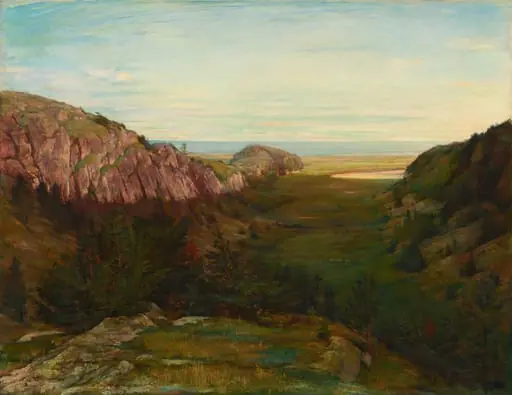 The Last Valley - Paradise Rocks
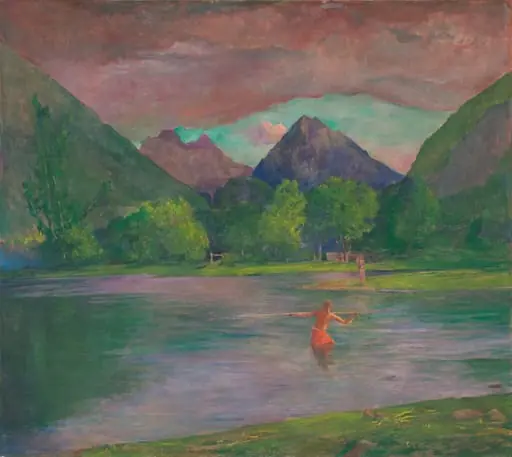 The Entrance to the Tautira River, Tahiti. Fisherman Spearing a Fish
 Flowers on a Window Ledge
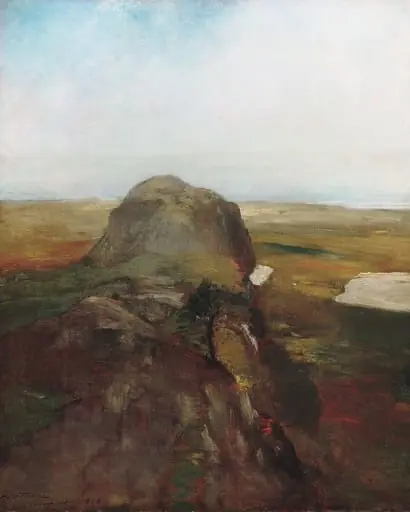 Autumn Study, View over Hanging Rock, Newport, R.I.
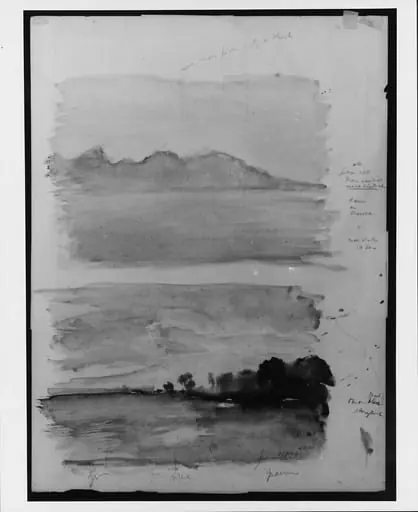 Double Study of Dawn, Moorea Seen across the Water, Tahiti
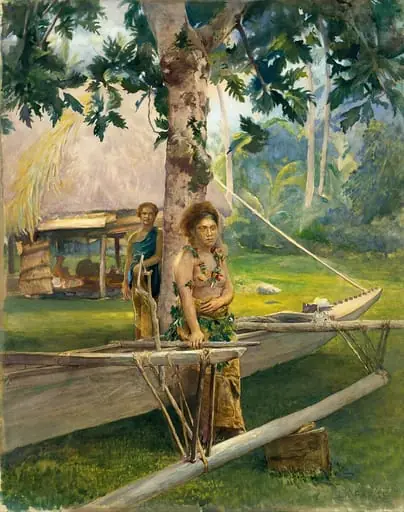 Portrait of Faase, the Taupo, or Official Virgin, of Fagaloa Bay, and Her Duenna, Samoa
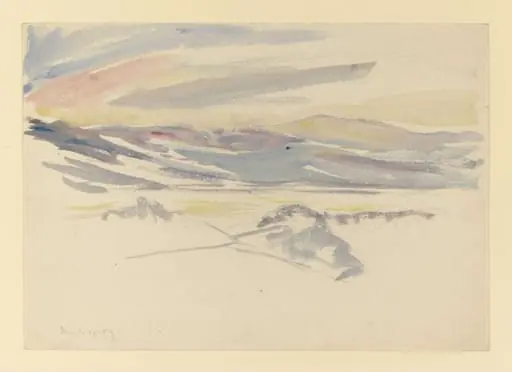 Snowy mountain landscape
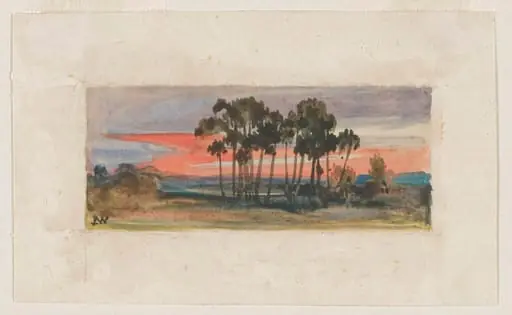 Sunset at Highcliffe
 Isles of Loch Lomond
 The Sabine Hills and Rocca Santo Stefano Seen from Civitella
 Tangier
 Towpath, Richmond, 1913
 Parnassus
 Above Mentone
 Tiberias. From the journey to Palestine
 View from the Mount of Olives. From the journey to Palestine
 Dyrnæs enge
- Tahitian Shore [verso]