Artwork
Olympia Montagne Russes
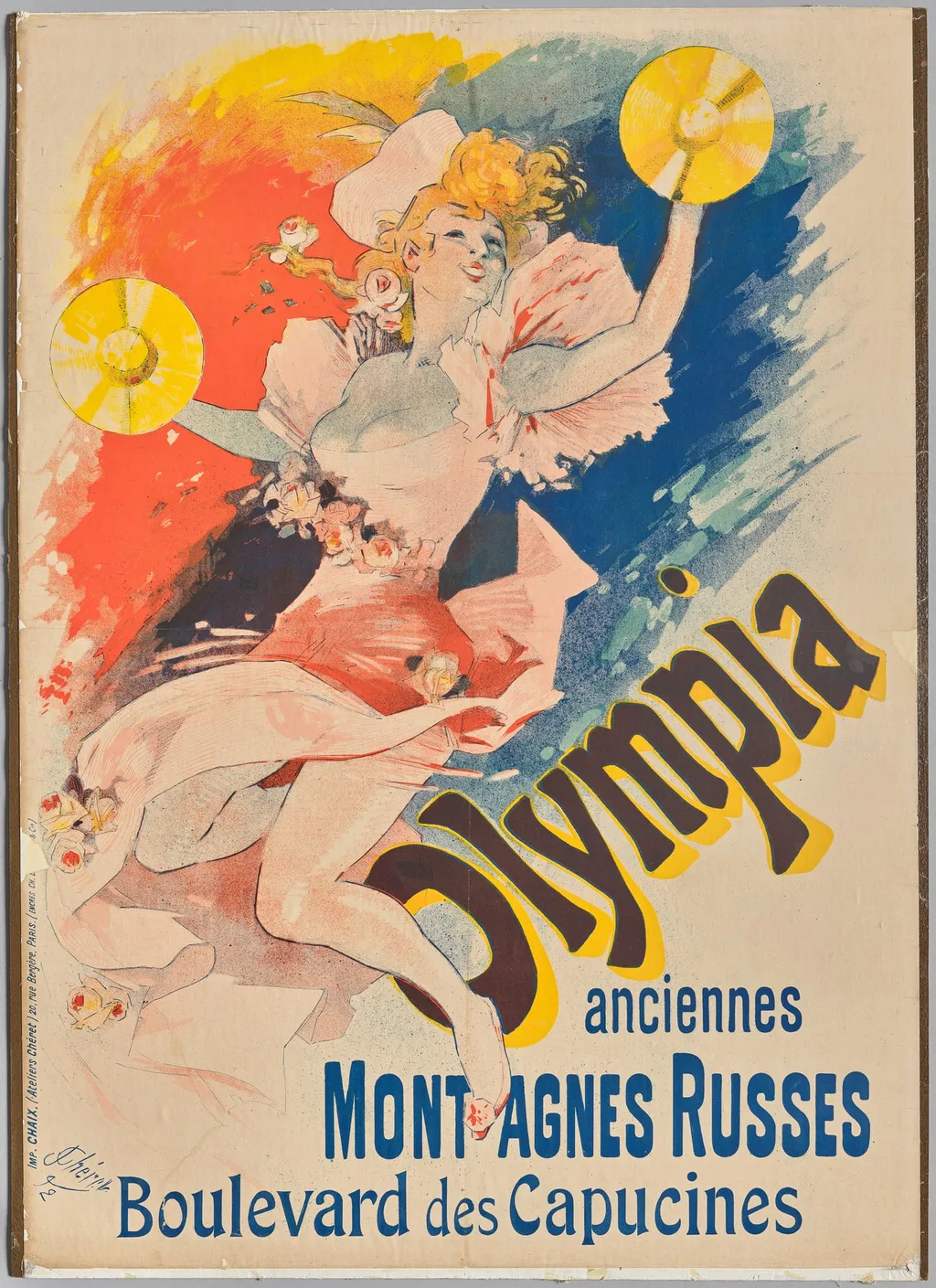
Olympia Montagne Russes is a print by the Impressionist artist Jules Chéret. It dates from 1892 and is held in the collection of the Cleveland Museum of Art.
- Accession no.
- 1987.1063
- Credit line
- Gift of Mrs. Henry Trenkamp Jr.
About this work
Overview
Jules Chéret created this color lithograph in 1892 under the title Olympia Montagne Russes. It is part of the collection at The Cleveland Museum of Art. The work was produced as a commercial poster, typical of Chéret’s output during the height of the Belle Époque. Its bold composition and vivid palette reflect the era’s fascination with public entertainment and urban leisure.
Subject & Meaning
The central figure is a woman wearing a hat and a pink dress, holding two circular objects that suggest carnival tokens or game prizes.
The central figure is a woman wearing a hat and a pink dress, holding two circular objects that suggest carnival tokens or game prizes. She stands amid swirling bands of red, blue, and yellow, evoking the energy of a fairground ride. The title references a roller coaster attraction, linking the figure to the spectacle of amusement parks. Her poised demeanor contrasts with the dynamic background, hinting at the allure and artificiality of modern recreation.
Technique & Style
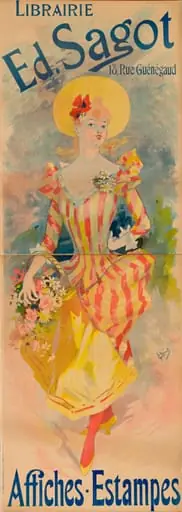
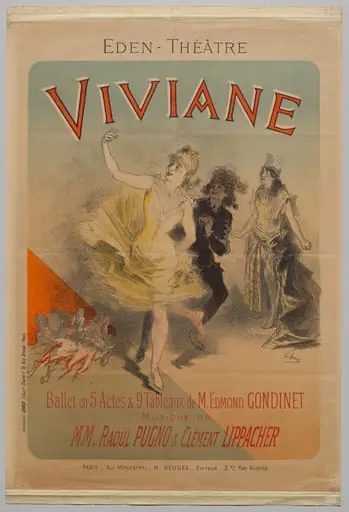
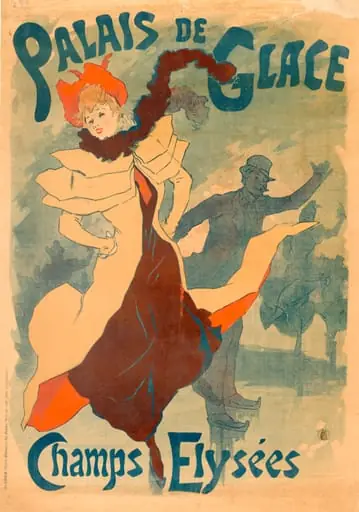
Chéret employed color lithography, a technique that allowed for sharp, layered hues and fluid lines. The figure is rendered with soft contours and subtle modeling, blending naturalism with decorative stylization. Background elements are reduced to rhythmic planes of color, creating movement without detailed perspective. This synthesis of realism and graphic abstraction became a hallmark of his poster design.
History & Provenance
Produced in 1892, the poster was likely commissioned to advertise an amusement ride in Paris. Chéret’s posters were widely distributed, appearing on city walls and in public spaces. The Cleveland Museum of Art acquired the print as part of its broader collection of 19th-century graphic arts, preserving it as an example of commercial art elevated to cultural significance.
Context
During the 1890s, Paris experienced a boom in public amusements, including fairgrounds and mechanical rides. Chéret’s posters captured this cultural shift, transforming advertising into a visual language of movement and delight. His work intersected with the rise of poster art as a legitimate medium, bridging fine art and mass communication in an era of rapid urbanization.
Legacy
Chéret’s posters influenced generations of graphic designers and illustrators, helping to define the aesthetic of modern advertising. Olympia Montagne Russes exemplifies his role in elevating lithography beyond commerce into a recognized art form. Though created for ephemeral display, such works are now studied for their contribution to visual culture and the evolution of print media.
Own this work as a print
Artist & collection
Artist
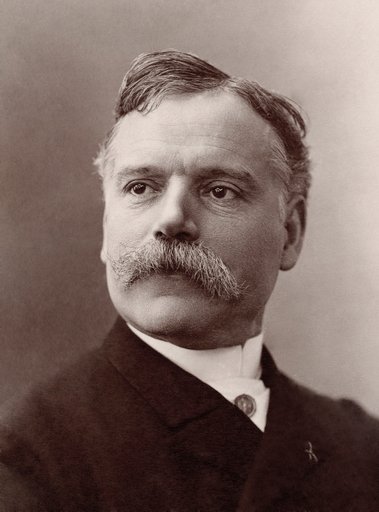
Jules Chéret was a French painter and lithographer who became a master of Belle Époque poster art. He has been called the father of the modern poster.