Artwork
La Brebis; Le Tandem
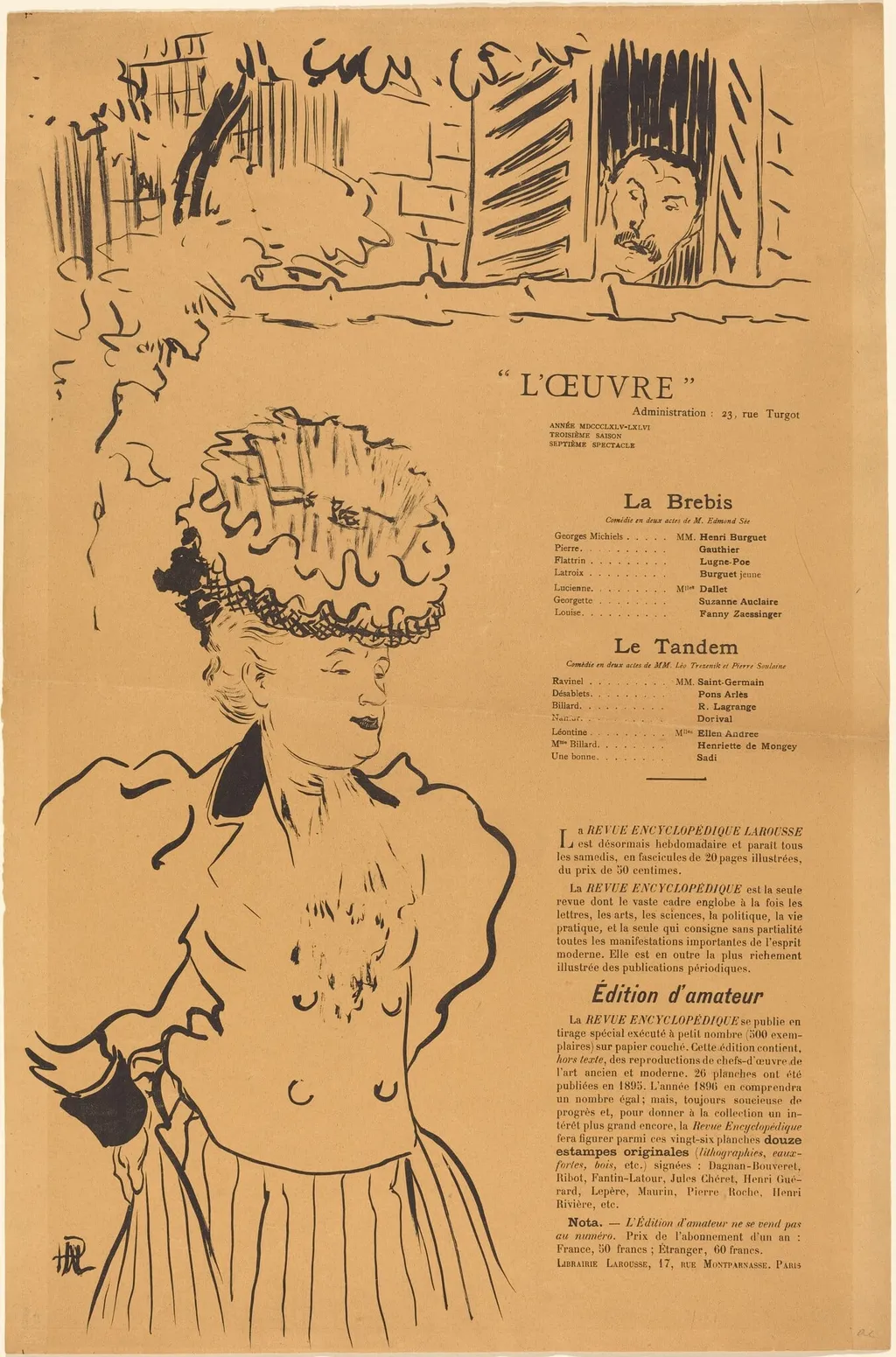
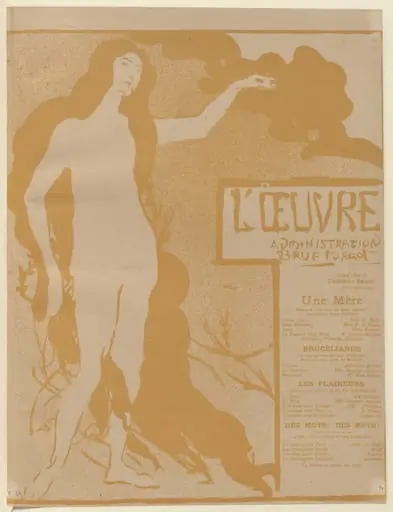
La Brebis; Le Tandem is an ink print by the Impressionist artist Hermann Paul. It dates from 1896 and is held in the collection of the National Gallery of Art.
- Inscription
- Inscribed:lower left in stone in ligature: HMPL; center right printed: "L'OEUVRE" / Administration: 23 rue Turgot / ANNÉE MDCCCLXLV-LXLVI / TROISIEME SAISON / SEPTIEME SPECTACLE / La Brebis / Comédie en deux actes de M. Edmond Sée... / Le Tandem / Comédie en deux actes de MM. Léo Trezenik et Pierre Soulaine...
About this work
Overview
Created in 1896, La Brebis; Le Tandem is a black lithograph printed on light‑brown wove paper. The work originates from French illustrator René Georges Hermann‑Paul, whose career spanned newspaper and periodical illustration as well as fine‑art exhibitions alongside contemporaries such as Vuillard, Matisse and Toulouse‑Lautrec.
Subject & Meaning
The image presents a woman wearing an elaborate hat crowned with a feather, positioned before a stylised urban backdrop. Within the sketchy skyline a small face peers from a window, while surrounding text advertises theatrical productions, performers and the Revue Encyclopédique magazine, suggesting a promotional poster that blends fashion, entertainment and media.
Technique & Style
Hermann‑Paul employed stark black lines against the warm tone of the paper, producing a rough, sketch‑like quality. The hat is rendered with exaggerated, almost regal contours, and the cityscape is reduced to angular, uneven forms. This simplification and use of bold black shapes reflect the artist’s early satirical approach, employing caricature to comment on contemporary life.
History & Provenance
The lithograph belongs to Hermann‑Paul’s late‑nineteenth‑century output, a period when he was active in Parisian illustration circles.
The lithograph belongs to Hermann‑Paul’s late‑nineteenth‑century output, a period when he was active in Parisian illustration circles. Though primarily known for his newspaper work, he exhibited fine‑art prints alongside avant‑garde peers. The piece’s provenance traces to the artist’s estate after his death in 1940, later entering public collections that document the crossover between commercial and fine art in the Belle Époque.
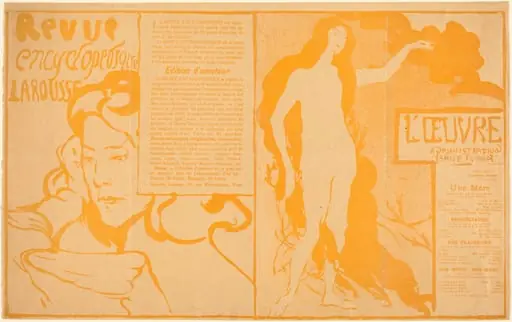
Own this work as a print
Artist & collection

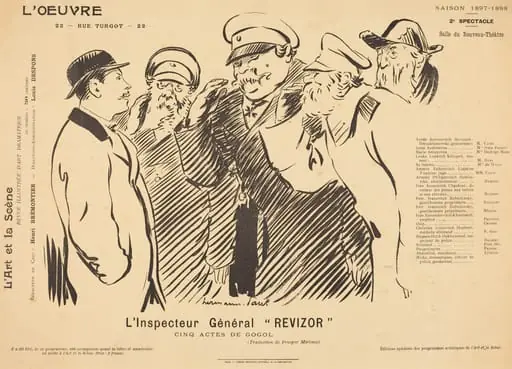 L'Inspecteur Général Revizor
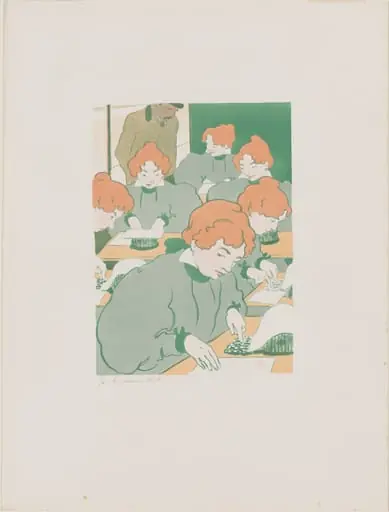 Les petits machines à écrire
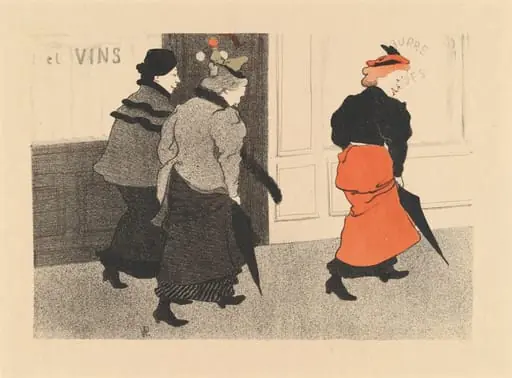 Milliners (Modistes)
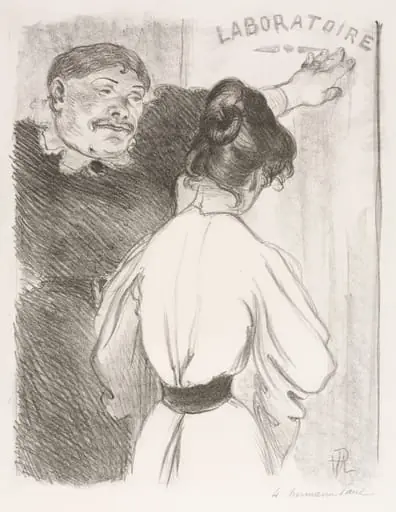 Laboratoire
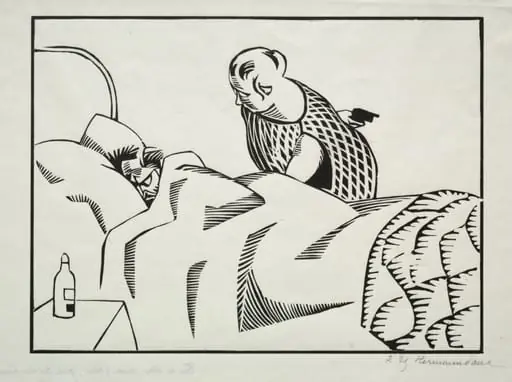 You are sure my dear that you cannot think of anything more to help the pain?
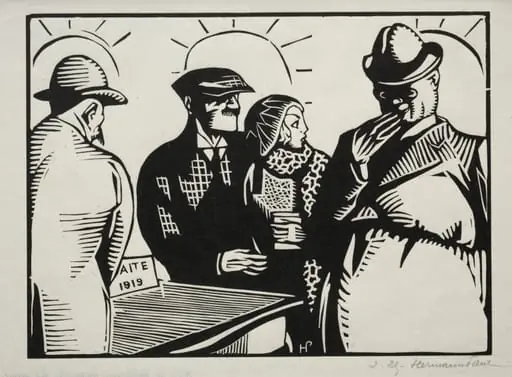 It is the Table on Which the Treaty of Versailles was Signed
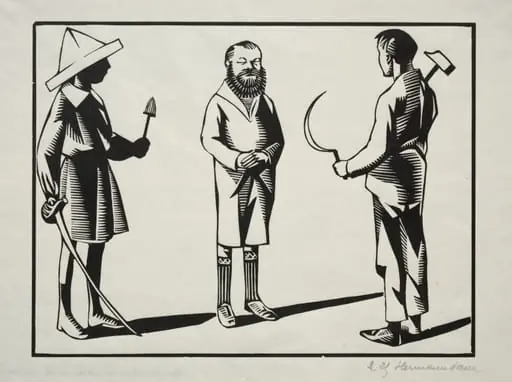 Moi! je tiens le sabre, et le goupillon; toi la faucille, le marteau et ler pastel. C'est la barbe.
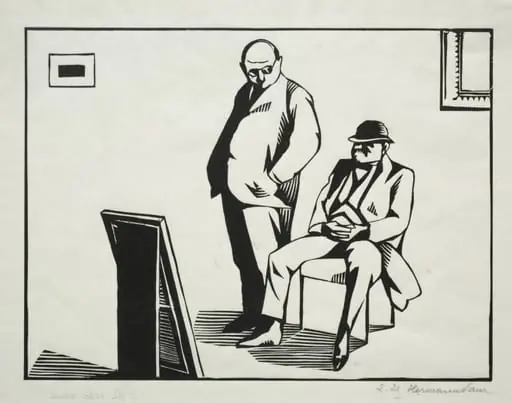 Et cela vaut! 100,000! et tout le monde le sait.
 Untitled
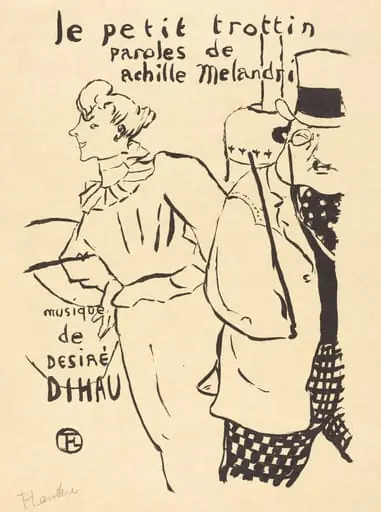 The Little Errand-Girl (Le petit trottin)
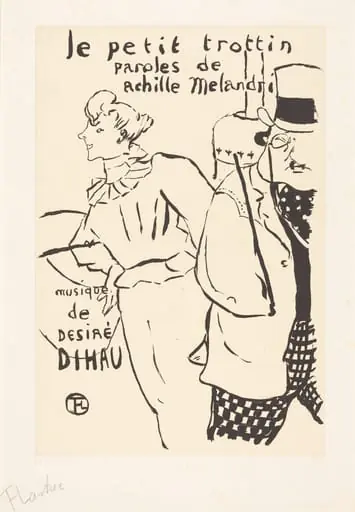 The Little Errand-Girl (Le petit trottin)
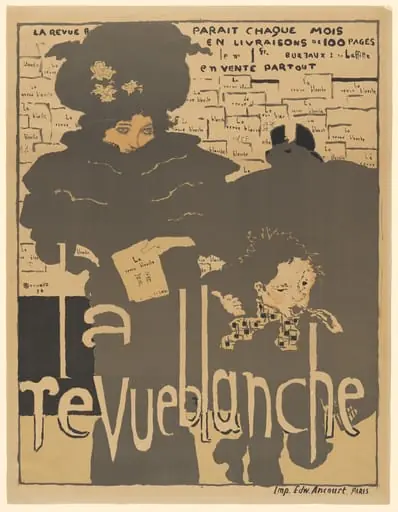 Untitled
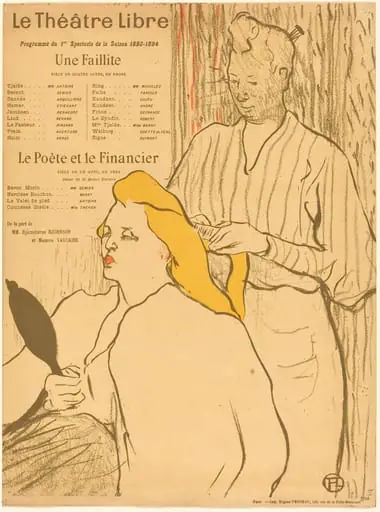 The Hairdresser - Program for the Theatre-Libre (Le coiffeur - Programme du Théatre-Libre)
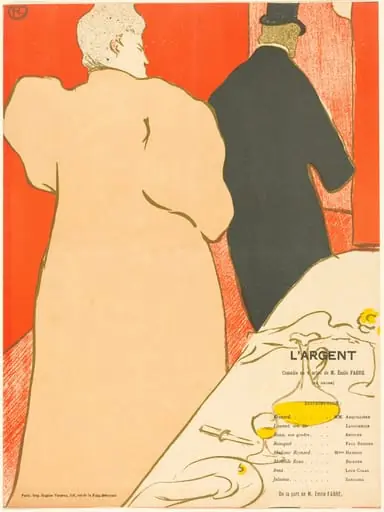 L'Argent
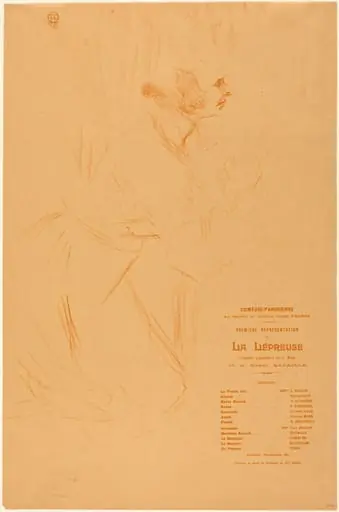 Program for "La lepreuse" (Programme pour "La lépreuse")
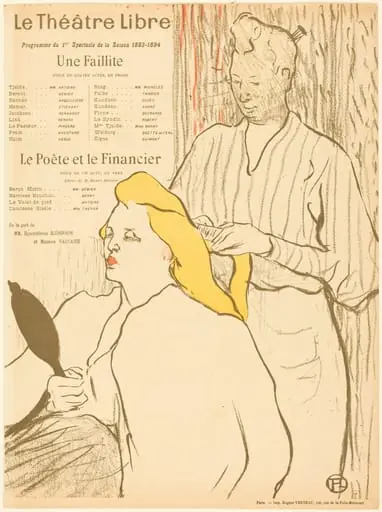 Une Faillite; Le Poète et le financier
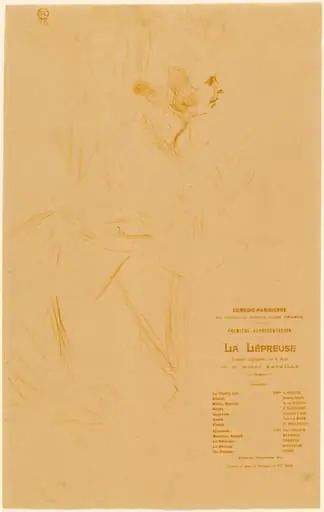 La Lépreuse
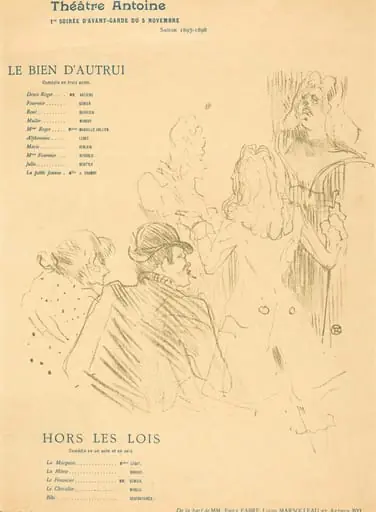 Le Bien d'autrui; Hors Les Lois
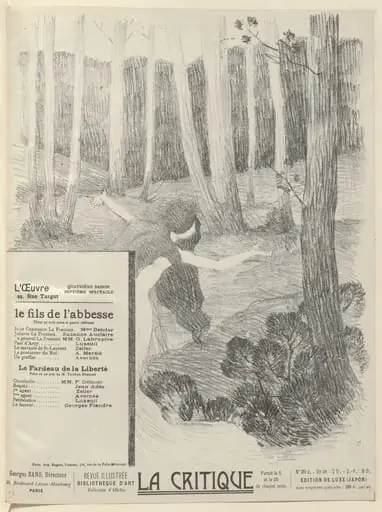 Untitled
- Une Mère; Brocéliande; Les Flaireurs; Des Mots! Des Mots!