Artwork
Giant Tree and Torii Gates
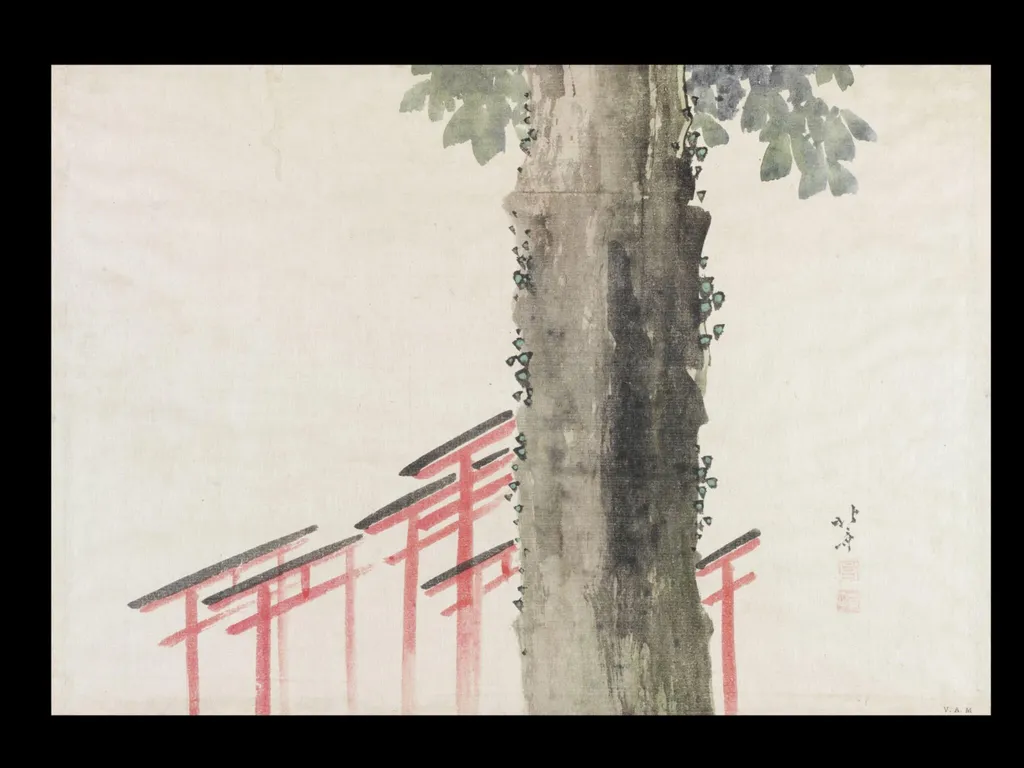
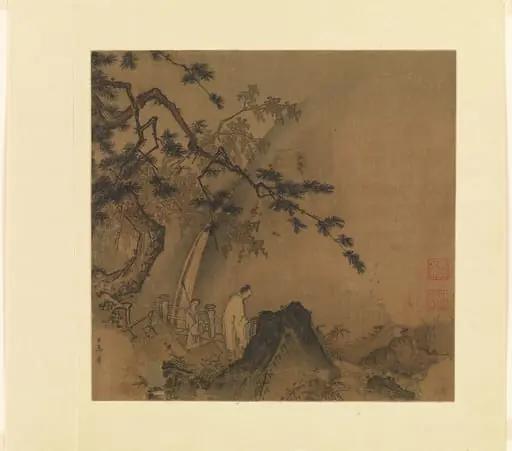
Giant Tree and Torii Gates is a paint painting by the Japonisme artist Katsushika Hokusai. It dates from 1808 and is held in the collection of the Victoria and Albert Museum.
About this work
A big tree stands in the center. Green leaves fill its branches. Behind it, red shrine gates peek through.
Hokusai painted this on silk in 1808. He used thin, smooth brush strokes. The tree looks alive while the gates feel far away.
See how the green contrasts with the red. It pulls your eye right to the middle.
Look up Katsushika Hokusai next.
Overview
This piece reflects his shift toward more intimate, personal compositions, moving beyond mass-produced imagery toward refined artistic expression.
Painted in 1808 on silk, this work is one of seven in a small album by Katsushika Hokusai. Though best known for his woodblock prints, Hokusai produced a number of paintings later in his career, often exploring natural forms with heightened sensitivity. This piece reflects his shift toward more intimate, personal compositions, moving beyond mass-produced imagery toward refined artistic expression.
Subject & Meaning
The composition centers on a towering tree, its dense foliage dominating the foreground, while the red torii gates of a shrine emerge faintly behind it. The tree may symbolize endurance or spiritual presence, while the gates suggest a threshold to the sacred. The deliberate placement implies a quiet reverence, as if nature envelops and obscures human-made sacred spaces, inviting contemplation rather than direct worship.
Technique & Style
Hokusai employed fine, fluid brushwork on silk, achieving a delicate transparency that enhances the sense of depth. The tree’s leaves are rendered with thin, rhythmic strokes, giving them a living, breathing quality. In contrast, the torii gates are painted with restrained, flat planes of red, receding visually into the background.
The sharp contrast between vibrant green and crimson draws attention to the tree’s central position without overwhelming the composition.
History & Provenance
The painting was created during a period when Hokusai was experimenting beyond printmaking, likely for private collectors or scholarly circles. It remains part of a bound album, a format favored by connoisseurs for its portability and intimate viewing experience. Its survival in this form suggests it was carefully preserved, possibly within a literati or temple context, rather than displayed publicly.
Context
In early 19th-century Japan, artists like Hokusai were increasingly drawn to nature as a subject worthy of deep study, influenced by both traditional ink painting and emerging secular interests. While ukiyo-e prints catered to urban audiences, this painting reflects a quieter, more introspective mode, one aligned with scholarly aesthetics and the contemplative traditions of Zen and Shinto, where nature and spirituality intertwine.
Legacy
This work exemplifies Hokusai’s versatility beyond printmaking and his ability to convey atmosphere with minimal means. Though less widely known than his landscapes, such paintings reveal his evolving vision, one that valued subtlety, spatial ambiguity, and the emotional resonance of natural forms. It contributes to a broader understanding of his artistic range and the diversity of Japanese painting in the Edo period.
Own this work as a print
Artist & collection

Artist
Katsushika Hokusai spent his life in Edo, now Tokyo, where he drew and carved prints for a living.