Artwork
Miyako-gai|元禄歌仙貝合|Miyako Shell
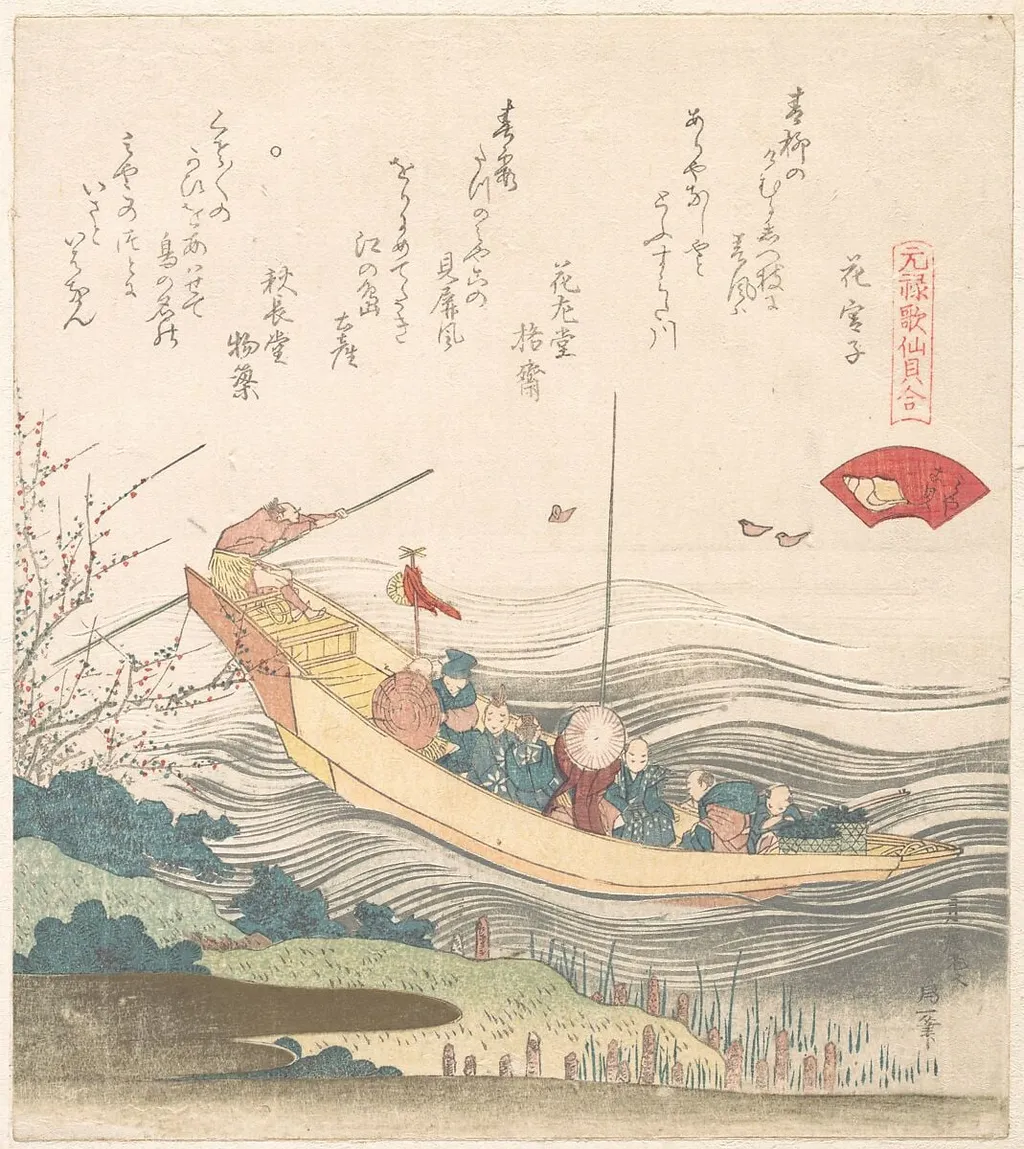
Miyako-gai|元禄歌仙貝合|Miyako Shell is an ink print by the Japonisme artist Katsushika Hokusai. It dates from 1821 and is held in the collection of the Metropolitan Museum of Art.
- Accession no.
- JP2579
About this work
Technique & Style
Executed as a surimono in 1821, the print is a polychrome woodblock in the nishiki-e technique, printed on paper with dense mineral and organic pigments layered to achieve subtle gradations and metallic sheen. Compositionally, three shell-matching figures occupy a shallow stage-like foreground, their postures and layered garments rendered with clear contour lines and minimal internal modeling, while the background reduces the bay to a narrow strip of water and distant sailboat silhouette, focusing attention on the shells and calligraphic cartouches. Handling is crisp, with precise cutting of fine lines for text and shell textures, and the color areas show careful bokashi gradation, especially in the graded indigo of the water.
History & Provenance
The work was created in 1821 by Katsushika Hokusai as a woodblock print (surimono) in ink and color on paper, part of the ukiyo-e tradition.
The work was created in 1821 by Katsushika Hokusai as a woodblock print (surimono) in ink and color on paper, part of the ukiyo-e tradition. It depicts shell-matching figures along with a longboat, watercourse, fishing rod, and pole. The print is held in the collection of the Metropolitan Museum of Art. The available sources do not record a specific accession number or exhibition history for the work.
Overview
Miyako-gai, also known as Miyako Shell, is a surimono woodblock print executed in ink and color on paper around 1821. The work is attributed to the prolific Edo‑period artist Katsushika Hokusai. As a privately commissioned print, it exemplifies the refined, limited‑edition format typical of surimono, which were often produced for specialized audiences rather than the open market.
Subject & Meaning
The composition presents a nocturnal river scene in which a slender longboat drifts beneath moonlight. Within the vessel a fishing rod and a pole are visible, suggesting a quiet activity of fishing or preparation. The restrained arrangement of these elements conveys a moment of stillness and contemplation, characteristic of many Edo‑period depictions of everyday labor.
Artist & collection

Artist
Katsushika Hokusai spent his life in Edo, now Tokyo, where he drew and carved prints for a living.

 葛飾北斎画 冨嶽三十六景
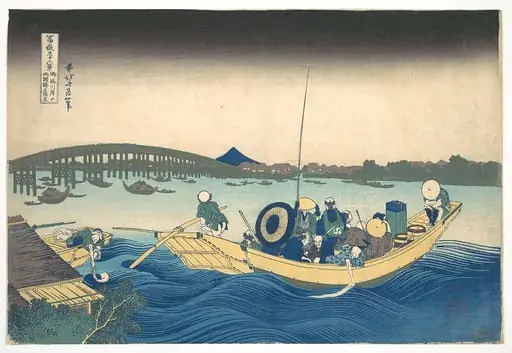
御厩川岸より両国橋夕陽見|Viewing the Sunset over Ryōgoku Bridge from the Onmaya Embankment (Onmayagashi yori Ryōgokubashi sekiyō o miru), from the series Thirty-six Views of Mount Fuji (Fugaku sanjūrokkei)
葛飾北斎画 冨嶽三十六景
御厩川岸より両国橋夕陽見|Viewing the Sunset over Ryōgoku Bridge from the Onmaya Embankment (Onmayagashi yori Ryōgokubashi sekiyō o miru), from the series Thirty-six Views of Mount Fuji (Fugaku sanjūrokkei)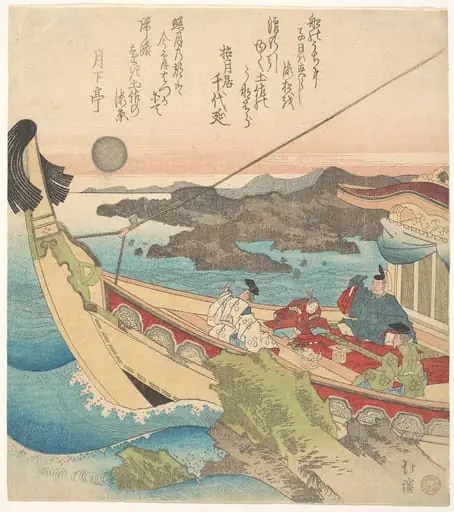 Tosa no umi|Inland Sea near Tosa
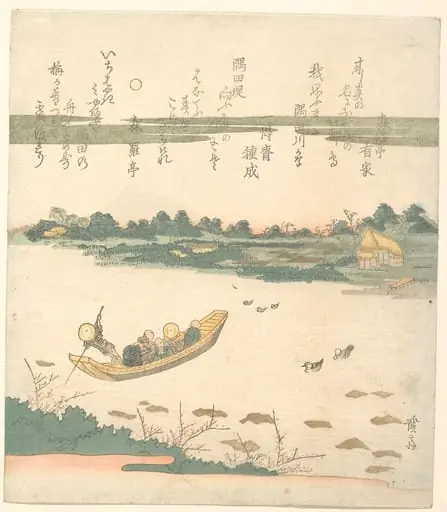 Untitled
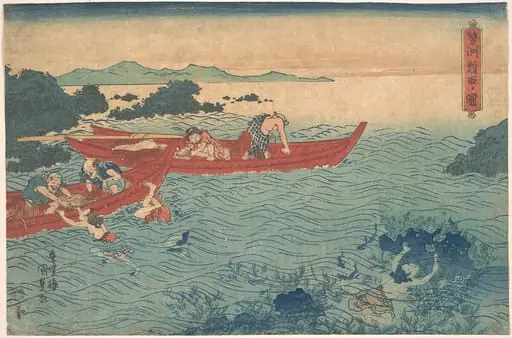 Untitled
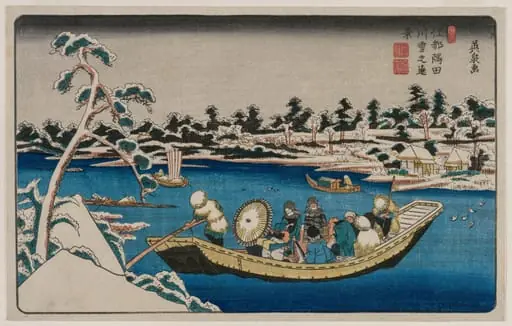 A Distant View of Snow on the Sumida River in Edo
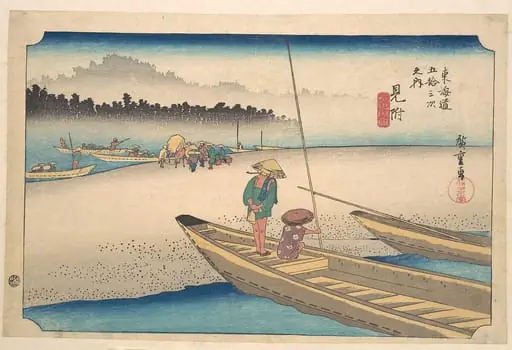 東海道五十三次 見附 天竜川|Mitsukei Tenryugawa
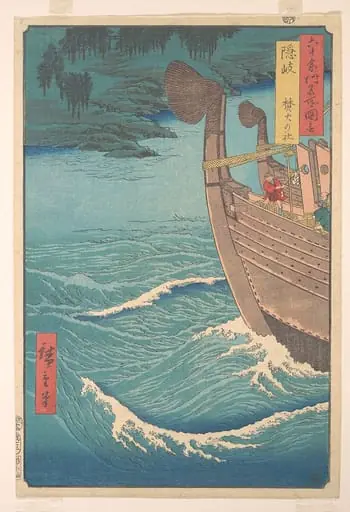 六十余州名所図会 隠岐 焚火の社|The Takihi Shrine, Oki Province, from the series Views of Famous Places in the Sixty-Odd Provinces
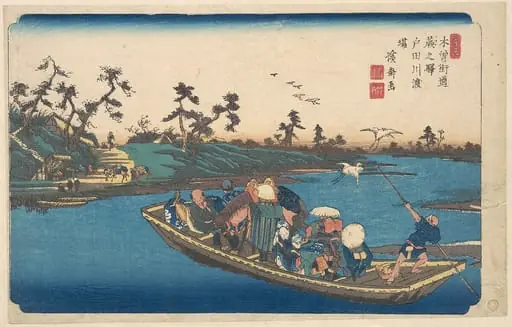 Untitled
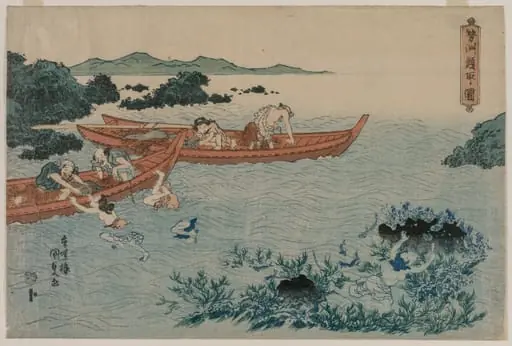 Abalone Divers off the Coast of Ise, from an Untitled Landscape Series