Artwork
百人一首 うはかゑとき 天智天皇|Poem by Tenchi Tennō, from the series One Hundred Poems Explained by the Nurse (Hyakunin isshu uba ga etoki)
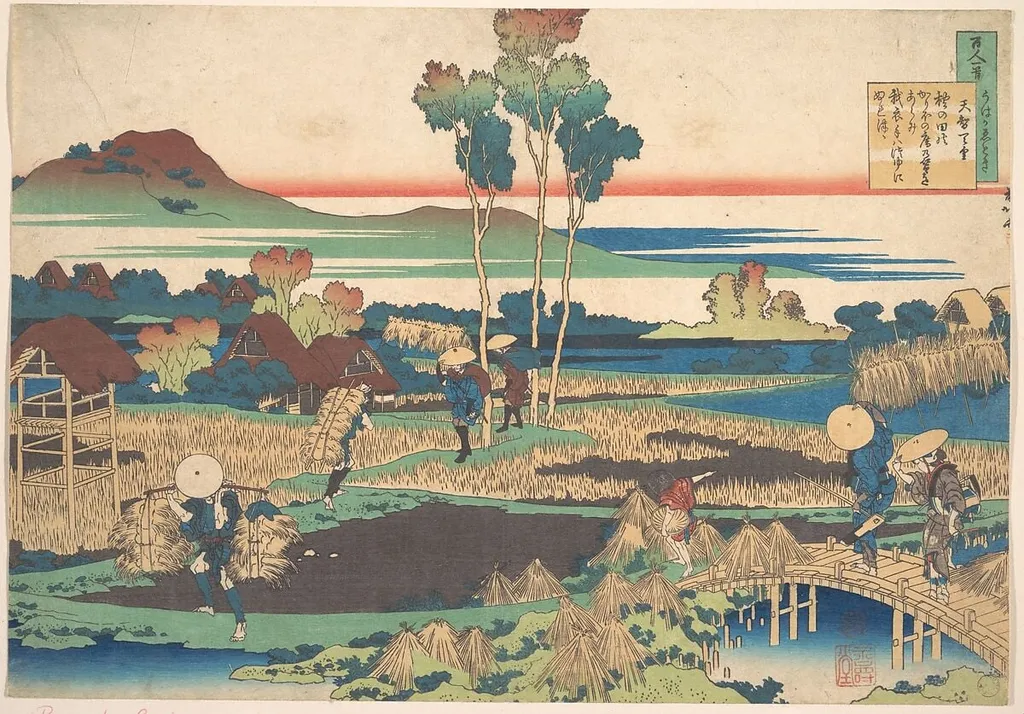
百人一首 うはかゑとき 天智天皇|Poem by Tenchi Tennō, from the series One Hundred Poems Explained by the Nurse (Hyakunin isshu uba ga etoki) is an ink print by the Japonisme artist Katsushika Hokusai. It dates from 1839 and is held in the collection of the Metropolitan Museum of Art.
About this work
Overview
This 1839 woodblock print by Katsushika Hokusai forms part of his series interpreting the classic anthology of one hundred poems. Executed with ink and color on paper, the work is preserved in the collection of the Metropolitan Museum of Art. The image translates a verse attributed to Emperor Tenchi into a visual tableau of countryside life.
Subject & Meaning
The scene presents a tranquil agrarian landscape: laborers attend to fields beside a river, modest huts punctuate the terrain, and a modest bridge spans the water where two figures pause. The composition reflects the poem’s contemplation of fleeting moments and the quiet dignity of everyday labor.
Technique & Style
Hokusai employs simplified geometric forms and flat expanses of pigment, avoiding intricate detailing in favor of bold outlines. The use of cross‑hatching adds subtle texture to foliage and water, while the limited palette, soft blues, greens, and a pink horizon, creates depth through color contrast rather than linear perspective.
History & Provenance
Created during the late Edo period, the print was produced for a popular series that paired classical poetry with illustrative woodcuts. After circulating in Japan, the piece entered the international art market and was eventually acquired by the Metropolitan Museum of Art, where it remains on view.
Context
The work belongs to a broader tradition of ukiyo‑e prints that visualized literary texts, a practice that made poetry accessible to a wider audience. Hokusai’s interpretation aligns with his ongoing interest in blending narrative content with stylized landscape.
Artist & collection

Artist
Katsushika Hokusai spent his life in Edo, now Tokyo, where he drew and carved prints for a living.

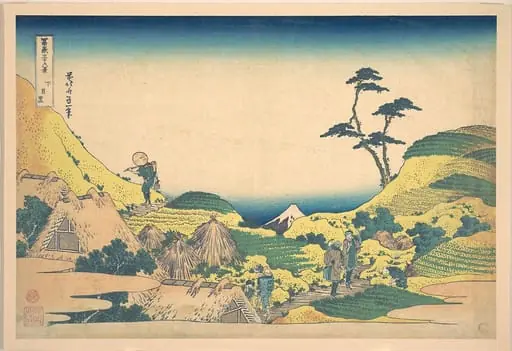 冨嶽三十六景 下目黒|Lower Meguro (Shimo Meguro), from the series Thirty-six Views of Mount Fuji (Fugaku sanjūrokkei)
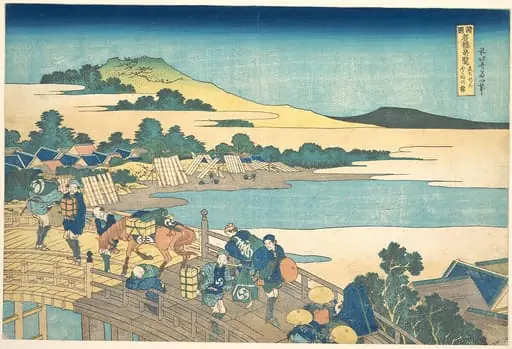 諸國名橋奇覧 ゑちぜんふくゐの橋|Fukui Bridge in Echizen Province (Echizen Fukui no hashi), from the series Remarkable Views of Bridges in Various Provinces (Shokoku meikyō kiran)
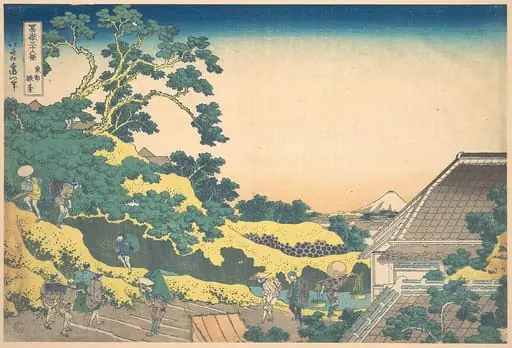 冨嶽三十六景 東都駿台|Surugadai in Edo (Tōto Sundai), from the series Thirty-six Views of Mount Fuji (Fugaku sanjūrokkei)
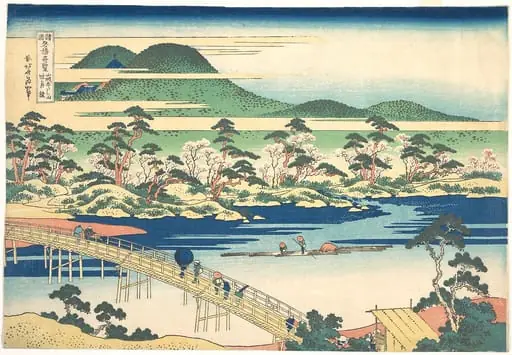 諸國名橋奇覧 山城あらし山吐月橋 |Togetsu Bridge at Arashiyama in Yamashiro, from the series Remarkable Views of Bridges in Various Provinces (Shokoku meikyō kiran)
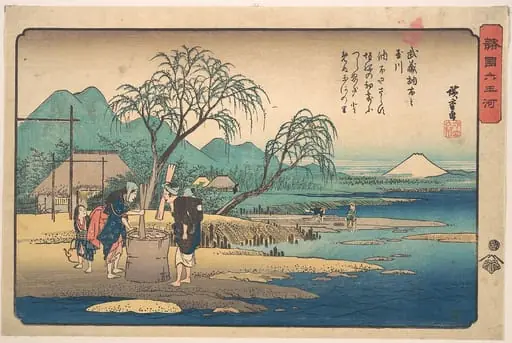 諸国六玉河 武蔵 調布の玉川|Musashi: Chōfu no Tamagawa
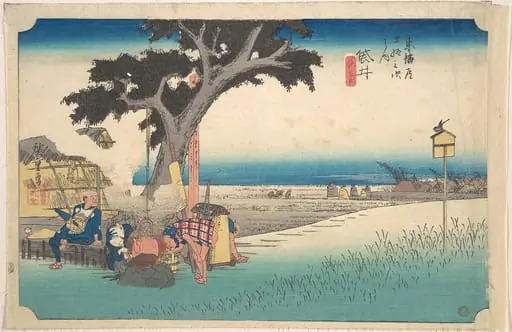 東海道五十三次之内 袋井 出茶屋の図|Fukuroi; De Chaya
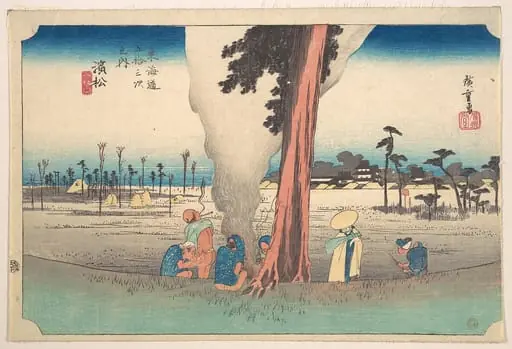 東海道五十三次之内 濱松 冬枯の図|Hamamatsu, Toko no Zu