Artwork
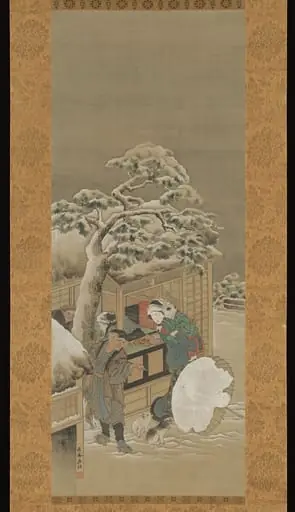
Women Carrying Pots for the Tsukuma Festival
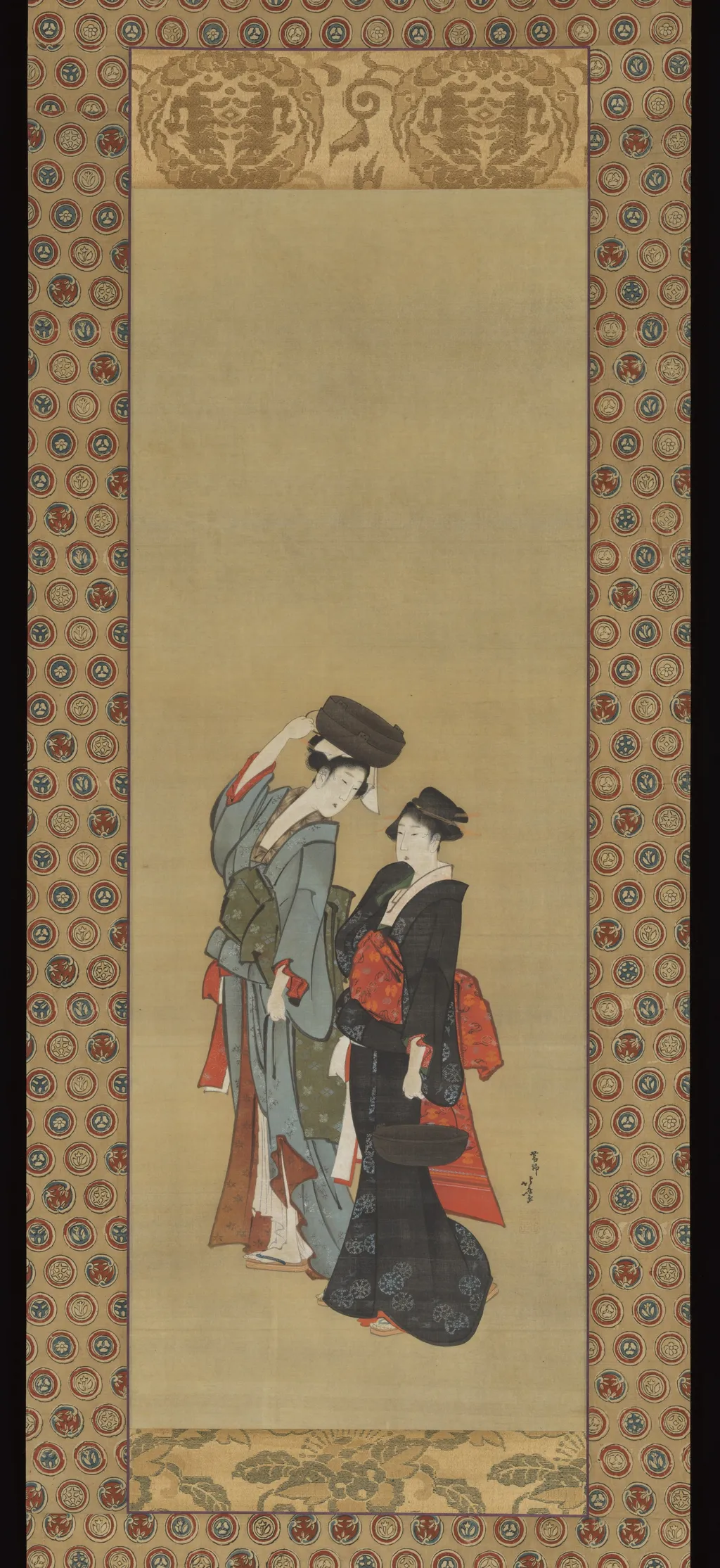
Women Carrying Pots for the Tsukuma Festival is an unspecified painting by the Ukiyo-e artist Katsushika Hokusai. It is held in the collection of the Metropolitan Museum of Art.
About this work
History & Provenance
The painting Women Carrying Pots for the Tsukuma Festival by Katsushika Hokusai is held in the collection of the Metropolitan Museum of Art. Created in 1881, the work is located at the museum's premises. While the piece is cataloged within the institution's holdings, the available records do not list a specific inventory number or detail any past exhibitions for this artwork.
Context
Scholarship emphasizes its technical mastery in depicting communal ritual through fluid brushwork and compositional balance characteristic of late Edo painting.
The work is situated within the final period of Hokusai's prolific career, when his focus shifted toward more intimate genre scenes alongside his celebrated landscape series. Scholarship emphasizes its technical mastery in depicting communal ritual through fluid brushwork and compositional balance characteristic of late Edo painting. The piece's presence in the Metropolitan Museum of Art collection underscores its significance as a representative example of ukiyo-e's evolving narrative scope beyond mere theatrical subjects.
Its creation in Japan during 1881 situates it within a transitional moment in Japanese art history, reflecting both traditional practices and emerging artistic sensibilities.
Overview
Katsushika Hokusai’s painting Women Carrying Pots for the Tsukuma Festival (1891) depicts a pair of women moving together in traditional attire. The work is part of the collection at the Metropolitan Museum of Art, where it is displayed as an example of late Edo‑period genre painting.
Subject & Meaning
The scene captures two female participants in the Tsukuma Festival, a local celebration that involved women transporting ceremonial vessels. One figure bears a red bundle on her back while the other supports a round container, suggesting a shared responsibility in the ritual procession.
Technique & Style
Hokusai renders the figures with flat, saturated hues of dark blue, green, and red, emphasizing the wide sleeves and tall hats characteristic of the period costume. The faces are reduced to minimal line work, and the background is largely empty, framed only by a repetitive border of red, blue, and gold circles that accentuate the composition’s decorative quality.
Artist & collection

Artist
Katsushika Hokusai spent his life in Edo, now Tokyo, where he drew and carved prints for a living.

 Untitled
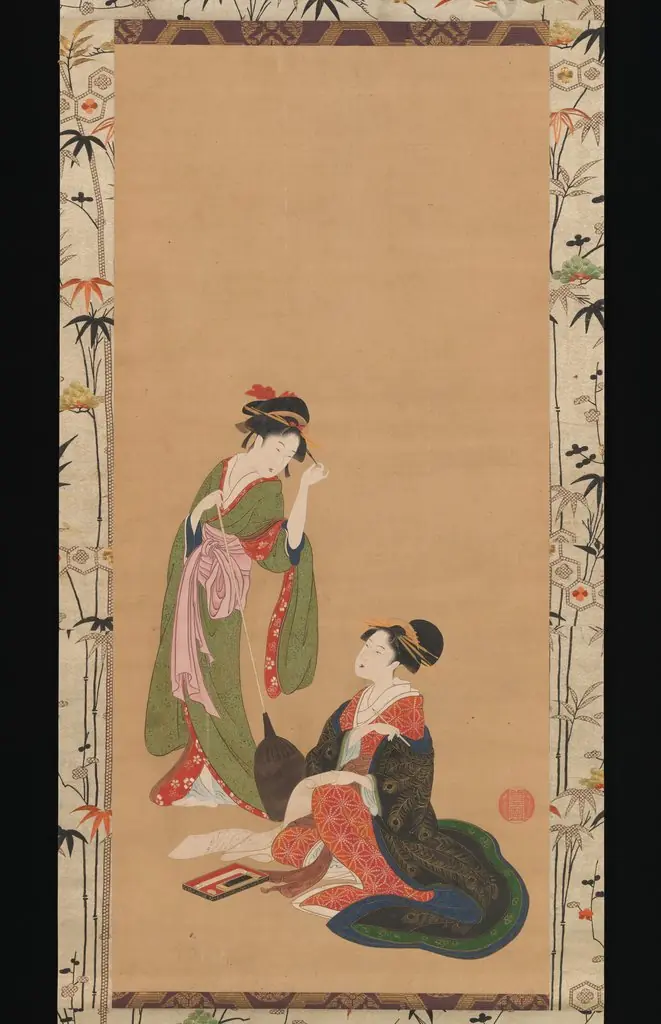 Courtesans Parodying Kanzan and Jittoku
 Untitled
 Two Women and a Puppy
 Untitled
 Courtesans and Attendants
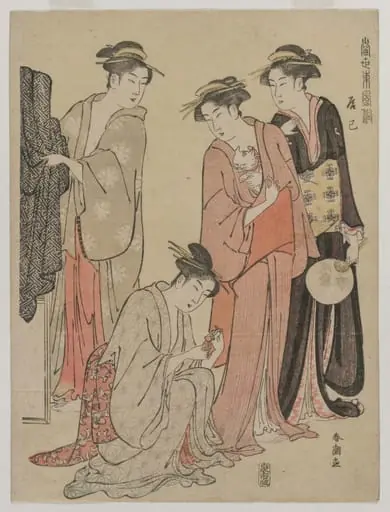
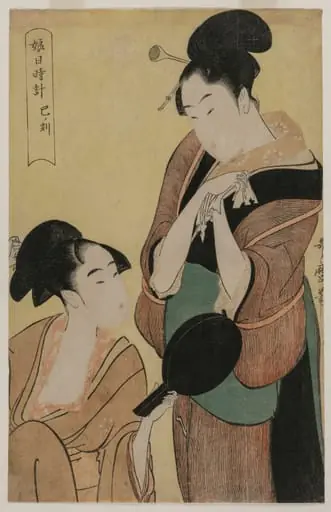 The Hour of the Snake (from the series A Clock for Young Women)
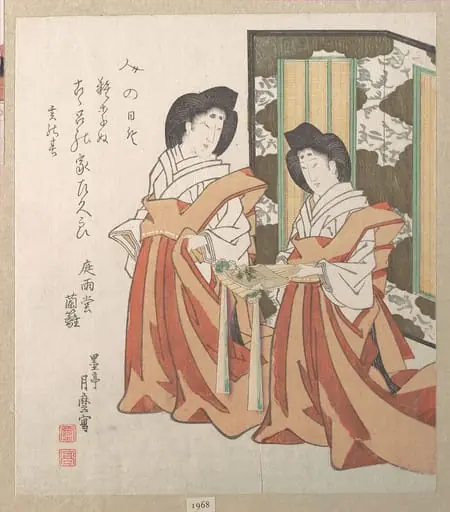 Untitled
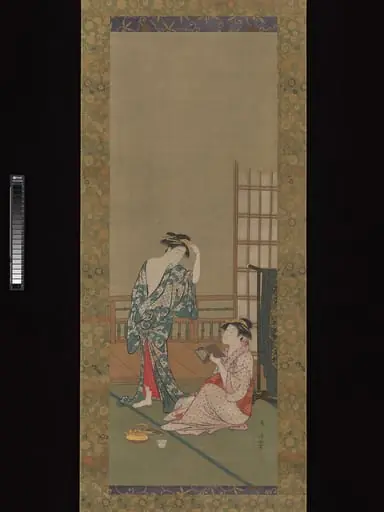 Untitled
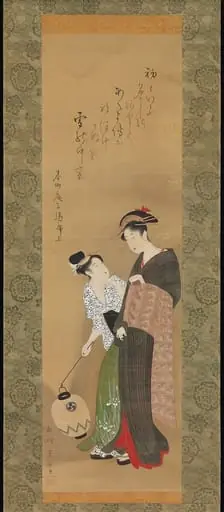 Untitled
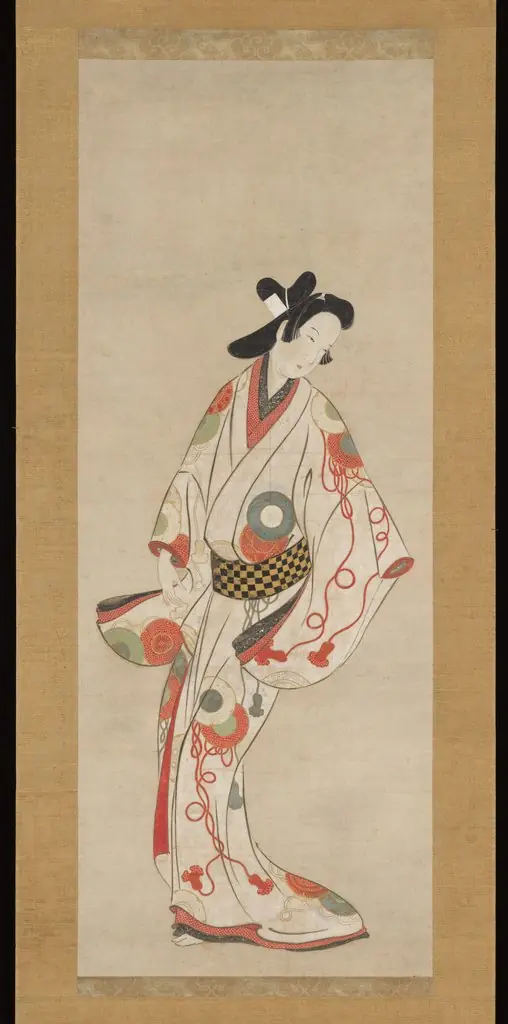 Elegantly Garbed Male Youth
- Women of the Tatsumi District (from the series Eastern Customs of the Present Day)