Artwork
Yellow Warbler
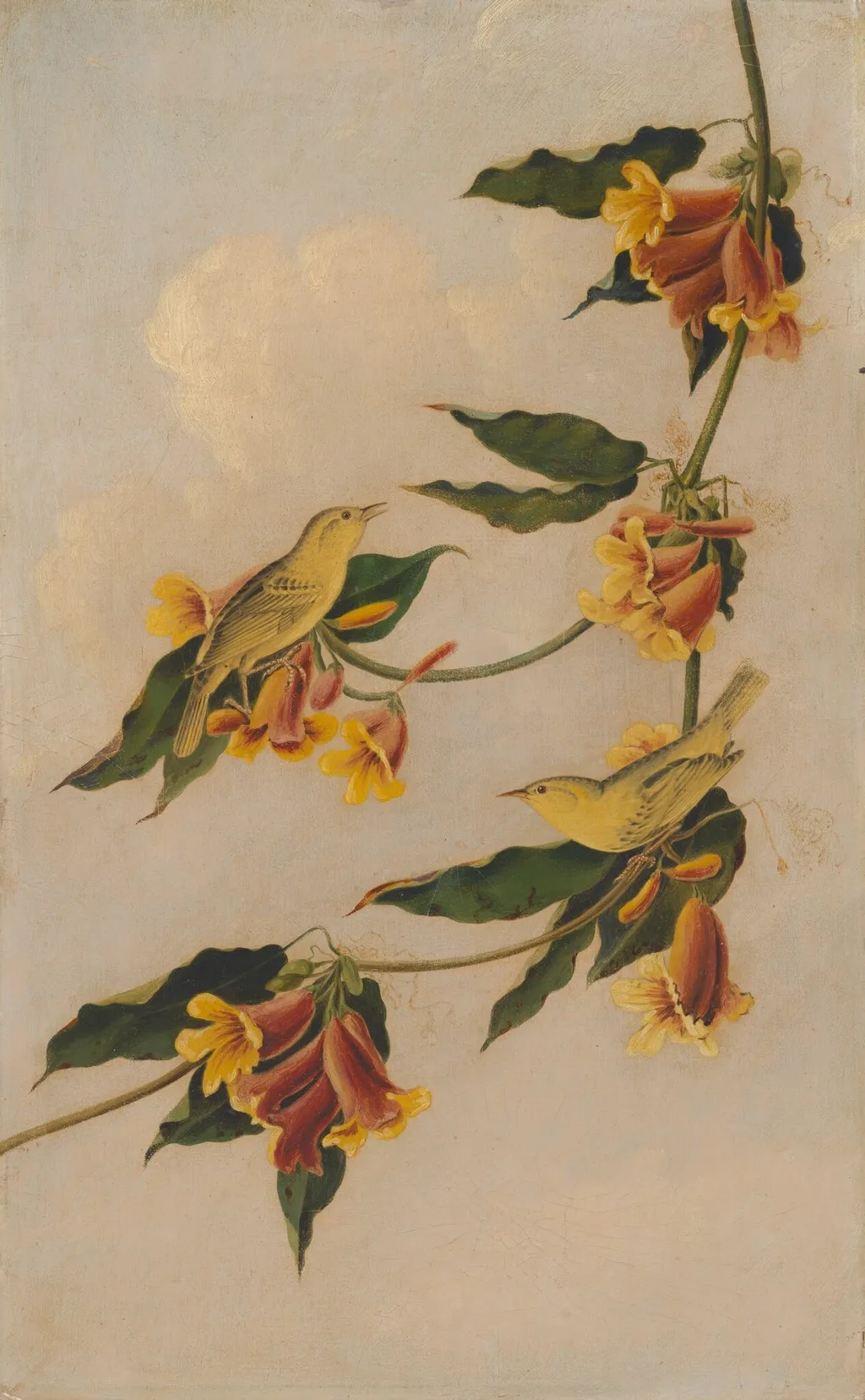
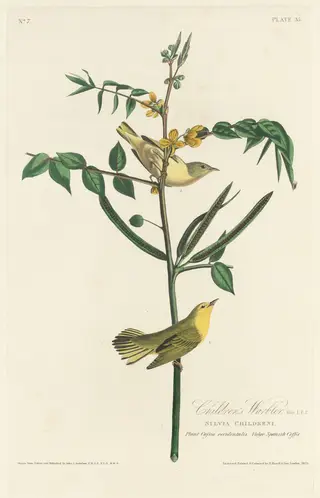
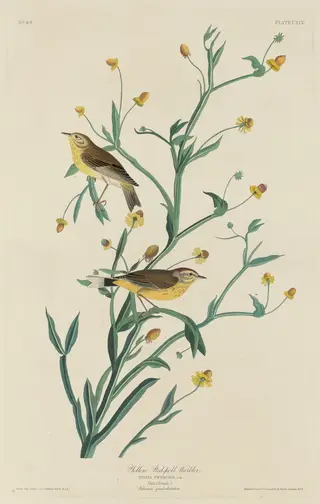
Yellow Warbler is an oil painting by the American Folk Art artist Joseph Bartholomew Kidd. It dates from 1832 and is held in the collection of the National Gallery of Art.
About this work
Subject & Meaning
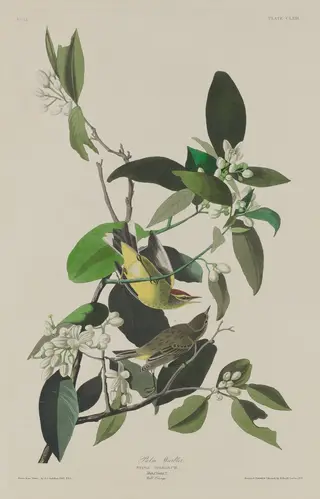
The work depicts an American Yellow Warbler perched among a tree and flowers, rendered in pencil and oil on millboard.
The work depicts an American Yellow Warbler perched among a tree and flowers, rendered in pencil and oil on millboard. Created in 1832 by Joseph Bartholomew Kidd, the painting focuses on the naturalistic representation of this specific avian species within its botanical environment. The piece serves as a precise ornithological study commissioned for John James Audubon; the sources do not provide explicit details regarding deeper symbolic meanings or allegorical iconography beyond the direct depiction of the bird and its habitat.
The artwork's primary significance lies in its detailed observation of the American Yellow Warbler, presented as a standalone subject rather than part of a larger narrative sequence.
Technique & Style
The work titled Yellow Warbler, painted by Joseph Bartholomew Kidd in 1832, is executed in pencil and oil on a millboard support, measuring approximately 48.2 cm by 29.7 cm. It forms part of the National Gallery of Art's collection in Washington, D.C. The composition portrays an American Yellow Warbler perched among a tree branch and a flower, rendered with fine linear detail and a naturalistic palette characteristic of early 19th-century scientific illustration. The piece was originally commissioned by John James Audubon and later passed through the Audubon family before being acquired by the National Gallery of Art.
History & Provenance
Created in 1832, Yellow Warbler is an oil and pencil work on millboard executed by Joseph Bartholomew Kidd and originally commissioned by John James Audubon. Following Audubon's death, the work remained within the family, descending to his great-grandson, Leonard Benjamin Audubon, who resided in Sydney, Australia. The piece traveled to Australia in the late 19th century, likely around 1899 or 1900 alongside other family paintings after the death of Caroline Hall Audubon.
In 1950, Leonard Benjamin Audubon sold the painting to E.J.L. Hallstrom, also of Sydney. The following year, in 1951, Hallstrom gifted the artwork to the National Gallery of Art in Washington, D.C., where it remains part of the permanent collection.
Overview
Joseph Bartholomew Kidd's Yellow Warbler, created in 1832, is a painting rendered in pencil and oil on millboard. This artwork presents an American Yellow Warbler perched on a flowering branch, alongside a flower and a tree. The composition balances a detailed, lifelike portrayal of the bird with a sense of understated simplicity, characteristic of natural history illustrations from the period.
Context
Working in the early 1800s, Joseph Bartholomew Kidd was part of a broader movement among artists to meticulously document flora and fauna. His practice emphasized scientific care in rendering natural subjects, moving beyond purely aesthetic representation to capture the specific characteristics of species. This dedication to accurate portrayal positions his work within the tradition of natural history illustration, contributing to a growing body of visual knowledge about the natural world.
Own this work as a print
Artist & collection