Artwork
Lumber Schooners at Evening on Penobscot Bay
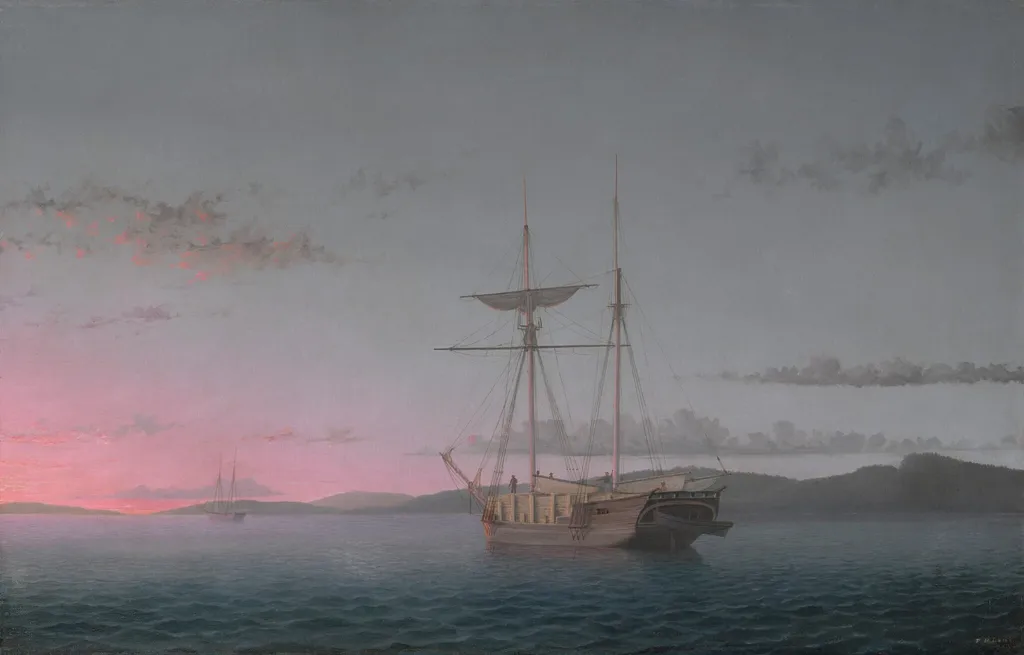
Lumber Schooners at Evening on Penobscot Bay is an oil painting by the Hudson River School artist Fitz Henry Lane. It dates from 1863 and is held in the collection of the National Gallery of Art.
- Inscription
- Inscribed:lower right: F. H. Lane / 1863
About this work
Subject & Meaning
The painting shows two lumber-laden schooners in Penobscot Bay at dusk.
The painting shows two lumber-laden schooners in Penobscot Bay at dusk. As a marine painting by Fitz Henry Lane, created in 1863, it belongs to the marine genre that traditionally documents coastal commerce and the region's seafaring heritage. The depiction of vessels loaded with timber underscores the importance of the lumber trade to New England's economy in the mid-nineteenth century, while the evening light and calm harbor convey a moment of transition, suggesting both the vitality and the waning of traditional sailing ships before industrial shipbuilding took hold.
Technique & Style
The work is an oil painting on canvas, a support typical of Fitz Henry Lane's marine subjects, created in 1863. Lane built up layered applications of oil paint to achieve the luminous, atmospheric light over Penobscot Bay for which his work is known. The composition renders the lumber schooners with careful attention to hull detail and reflected sky, reflecting the formal precision characteristic of his luminist marine painting.
History & Provenance
Lumber Schooners at Evening on Penobscot Bay was created by Fitz Henry Lane in 1863 as an oil on canvas. The earliest documented owner is Harvey Additon of Boston, who held it until about 1940. According to a letter of 9 September 1982 from Francis Hatch, Jr., in the NGA curatorial files, his father bought the work from Additon's store on LaGrange Street in Boston about forty years earlier, noting that Additon also sourced paintings for Maxim Karolik's collection.
The painting then passed to Mr. and Mrs. Francis Whiting Hatch, Sr., of Boston and Castine, Maine, who donated it to the National Gallery of Art in 1980, where it remains. No specific exhibition history is documented in the available sources.
Overview
Fitz Henry Lane's 'Lumber Schooners at Evening on Penobscot Bay' (1863) depicts two wooden sailing vessels resting on the tranquil waters of Maine's coast during twilight. The composition is defined by the artist's signature luminist style, characterized by a smooth, invisible brushwork that renders the water as a glass-like surface and the sky in soft, glowing hues of pink and gold. The larger schooner dominates the foreground with its sails furled, while a smaller vessel sits lower in the water, suggesting a heavy cargo of timber consistent with the region's dominant industry.
Lane executed this work late in his career, a period marked by an intensified focus on atmospheric effects and the serene stillness of the maritime environment. The painting captures a specific moment of industrial calm, where the commercial activity of the lumber trade is suspended in the quietude of the evening. By eliminating visible brushstrokes and emphasizing the precise geometry of the masts against the expansive sky, Lane elevates a mundane maritime scene into a meditation on light, space, and the enduring relationship between human enterprise and the natural landscape.
Context
Created in 1863, this painting reflects Fitz Henry Lane's deep engagement with the coastal landscapes of Maine during the mid-19th century. The presence of lumber schooners highlights the region's vital role in the timber industry, as these vessels were essential for transporting wood from Maine's forests to growing urban centers. Lane often depicted this interplay between nature and commerce.
Own this work as a print
Artist & collection
Artist
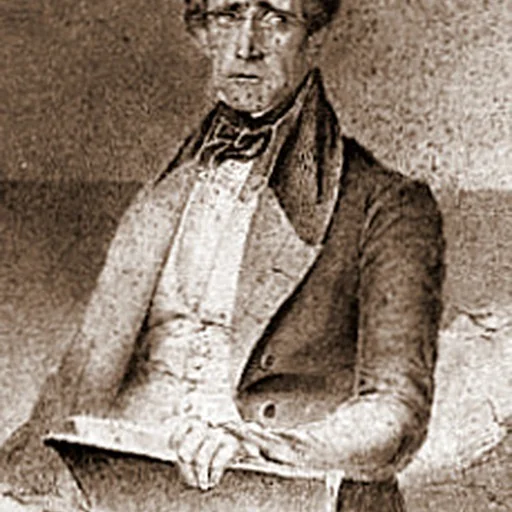
Fitz Henry Lane (born Nathaniel Rogers Lane; also formerly, mistakenly, known as Fitz Hugh Lane; December 19, 1804 – August 14, 1865) was an American painter and printmaker of a style that would later be called Luminism, for its use of…

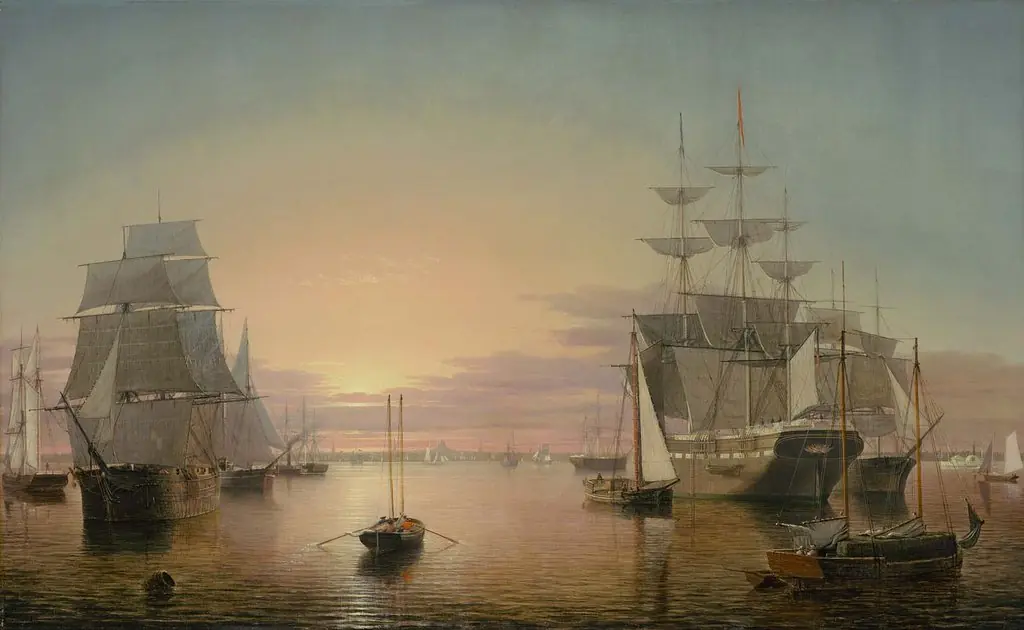 Boston Harbor
 Meri ja purjelaivoja
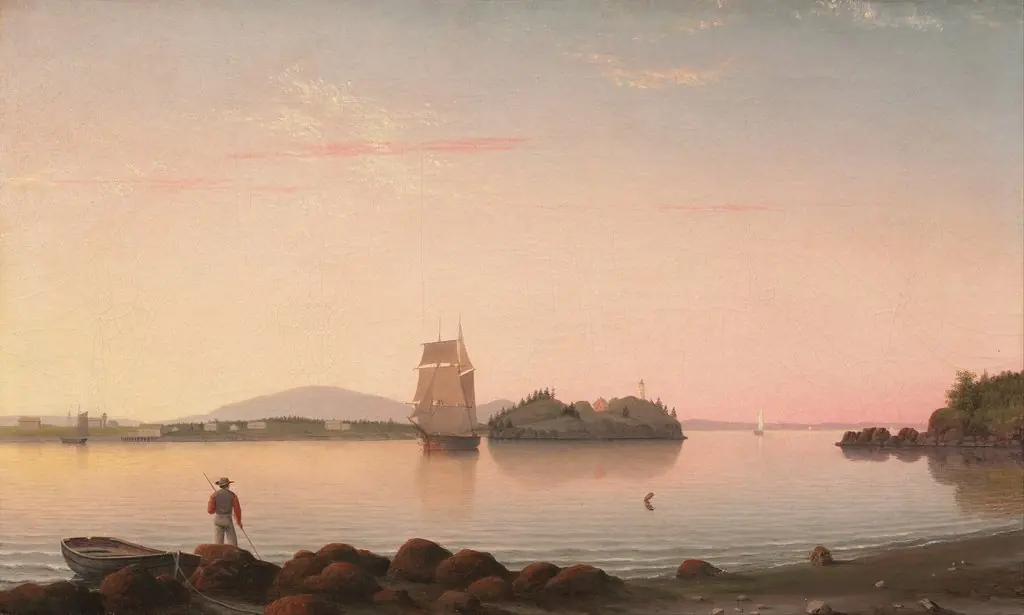 Owl's Head, Penobscot Bay, Maine
 The Corvette "Galathea" Lying to in order to Send Help to the Brig "St Jean"
 An American Naval Brig Lying at Anchor while Her Sails Are Drying
 Salem Harbor
 New York Harbor with Brooklyn Bridge
 Felsküste und Segelboote
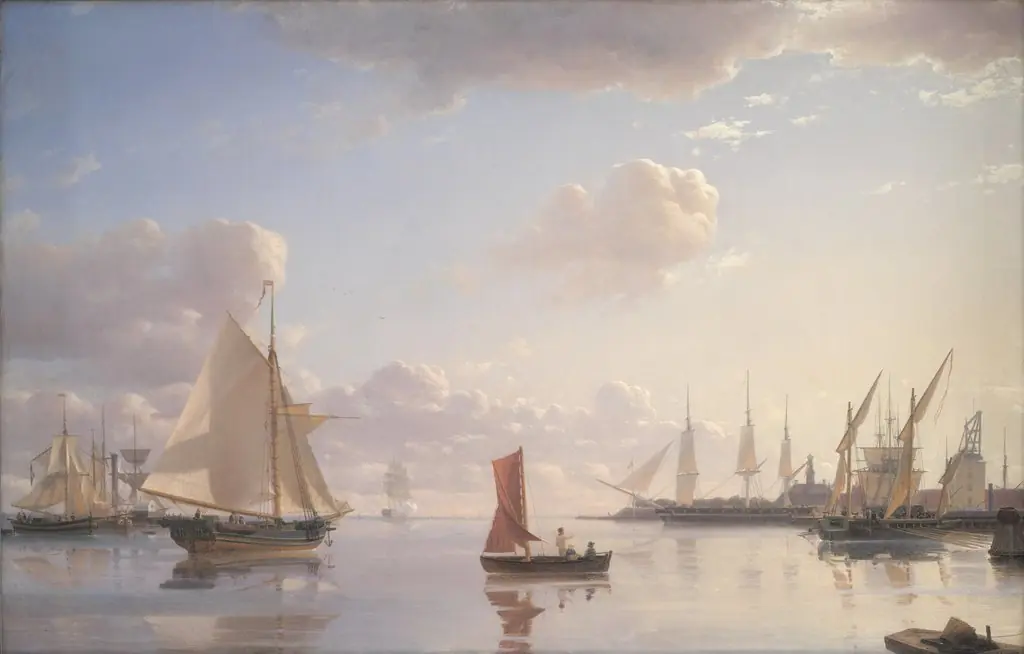 View from Langelinie towards the Royal naval Dockyards at Nyholm, Copenhagen. Morning Light
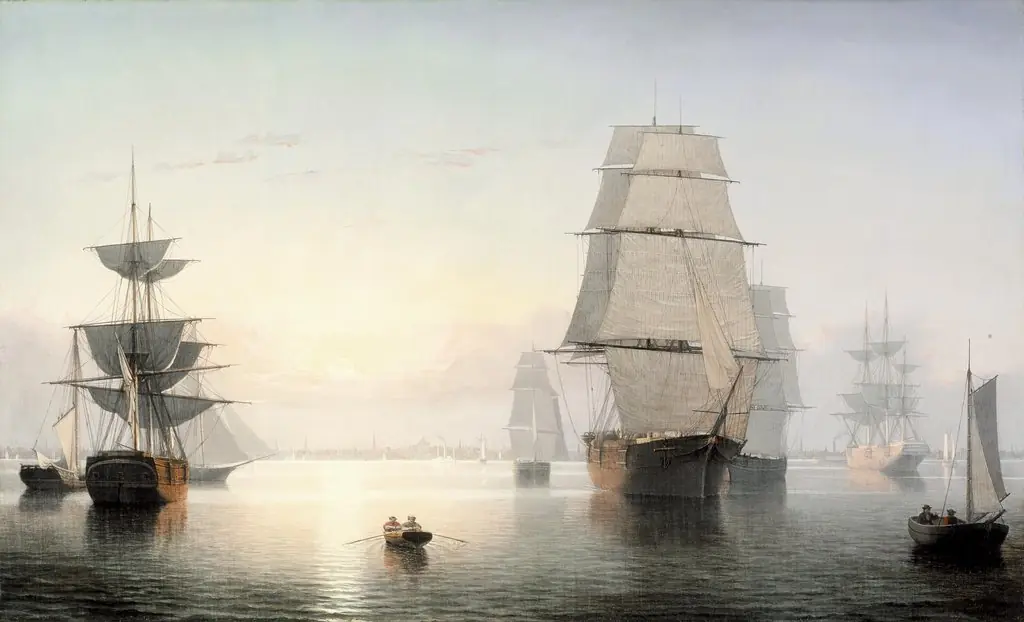 Boston Harbor, Sunset
 View from Langelinie towards the Royal naval Dockyards at Nyholm, Copenhagen. Morning Light