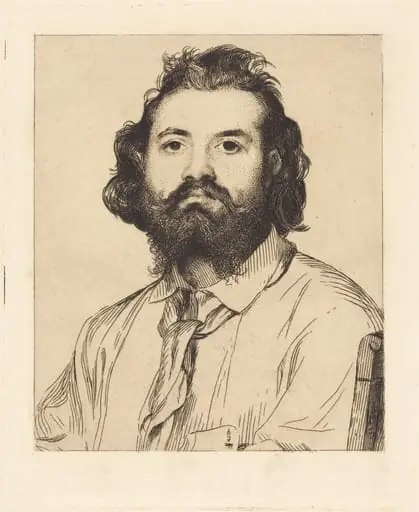
Artwork
Frederic Regamey
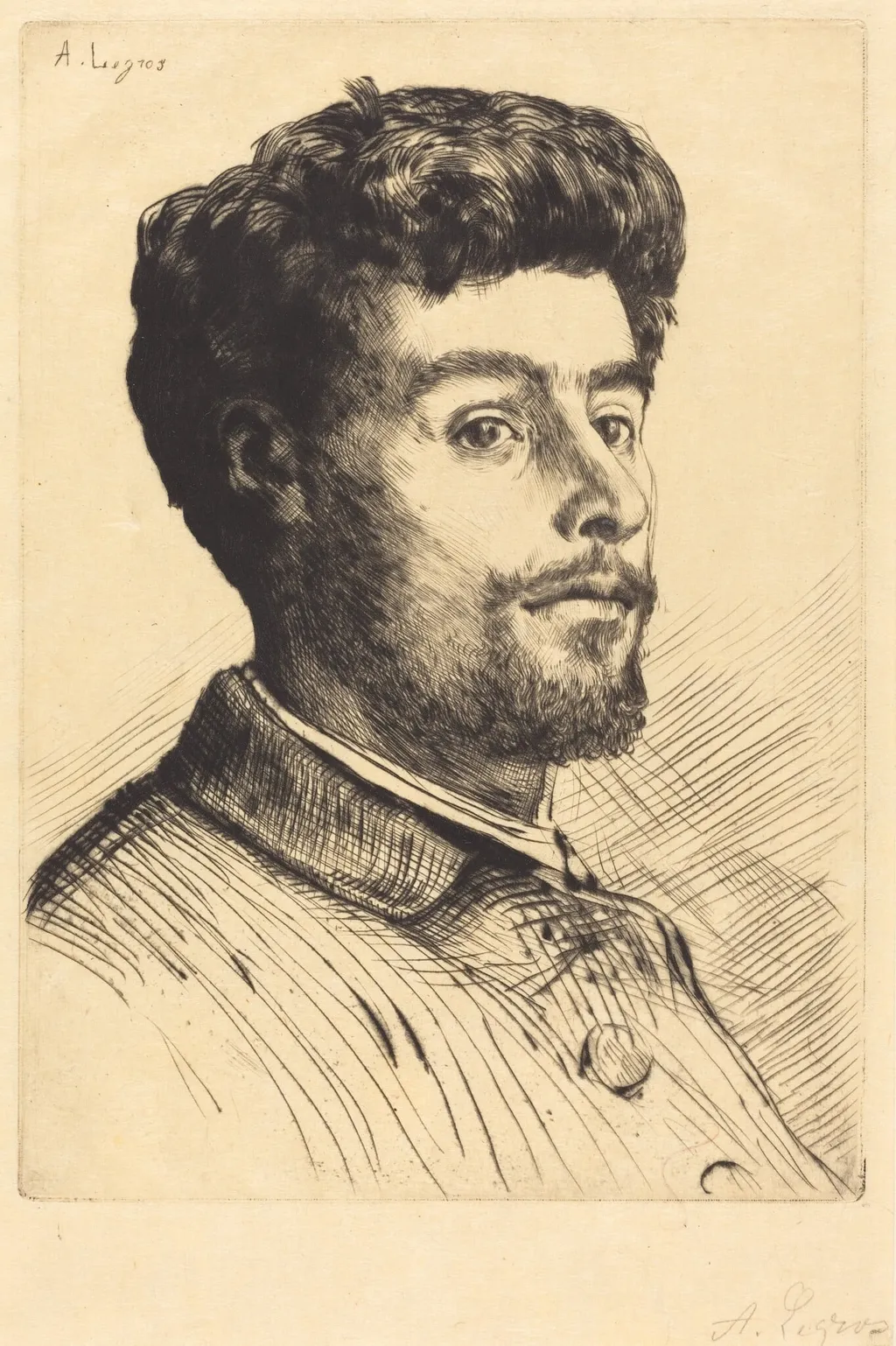
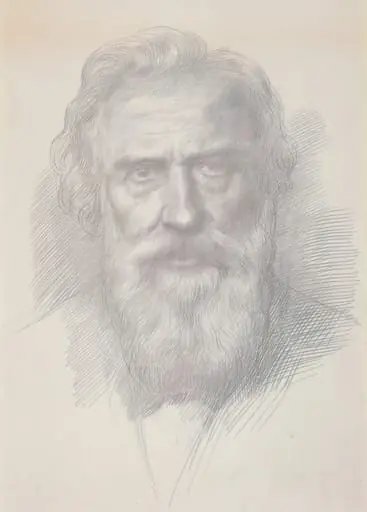
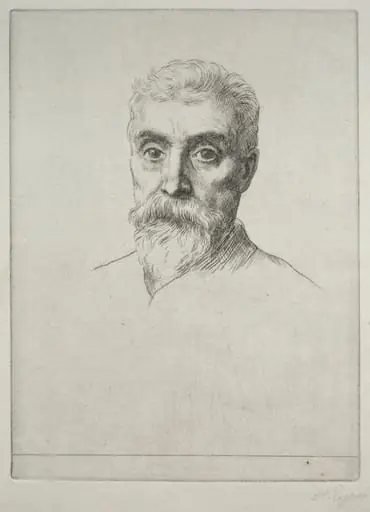
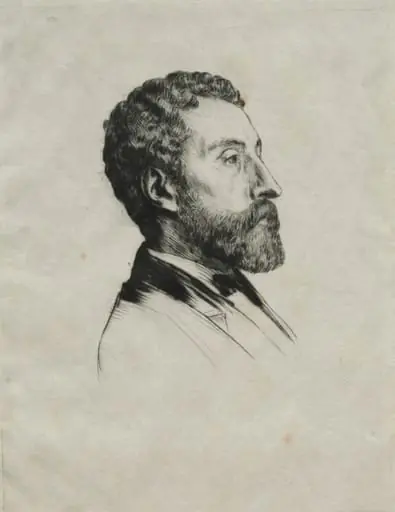
Frederic Regamey is an ink print by the Romanticist artist Alphonse Legros. It dates from 1874 and is held in the collection of the National Gallery of Art.
About this work
Overview
Created in 1874, Frederic Regamey is a drypoint print by Alphonse Legros, a French artist who settled in London in 1863. As part of the British etching revival, Legros used this intimate printmaking method to capture a portrait of a contemporary within his circle. The work reflects his commitment to direct, expressive line work and his role as a teacher shaping British printmaking practices.
Subject & Meaning
The subject, Frederic Regamey, was likely a member of Legros’s artistic network in London. The portrait presents him in a candid, unidealized manner, facing slightly away, beard and curls rendered with unpolished energy. There is no narrative or symbolism; the focus is on presence, not status. The immediacy of the image suggests a sitting observed closely, emphasizing character over formality.
Technique & Style
Shadows and contours are built through dense, irregular strokes rather than smooth contours, preserving the tactile quality of the mark.
Drypoint was chosen for its capacity to produce rich, scratchy lines that hold ink deeply. Legros applied the needle with urgency, leaving rough, uneven grooves that create a grainy texture across the paper. Shadows and contours are built through dense, irregular strokes rather than smooth contours, preserving the tactile quality of the mark. The surface retains the rawness of direct drawing, rejecting refinement in favor of perceptual honesty.
History & Provenance
The print emerged during Legros’s tenure at the Slade School of Fine Art, where he encouraged direct observation and technical experimentation. While specific early ownership records are sparse, the work aligns with his broader output of portraits and studies made for students and peers. Its survival reflects its value as an example of his pedagogical and artistic priorities in late 19th-century Britain.
Context
In the 1870s, British artists were re-engaging with etching as a serious medium, moving away from reproductive prints toward original, expressive work. Legros, trained in France but active in London, bridged continental precision with a more spontaneous, personal approach. This portrait fits within that shift, emphasizing the artist’s hand and the immediacy of the sitter’s likeness over polished finish.
Legacy
Frederic Regamey exemplifies Legros’s influence on a generation of British printmakers who valued directness and material truth. His use of drypoint as a tool for psychological observation, rather than decorative effect, helped redefine the genre. The print remains a quiet but significant document of artistic practice in Victorian London, valued for its unembellished realism.
Own this work as a print
Artist & collection

Artist
Alphonse Legros (French pronunciation:; 8 May 1837 – 8 December 1911) was a French, later British, painter, etcher, sculptor, and medallist.