Artwork
Bison-Dance of the Mandan Indians
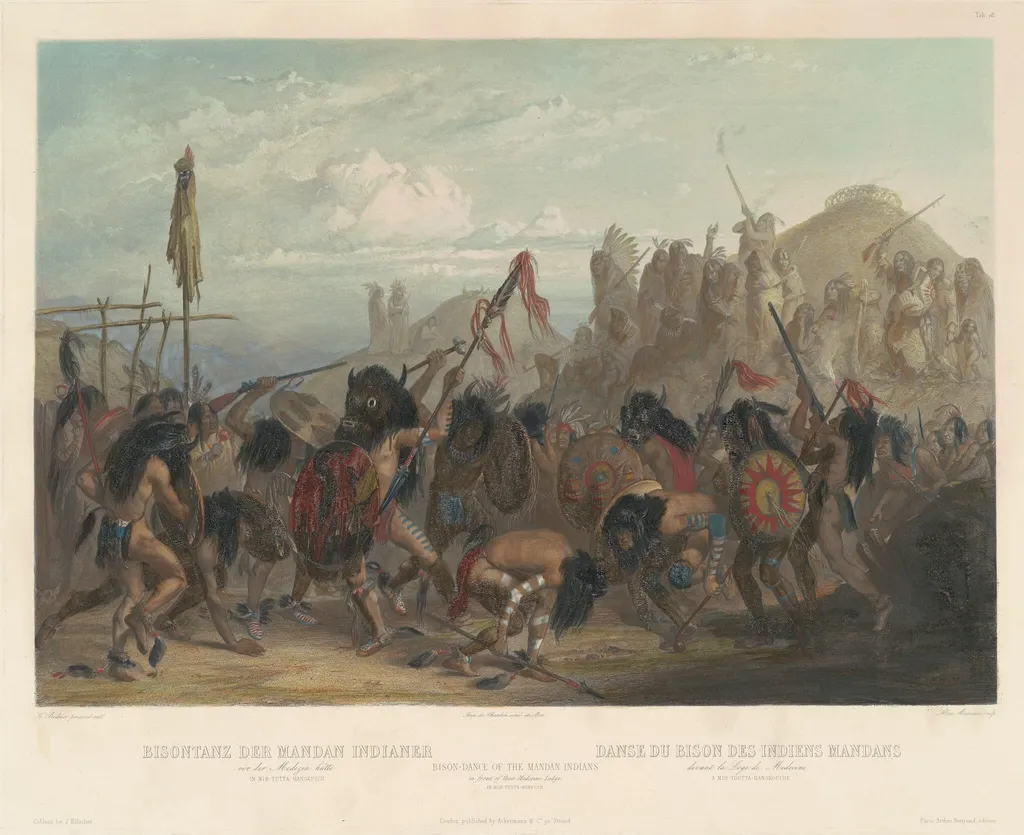
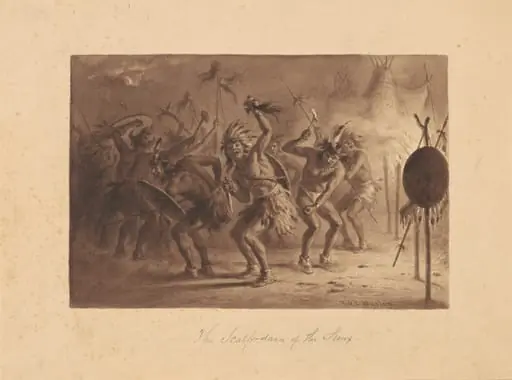
Bison-Dance of the Mandan Indians is an ink print by the Romanticist artist Alex Manceau. It dates from 1842 and is held in the collection of the National Gallery of Art. Created in 1842, this print depicts a ceremonial dance of the Mandan people centered around a fallen bison.
- Inscription
- Inscribed:text in plate: Tab. 18 / K. Bodmer pinx. ad nat / Imp. de Chardon ainé et Aze / Alex. Manceau sculp. / Bisontanz der Mandan Indianer / vor der Medezin hütte / in Mih-Tutta-Hangkusch / Bison-Dance of the Mandan Indians / in front of their Medecine Lodge. / in Mih-Tutta-Hankush / Danse du Bison des Indiens Mandans / devant la Loge de Medecine / a Mih-Toutta-Hangkouche. / Coblenz bei J. Hölscher / London, published by Ackermann & Co. 90. Strand. / Paris. Arthus Bertrand, éditeur
- Markings
- Marked:blindstamped lower center: C. Bodmer / Direct
About this work
Overview
Created in 1842, this print depicts a ceremonial dance of the Mandan people centered around a fallen bison.
Created in 1842, this print depicts a ceremonial dance of the Mandan people centered around a fallen bison. Executed through a combination of etching, aquatint, and mezzotint on wove paper, the work combines fine line work with tonal depth to render motion and texture. The artist, Alex Manceau, translated observed rituals into a layered printed image, emphasizing communal activity and ritual significance through dramatic composition and hand-coloring.
Subject & Meaning
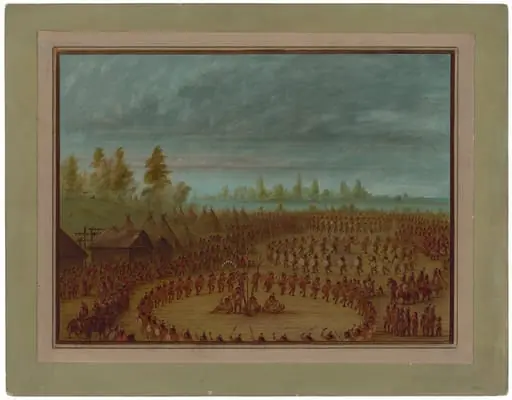
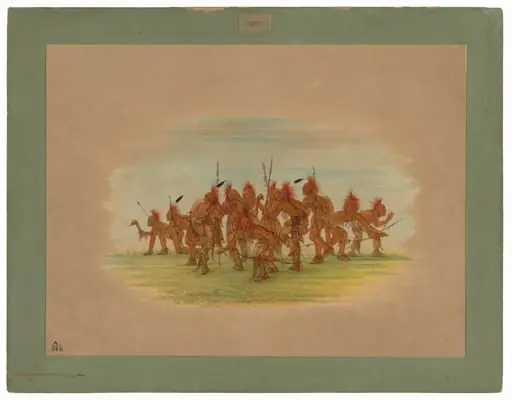
The scene portrays a Mandan ritual honoring the bison, a vital resource for sustenance and spiritual life. Dancers, adorned in animal hides and feathers, encircle the fallen animal, their gestures suggesting invocation, gratitude, or renewal. Figures on the hillside observe silently, reinforcing the communal and ceremonial nature of the event.
The inclusion of spears, shields, and flags hints at both practical and symbolic elements tied to the hunt and its ritual aftermath.
Technique & Style
Manceau employed etching for precise outlines, aquatint for soft gradations of tone, and mezzotint to achieve rich, velvety shadows. Hand-coloring added localized intensity to garments and sky, enhancing emotional resonance without overwhelming the print’s structure. The dynamic arrangement of figures and steeply receding background create a sense of depth and movement, characteristic of 19th-century ethnographic illustration aiming for both accuracy and visual impact.
History & Provenance
The print was produced in 1842, likely as part of a broader project documenting Indigenous cultures of the North American plains. Manceau, working from sketches or reports by travelers or explorers, translated these observations into a printed format for European audiences. Its survival in institutional collections suggests early interest in Native American ceremonial life, though the work’s origin remains tied to outsider interpretation rather than direct Mandan participation.
Context
In the early 1840s, European and American audiences were increasingly curious about Indigenous lifeways, often filtered through colonial lenses. This print emerged amid a surge in illustrated ethnographic publications, where visual representation served both scientific curiosity and romanticized narratives. While intended as documentation, the work reflects the artist’s interpretive choices and the limitations of secondhand observation, shaping perceptions of Mandan culture beyond its lived reality.
Legacy
The print remains a historical artifact of 19th-century visual ethnography, illustrating how non-Indigenous artists interpreted and mediated Native American rituals. Though not created by Mandan hands, it contributes to the visual record of Plains ceremonies and reveals the technical ambitions of printmakers seeking to capture cultural complexity. Today, it is studied for its artistic methods and as a document of cross-cultural representation during a period of rapid displacement and change.
Own this work as a print
Artist & collection