Artwork
Saint John the Evangelist
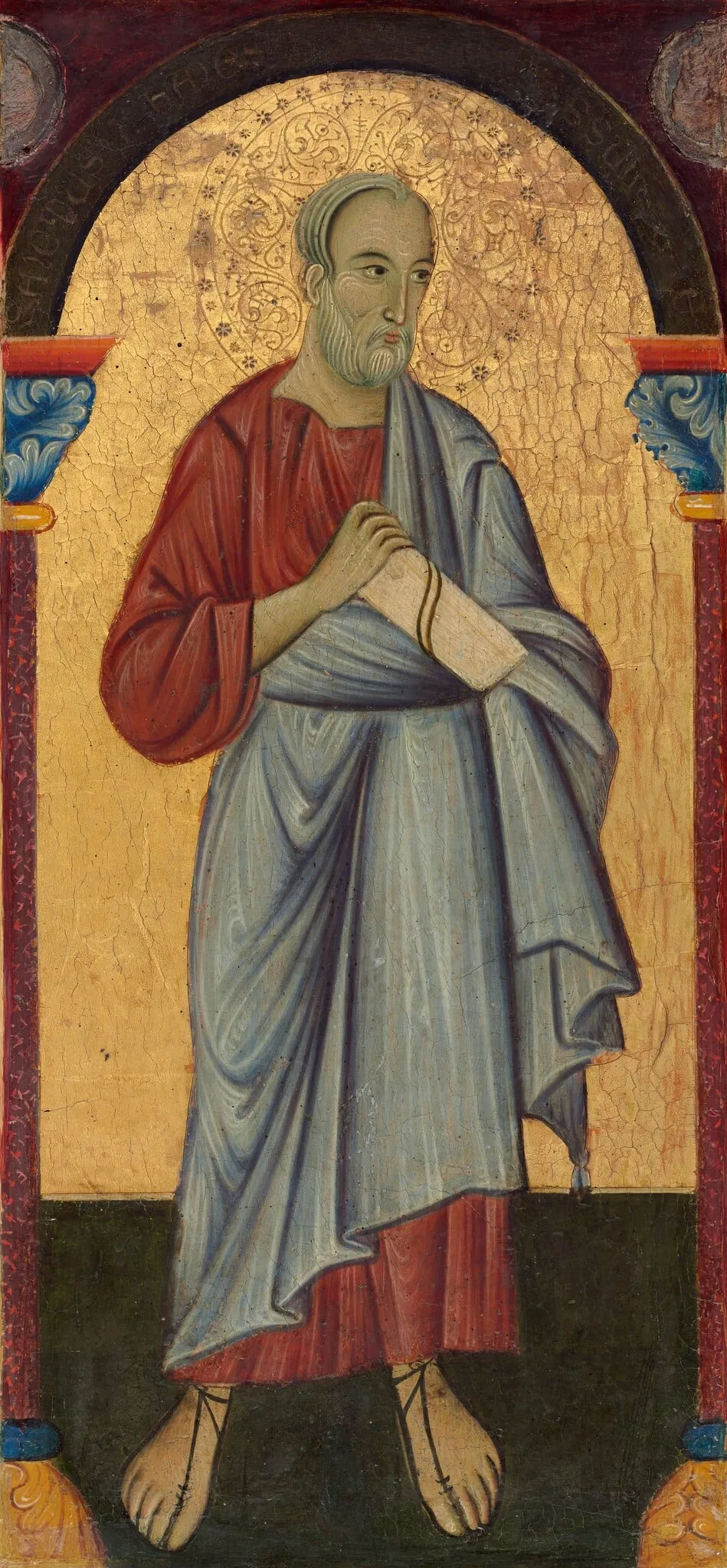
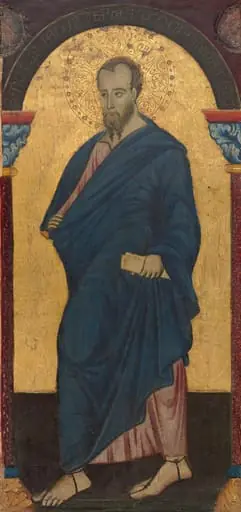
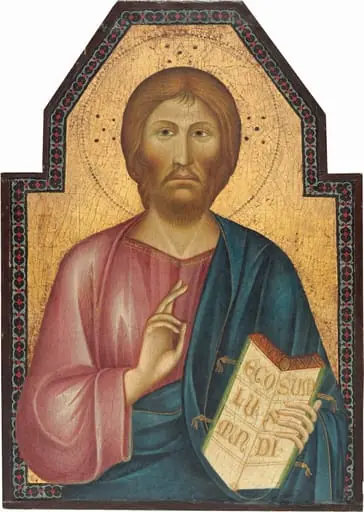
Saint John the Evangelist is a tempera painting by the Byzantine icon painting artist Master of Saint Francis. It dates from 1272 and is held in the collection of the National Gallery of Art.
- Inscription
- Inscribed:on the arch: SANCTVS I[O]HANES...SSUM...
About this work
Subject & Meaning
The panel depicts Saint John the Evangelist as a youthful apostle, identified by his traditional attributes.
The panel depicts Saint John the Evangelist as a youthful apostle, identified by his traditional attributes. He is shown holding a closed book, a reference to his authorship of the Fourth Gospel and the Book of Revelation, while a scroll bearing the opening words of his Gospel, "IN PRINCIPIO ERAT VERBVM," signals his role as the theologian of the divine Word. The figure’s serene expression and frontal pose emphasize his status as an inspired witness to Christ, aligning with medieval representations that stress contemplative insight over narrative detail.
The restrained palette and linear drapery of the Master of Saint Francis further underscore the sacred authority of the Evangelist within the context of a Franciscan altarpiece.
Technique & Style
The work is a tempera painting executed on a wooden panel, measuring 48.3 cm in height by 22.5 cm in width and dated to 1272. It belongs to the religious genre, depicting John the Evangelist as the main subject. The piece was created for the church of San Francesco al Prato in Perugia and later entered the Samuel H. Kress Collection, now housed at the National Gallery of Art in Washington, D.C. Its formal qualities reflect early Italian Gothic panel painting, characterized by a devotional composition and the use of tempera pigments on a flat wooden support. The painting’s condition is preserved within the museum’s collection, maintaining its original iconographic program and stylistic features.
History & Provenance
The panel of Saint John the Evangelist, executed in 1272 in tempera on wood, was originally created for the high altar of the Franciscan church of San Francesco al Prato in Perugia, where parts of the same altarpiece remained in 1793;[1] it likely remained in Perugia before entering the collection of Anton de Waal (1837–1917) in Rome, then passed to Paolo Paolini by 1921, and subsequently to Philip Lehman in New York by 1928; it was sold in June 1943 to the Samuel H. Kress Foundation and gifted to the National Gallery of Art in 1952. The work’s stylistic analysis and dating rely on the Master of Saint Francis attribution documented in scholarly sources.
Overview
This tempera painting, titled Saint John the Evangelist, was created around 1272 by the artist known as the Master of Saint Francis. The work depicts Saint John the Evangelist, a significant figure in Christian tradition. Executed on a small panel, its dimensions suggest it was likely intended for personal contemplation rather than public display.

Artist & collection

![Saint James Major [right panel], by Grifo di Tancredi](https://artifactworldgallery.com/img/grifo-di-tancredi--saint-james-major-right-panel--dc190378c0cddc8f-w320.webp)

![Saint Francis [far left panel], by Cosimo Tura](https://artifactworldgallery.com/img/cosimo-tura--saint-francis-far-left-panel--3b890eb4471ebc8a-w320.webp)