Artwork
The Mourning Saint John the Evangelist
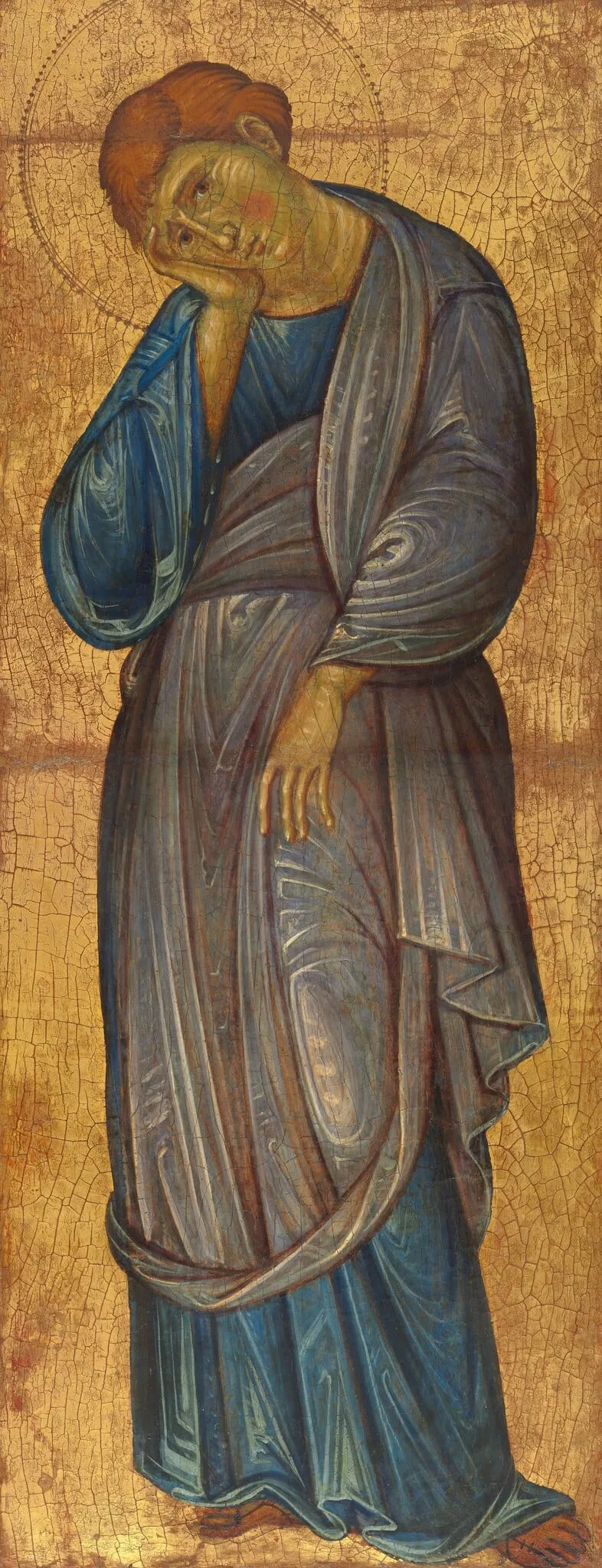
The Mourning Saint John the Evangelist is a tempera painting by the Byzantine icon painting artist Master of the Franciscan Crucifixes. It dates from 1272 and is held in the collection of the National Gallery of Art.
About this work
Saint John the Evangelist stands in plain robes, head bowed in grief. The Master of the Franciscan Crucifixes worked in tempera in the traditional style of the time, painting this around 1270 to 1275.
Subject & Meaning
The panel represents Saint John the Evangelist in a posture of mourning, his head bowed and hands clasped in grief.
The panel represents Saint John the Evangelist in a posture of mourning, his head bowed and hands clasped in grief. As the traditional witness to Christ’s Crucifixion, John’s sorrowful demeanor here underscores his role as the "disciple whom Jesus loved," a figure of both apostolic authority and human pathos. The fragmentary format, once part of a larger Crucifix’s lateral terminals, positions John as an attendant to the central agony of the Cross, emphasizing his presence at Calvary.
Iconographically, his youthful, beardless appearance and placement within a Franciscan context align with medieval typologies linking the Evangelist to the order’s devotional emphasis on Christ’s Passion. The work’s Franciscan provenance and the documented cult of the Bolognese Crucifix, reputedly consoling a repentant friar, suggest a programmatic intent: to evoke emotional engagement with sacred history through the Evangelist’s empathetic sorrow.
Technique & Style
The Mourning Saint John the Evangelist is executed in tempera on a wooden panel, a standard medium for Italian religious paintings of the late thirteenth century. Created circa 1270 by the Master of the Franciscan Crucifixes, the work survives as two distinct fragments that originally functioned as lateral terminals of a larger painted Crucifix. The support measures 81.2 centimeters in height and 31.1 centimeters in width.
Stylistically, the piece belongs to the religious genre and depicts the Evangelist John in a posture of mourning. The physical handling of the fragments indicates they were separated from their original context, likely when the parent Crucifix was moved to Santa Maria in Borgo in 1801 or during earlier disassembly. These surviving pieces retain their classification as significant examples of the Master's devotional output before entering the National Gallery of Art collection.
History & Provenance
The work, titled The Mourning Saint John the Evangelist, was created circa 1270 by the Master of the Franciscan Crucifixes as part of a Crucifix commissioned for the Lombardi Malvezzi Chapel in the church of San Francesco, Bologna, a commission documented between 1254 and 1278;[1] the painted panel formed a lateral terminal of that altarpiece, later removed when the Crucifix was moved to Santa Maria in Borgo in 1801;[3] the fragments remained in situ until they entered the collection of Osvald Sirén in Stockholm by 1922, then passed to Philip Lehman in New York by 1928, were acquired by the Samuel H. Kress Foundation in June 1943, and were gifted to the National Gallery of Art in 1952;[4] stylistic and documentary evidence places its execution in the late 13th century, aligning with the Master’s known activity around 1270.[2]
The Mourning Saint John the Evangelist is held in the National Gallery of Art, Washington, D.C., as part of the Samuel H. Kress Collection with inventory numbers NGA 1952.5.13 and NGA 1952.5.14. The two fragments were purchased by the Samuel H. Kress Foundation in June 1943 and gifted to the National Gallery of Art in 1952. The work's exhibition history traces its origins to a painted Crucifix likely made for the church of San Francesco, Bologna, between 1254 and 1278, later documented in the Lombardi Malvezzi Chapel in 1577.
It was moved to Santa Maria in Borgo, Bologna, in 1801 before being acquired by Osvald Sirén in Italy by 1922 and subsequently by Philip Lehman by 1928.
Overview
The Mourning Saint John the Evangelist is a tempera on panel painting created around 1272 by the artist known as the Master of the Franciscan Crucifixes. This religious work portrays Saint John the Evangelist with a solemn expression, reflecting the devotional art prevalent in Italy during the late 13th century. The piece exemplifies the artistic conventions of its era, offering insight into medieval Italian painting.
Context
Active during the 1260s and 1270s, the Master of the Franciscan Crucifixes is thought to have originated and trained in Umbria. His artistic output, including this depiction of Saint John, reflects the strong influence of Byzantine iconography that permeated Italian art during the late medieval period. This tradition provided a visual language for sacred subjects, shaping the devotional imagery produced across the peninsula.
Artist & collection
Artist
Master of the Franciscan Crucifixes
The Master of the Franciscan Crucifixes is the notname given to an Italian painter active in the 1260s and 1270s.

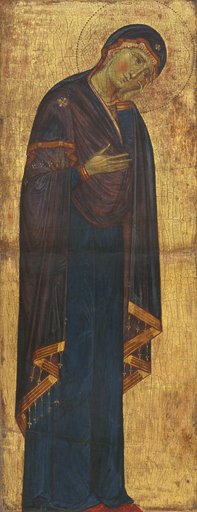
 The Mourning Madonna
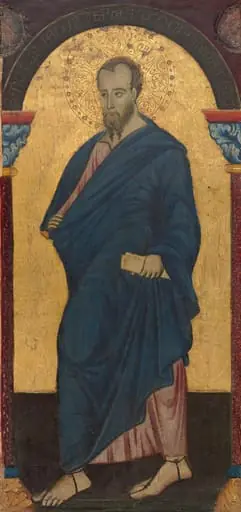 Saint James Minor
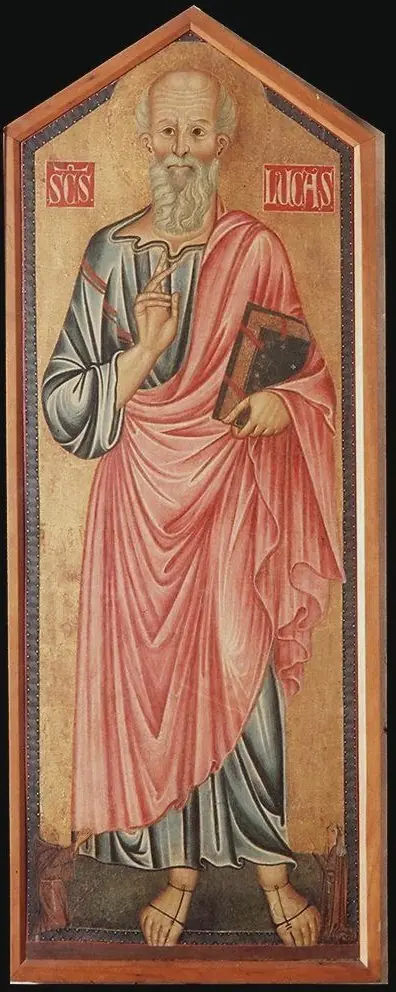 Saint Luke
 Detail
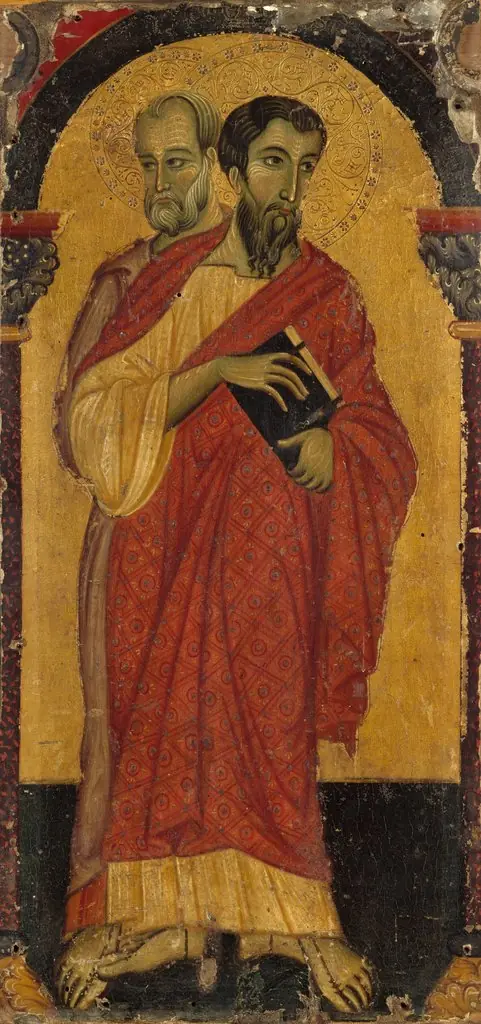 Saints Bartholomew and Simon
 Saint Peter
![Saint Francis [far left panel], by Cosimo Tura](https://artifactworldgallery.com/img/cosimo-tura--saint-francis-far-left-panel--3b890eb4471ebc8a-w320.webp) Saint Francis [far left panel]
Saint Francis [far left panel]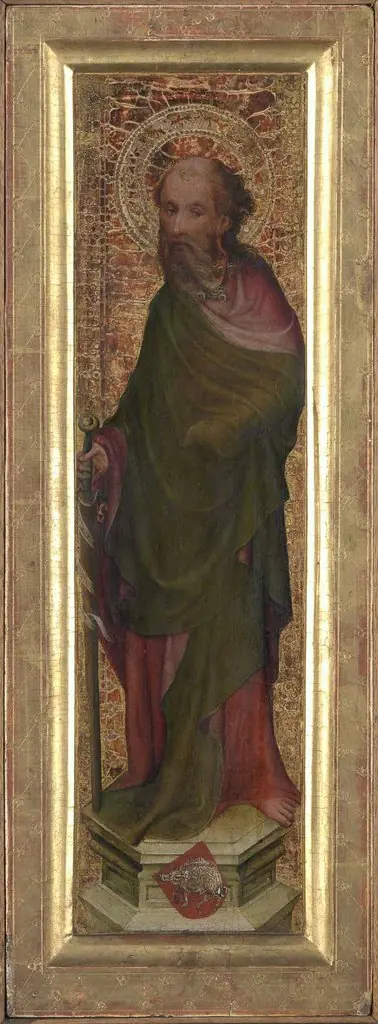 Hl. Paulus Rückseite: Hl. Reinoldus
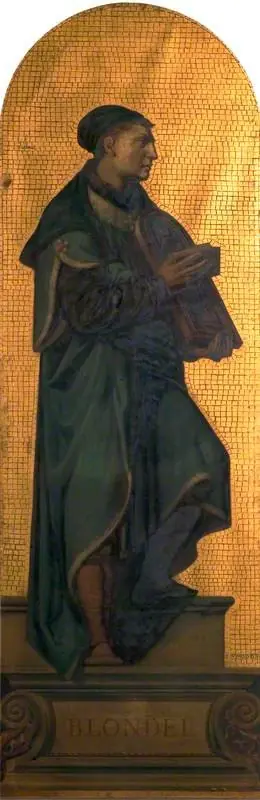 Lancelot Blondeel (1498–1561) (design for a mosaic in the Victoria and Albert Museum)
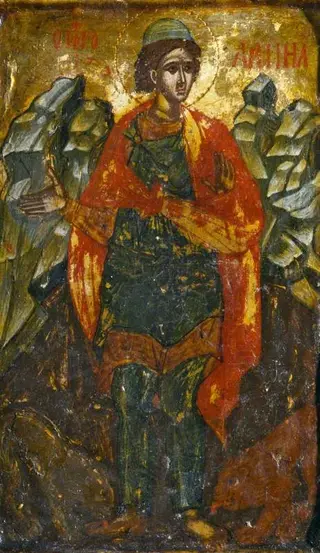 Daniel in the Lion's Den (one side of a two-sided panel)
![The Virgin Annunciate [middle right panel], by Cosimo Tura](https://artifactworldgallery.com/img/cosimo-tura--the-virgin-annunciate-middle-right-panel--9eeab22c5567995d-w320.webp) The Virgin Annunciate [middle right panel]
The Virgin Annunciate [middle right panel]- Saint John the Evangelist