Artwork
The Crucifixion
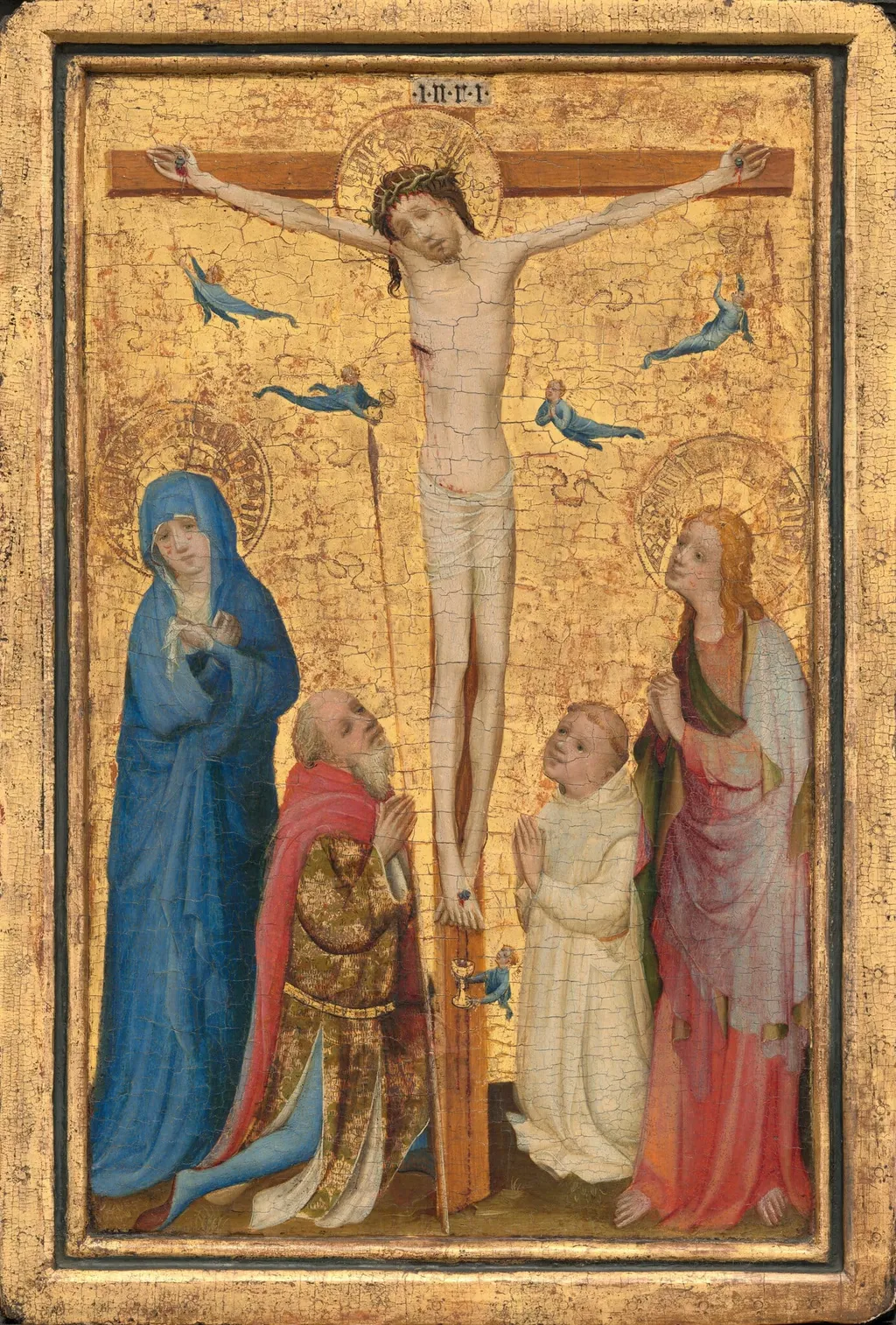
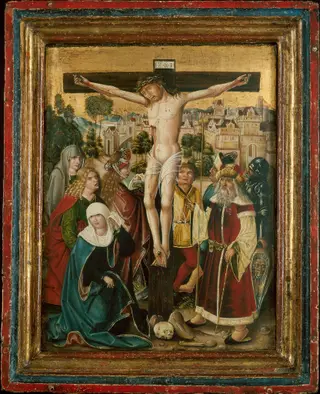
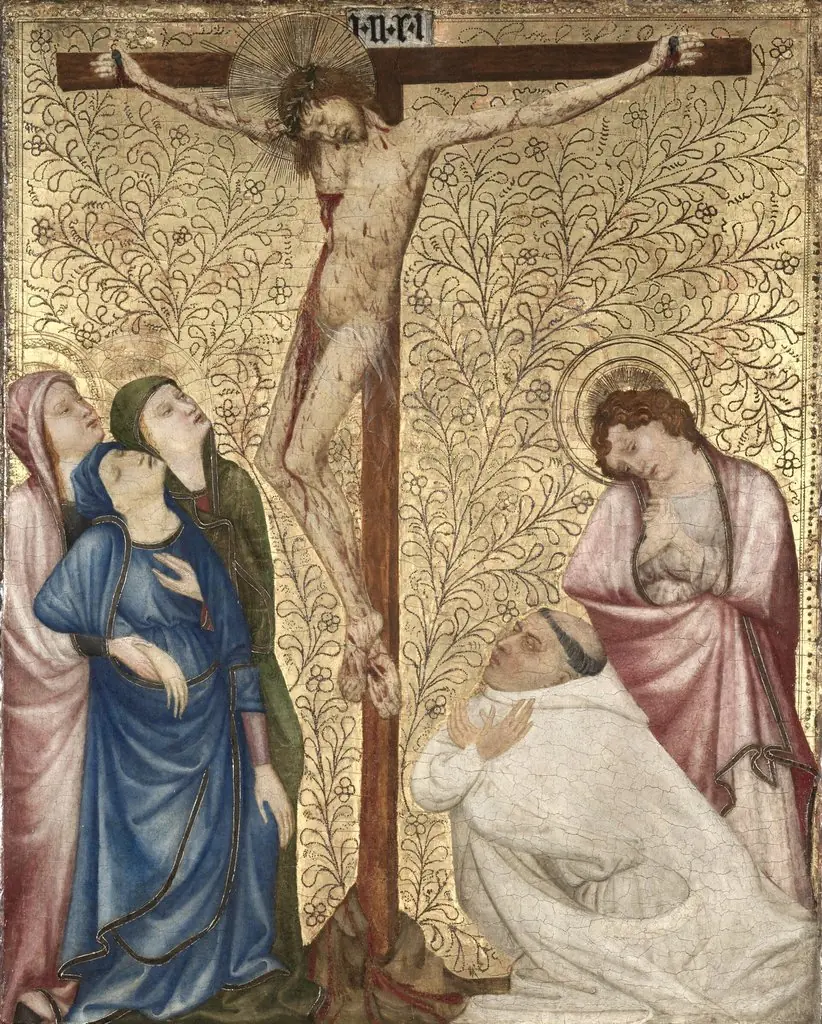
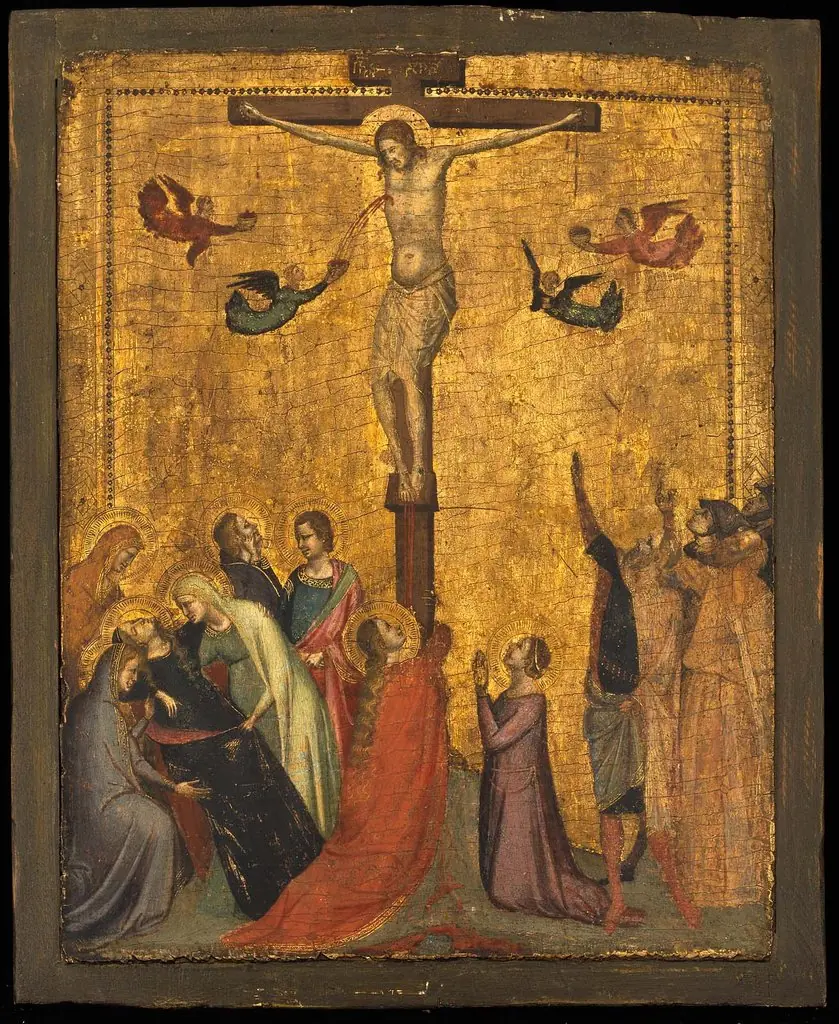
The Crucifixion is a tempera painting by the Northern Renaissance artist Master of Saint Veronica. It dates from 1405 and is held in the collection of the National Gallery of Art.
- Inscription
- Inscribed:at top of cross: I.N.R.I.; in Mary's halo: (possibly) salv [illegible] m[?]ar[?]ia:m[?]a; in Christ's halo: [illegible]; in John's halo: :s:Joha[illegible]:evia[illegible]
About this work
Jesus hangs on the cross with Mary and John below, set against a gold background. The colors are bright but the mood is grave. The Master of Saint Veronica worked in tempera, and fine brush strokes still show in the gold. Around 1405.
Subject & Meaning
Created around 1400 by the Master of Saint Veronica, this tempera on panel depicts the crucifixion of Jesus Christ as its central religious subject.
Created around 1400 by the Master of Saint Veronica, this tempera on panel depicts the crucifixion of Jesus Christ as its central religious subject. The work's iconography is defined by the solitary figure of Christ on the cross, a representation intended to facilitate deep spiritual engagement. Scholars suggest the painting was originally commissioned for the Carthusian monastery of Saint Barbara in Cologne, a context that heavily influences its meaning.
The Carthusian Order emphasized solitary contemplation and devotion, implying that this image served as a focal point for meditative prayer rather than public liturgical display. By focusing exclusively on the suffering of Jesus, the artwork aligns with the specific devotional practices of the charterhouse, encouraging viewers to reflect on the Passion in isolation. This intended function underscores the panel's role as an instrument for personal piety within the monastic environment of late medieval Cologne.
Technique & Style
Created around 1400 by the Master of Saint Veronica, this work is executed in tempera on a wooden panel. The painting measures 46.2 cm in height and 31.1 cm in width. As a piece of religious art, it depicts the Crucifixion of Jesus Christ.
The application of tempera on panel was a standard technique for devotional images of this period in Cologne, where the artist was active. The compact dimensions suggest the panel was intended for private contemplation, possibly within a monastic setting such as the Charterhouse of Saint Barbara. While specific details regarding surface condition or handling history are not explicitly detailed in the available records, the work's survival as a standalone panel indicates it has been preserved through various collections since the early twentieth century.
History & Provenance
Dated to circa 1400, this tempera on panel by the Master of Saint Veronica may have originally been commissioned for the Carthusian monastery of Saint Barbara in Cologne, a theory proposed by Eisler based on the artist's local activity and the monastery's construction campaigns between 1391 and 1405. If located there, the work likely remained until the monastery's dispersal in 1794. The first confirmed owner is Richard von Schnitzler of Cologne, who possessed the painting by 1917 until at least 1931.
It subsequently entered the inventory of Pinakos, Inc., operated by Rudolf Heinemann, before being sold to M. Knoedler & Co. in New York in 1953. The Samuel H. Kress Foundation purchased the work in 1954 and ultimately gifted it to the National Gallery of Art in Washington, D.C., in 1961.
Context
The Crucifixion is a tempera panel painting attributed to the Master of Saint Veronica, dated circa 1400 and depicting the crucifixion of Jesus. Scholars suggest it may have originated in the Carthusian monastery of St. Barbara in Cologne, a site linked to the artist’s activity and to the order’s contemplative devotion. Its provenance traces from Richard von Schnitzler through the dealer Knoedler to the Samuel H. Kress Foundation, which donated it to the National Gallery of Art in 1961.
The work is situated within early Netherlandish religious painting, reflecting Cologne’s artistic milieu and the devotional practices of late‑medieval Carthusian communities, informing both the artist’s broader context and the painting’s significance in art‑historical narratives.
Overview
The painting titled "The Crucifixion" is a religious work executed in tempera on panel, attributed to the artist known as the Master of Saint Veronica. Created around 1405, this artwork depicts the central Christian narrative of Jesus Christ's crucifixion, a pivotal event in Christian theology. It represents a significant example of early 15th-century devotional art.
Legacy
This painting is attributed to the Master of Saint Veronica, an unidentified artist active in the early 15th century whose distinctive style is recognizable across their body of work. "The Crucifixion" exemplifies the consistent artistic characteristics that define this master's oeuvre, contributing to the visual language of religious painting during a transitional era in art history.
Own this work as a print
Artist & collection