Artwork
Balmes House
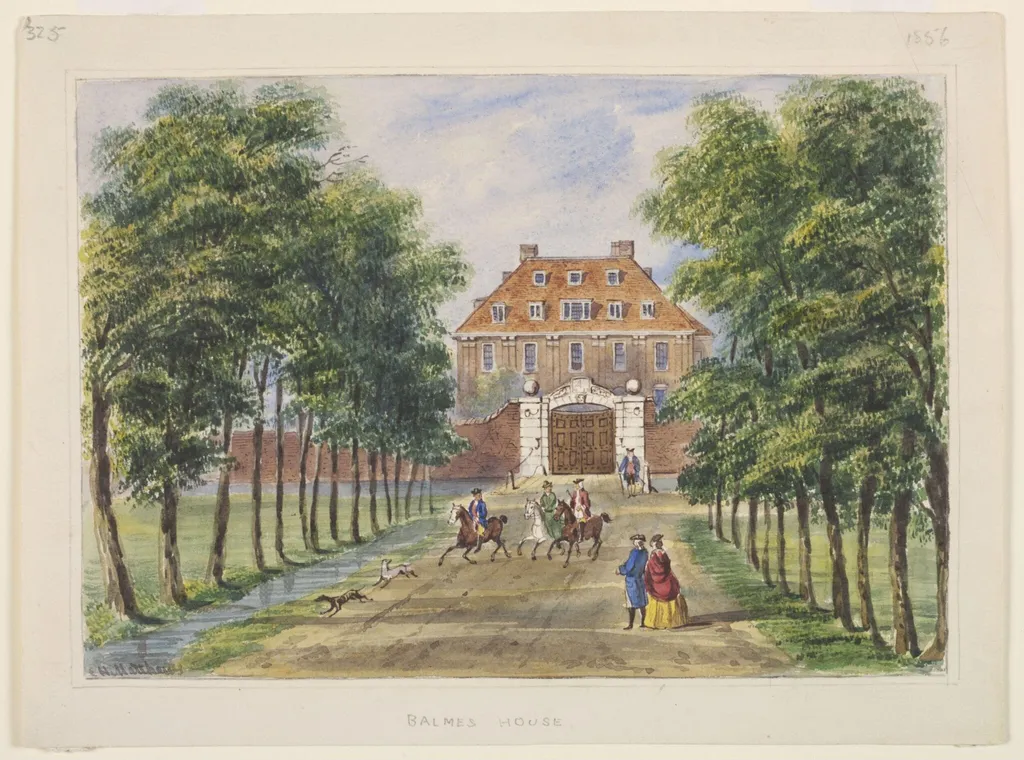
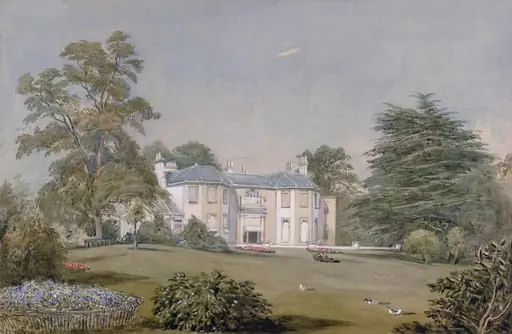
Balmes House is a watercolor work on paper by the Biedermeier artist E H Matthews. It dates from 1855 and is held in the collection of the Victoria and Albert Museum.
About this work
Overview
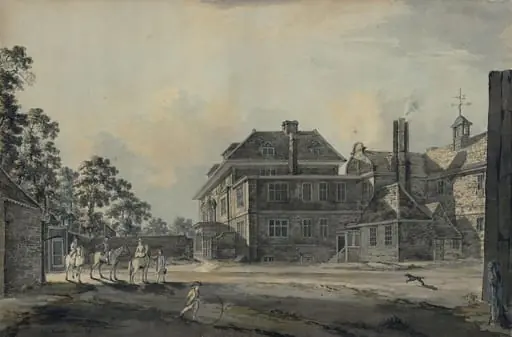
Figures in period dress move quietly through the scene, some walking, others on horseback, adding subtle life without disrupting the calm atmosphere.
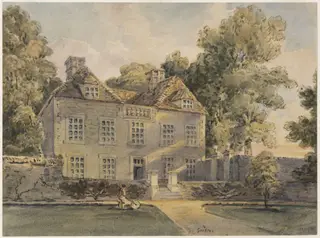
This watercolour captures the south façade of Balmes House in Hoxton, rendered with delicate brushwork and muted tones. The composition centers on the brick structure with a red-tiled roof, framed by tall trees and a winding path leading to its entrance. Figures in period dress move quietly through the scene, some walking, others on horseback, adding subtle life without disrupting the calm atmosphere.
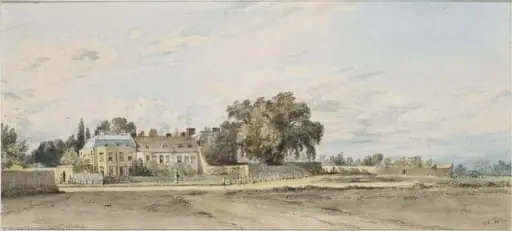
The work belongs to a collection of topographical records of London, valued for its observational precision rather than dramatic flair.
Subject & Meaning
The scene presents an unremarkable moment of daily life in late 18th-century Hoxton, avoiding grandeur in favor of quiet domesticity. The presence of pedestrians and equestrians near the house’s gate suggests the property’s accessibility to the local community, perhaps as a residence for the gentry. The absence of architectural emphasis or narrative drama implies the artist’s intent was documentation rather than commentary, preserving a slice of ordinary urban existence.
Technique & Style
Executed in transparent watercolour, the piece relies on light washes and soft edges to convey atmosphere. The sky is rendered with faint blue gradients, while foliage is suggested through loose, layered strokes rather than detailed rendering. Figures are minimally defined, their forms implied by posture and silhouette.
The technique prioritizes harmony and subtlety, avoiding bold contrasts to maintain a serene, observational tone consistent with topographical traditions of the period.
History & Provenance
The work was once part of John Edmund Gardner’s collection of London topographical drawings, assembled for its historical value. After passing through private hands, segments focused on Hoxton and nearby areas were gathered by the Hon. Arthur Villiers, who donated them to the Bethnal Green Museum in the late 19th century. This transfer ensured the preservation of local visual records, aligning with broader efforts to document London’s evolving urban fabric.
Context
During the late 1700s, Hoxton was transitioning from a rural outskirts district to a suburban enclave for London’s middle and upper classes. Balmes House, like many such residences, stood as a symbol of this shift. Topographical watercolours of this era served as visual archives, capturing the appearance of buildings and landscapes before rapid urbanization altered them. This piece reflects a moment of relative stillness before industrial expansion transformed the area.
Legacy
The watercolour remains a quiet testament to the value placed on local topography in 19th-century collecting practices. Its inclusion in the Bethnal Green Museum’s holdings, later absorbed into the Victoria and Albert Museum, ensured its survival as part of a larger archive of London’s architectural and social history. Though unassuming, it contributes to an understanding of how everyday spaces were observed, recorded, and preserved by contemporaries.
Own this work as a print
Artist & collection
Artist
E H Matthews painted delicate watercolors in the mid-1800s. One untitled piece from 1856 shows fine lines and soft washes of color, typical of early British watercolor traditions. Their work sits in that quiet space…