Artwork
Meeting of St Erasm and St Maurice
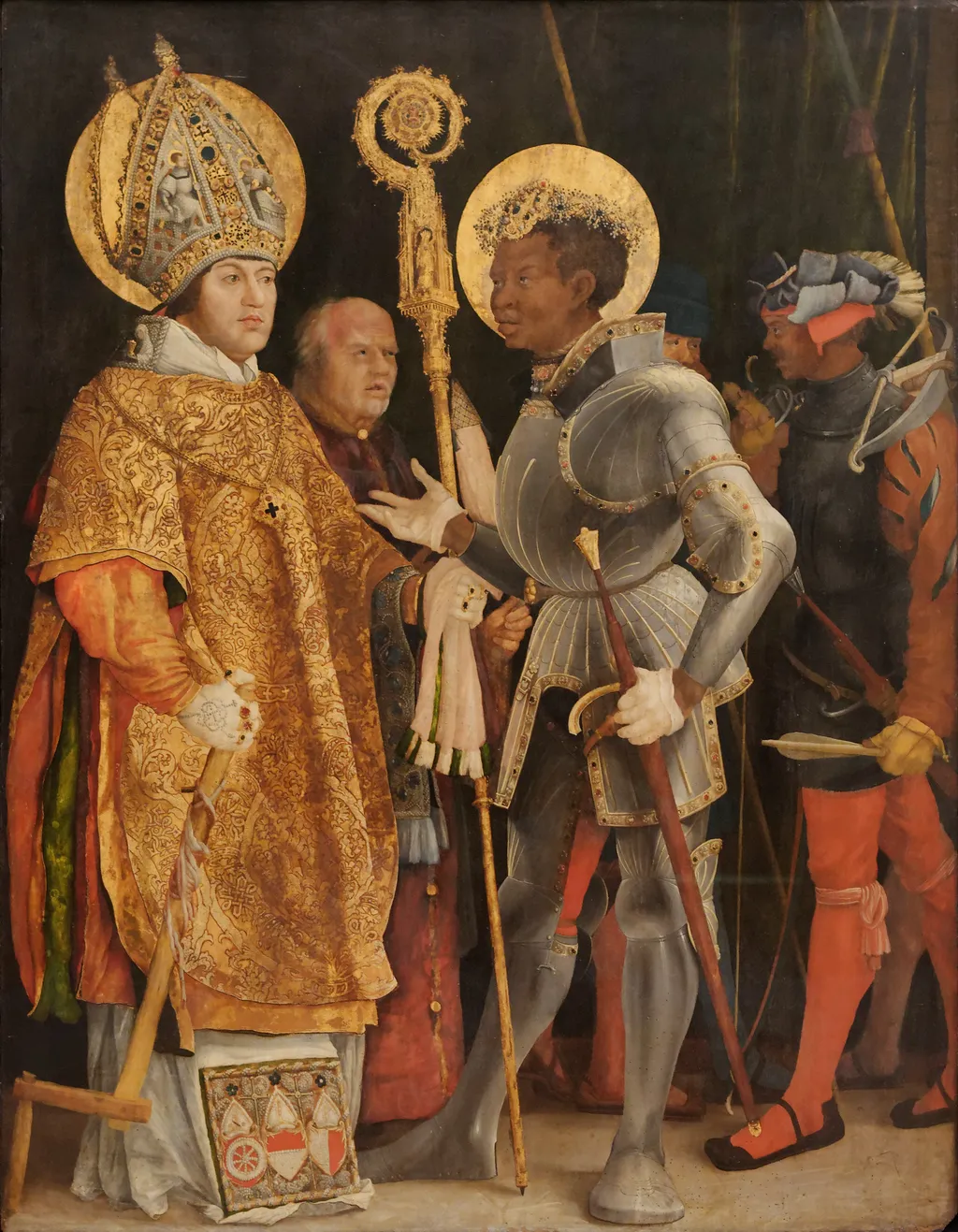
Meeting of St Erasm and St Maurice is an oil painting by the Northern Renaissance artist Matthias Grünewald. It dates from 1520 and is held in the collection of the Bavarian State Painting Collections.
About this work
Subject & Meaning
Maurice's attire, including a jeweled victory wreath and a specific ceremonial armor, alludes to Emperor Charles V, who gifted similar armor to Albrecht.
The painting depicts a non-historical encounter between Saint Erasmus and Saint Maurice. Saint Erasmus, dressed in full episcopal vestments, holds a spindle representing the instrument of his martyrdom, where a ship's winch was used to extract his entrails. His facial features are modeled after the patron, Cardinal Albrecht of Brandenburg, linking the saint to the House of Brandenburg-Hohenzollern.
Opposite him stands Saint Maurice, the leader of the Theban Legion, portrayed as a young African warrior in silver armor. Maurice's attire, including a jeweled victory wreath and a specific ceremonial armor, alludes to Emperor Charles V, who gifted similar armor to Albrecht. The work symbolizes a political and religious alliance between the Primate of Germany and the Holy Roman Emperor, uniting the patrons of the Archbishopric of Magdeburg and the House of Brandenburg against the rising Protestant Reformation.
Technique & Style
The work is an oil painting on a wood panel, measuring 226 × 176 cm. Grünewald executed the commission with meticulous, artful precision rather than the spiritual ecstasy seen in some of his other works. The panel depicts two full-length saints facing one another: Saint Erasmus in elaborate episcopal vestments and Saint Maurice in gleaming silver armor with jeweled trim. The artist rendered textile and metal surfaces with exceptional care, the mitra, the embroidered half-figure of Mary Magdalene on Erasmus's collar, and the ornate ceremonial armor are all painted with painstaking detail.
The figures have a statuesque, polychrome-sculpture quality, while smaller background figures create depth and spatial expansion. For Maurice, described as a Black African, no live model was available; Grünewald relied instead on a statue of the saint.
History & Provenance
The painting was commissioned by Albert of Brandenburg, Archbishop of Mainz and Magdeburg, who is depicted as Saint Erasmus. It was executed between 1520 and 1524 for the newly consecrated collegiate church at the prince-archiepiscopal residence in Halle (Saale).
Following the dissolution of the monastery during the Reformation, the panel was transferred to Aschaffenburg along with other artworks. The painting entered the collection of the Alte Pinakothek in Munich, where it has been held since the museum's opening in 1836. The work measures 226 cm in height and 176 cm in width.
The painting is held by the Bavarian State Painting Collections at the Alte Pinakothek in Munich. It has been part of this collection since the museum's opening in 1836, though one source notes it entered the collection in 1986.
The work was originally commissioned for the new cathedral in Halle and later transferred to Aschaffenburg after the dissolution of the monastery during the Reformation. No specific inventory or accession number is provided in the sources, and no individual exhibition history is documented.
Context
Scholars regard the Meeting of St Erasmus and St Maurice as one of Matthias Grünewald's most significant works, distinguishing it from his typical depictions of spiritual ecstasy through its artificial perfection and meticulous detail. Executed between 1520 and 1524 for Cardinal Albert of Brandenburg, the painting functions as a complex political statement amidst the rising Protestant Reformation. By portraying the patron as St Erasmus and incorporating armor worn by Emperor Charles V into the figure of St Maurice, the work symbolically unites the Primate of Germany and the Holy Roman Emperor on equal footing.
The composition further reflects the era's religious tensions, as Albert intensified the veneration of saints to reinforce ties between earthly powers and heavenly patrons. Although Grünewald lacked a live model for the African saint, he relied on existing statues to render the figure, achieving a level of textural realism in the vestments and armor that stands as a major accomplishment of German painting in the early sixteenth century.
Legacy
The Meeting of St Erasm and St Maurice has been recognized as one of Matthias Grünewald’s most significant works since the mid-19th century. Acquired by the Alte Pinakothek in Munich upon its opening in 1836, the panel became a centerpiece of the Bavarian State Painting Collections and has remained a touchstone for discussions of German Renaissance art.
Its later reputation has rested on its political iconography and technical virtuosity. The work’s fusion of portraiture with sacred narrative, and its detailed rendering of vestments and armor, have been repeatedly cited as exemplars of late medieval German painting’s synthesis of realism and symbolic power. Since its transfer from Halle via Aschaffenburg, the painting has been treated as a key document of Counter-Reformation patronage under Cardinal Albrecht of Brandenburg, anchoring scholarly narratives about the visual strategies of the Catholic revival before and after the Reformation.
Overview
Matthias Grünewald’s oil painting on wood, created between 1520 and 1524, depicts a gathering of four figures in a dimly lit interior. The work was originally commissioned by Albert of Brandenburg for the new cathedral in Halle, though it now resides in Munich’s Alte Pinakothek.
Own this work as a print
Artist & collection

Artist
Matthias Grünewald (c. 1470 – 31 August 1528; also known as Mathis Gothart Nithart) was a German Renaissance painter of religious works who ignored Renaissance classicism to continue the style of late medieval Central…

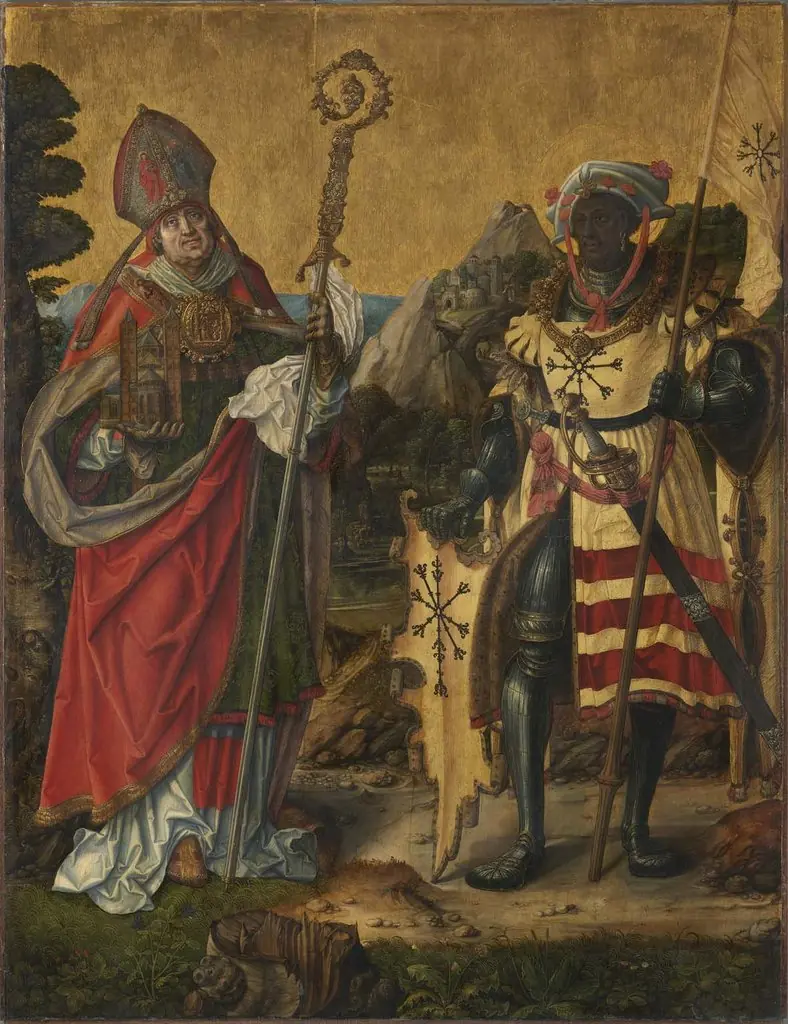 Saints Anno and Gregor the Moor
 Universitätsaltar: Hll. Narzissus und Mathäus
 The Life and Miracles of Saint Godelieve
 Saint Vincent before Dacian
 San Agustín de pontifical
 Marientod Altarpiece - left wing
 Two Magi
 Der hl. Laurentius vor Kaiser Decius
 Balthazar, one of the three Magi, with a servant
 Two male saints