Artwork
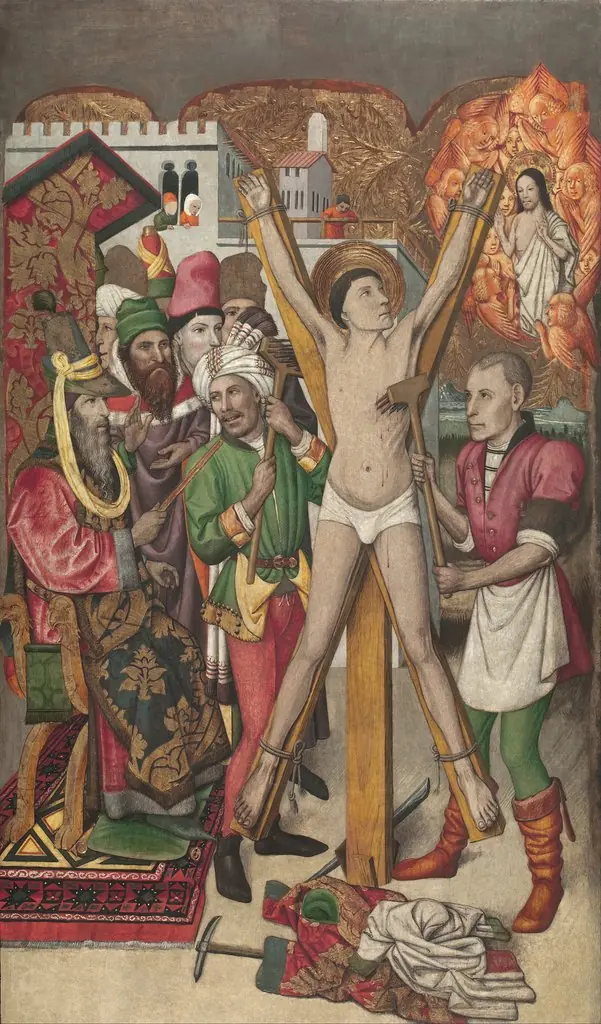
Saint Vincent before Dacian
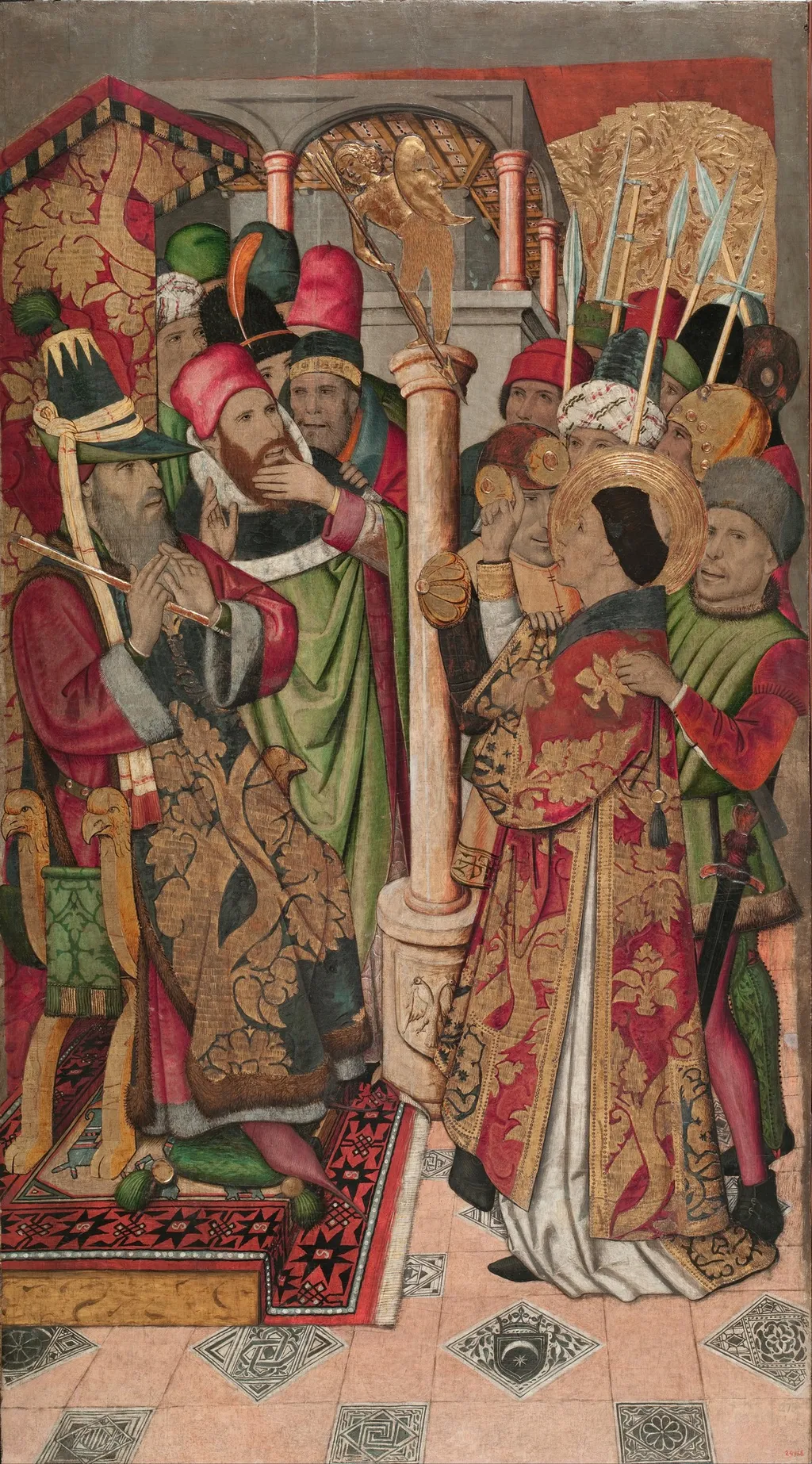
Saint Vincent before Dacian is a tempera painting by the Gothic painting artist Jaume Huguet. It dates from 1455 and is held in the collection of the Museu Nacional d'Art de Catalunya.
About this work
Overview
Created around 1455 by Jaume Huguet, this stucco-on-panel work portrays a moment from the martyrdom of Saint Vincent of Saragossa. It belongs to the late Gothic tradition in Catalonia and was likely part of a larger altarpiece. The piece is now housed in the Museu Nacional d'Art de Catalunya, where it remains a key example of 15th-century Catalan religious art.
Subject & Meaning
The surrounding crowd, dressed in varied garments, represents witnesses to his steadfast faith, emphasizing his moral defiance amid political pressure.
The scene depicts Saint Vincent, a Christian deacon, standing before Dacian, the Roman governor who ordered his persecution. Vincent, identified by his red hat and staff, gazes upward toward a golden object on a pole, likely a pagan idol or symbol of imperial authority. The surrounding crowd, dressed in varied garments, represents witnesses to his steadfast faith, emphasizing his moral defiance amid political pressure.
Technique & Style
Executed in stucco applied to a wooden panel, the work combines sculptural relief with painted detail, a technique common in Catalan altarpieces of the period. Huguet employs rich, localized color and linear precision to define figures and drapery. The composition is hierarchical, with Vincent centrally placed and elevated, reflecting devotional priorities over naturalistic space.
History & Provenance
The panel was originally part of a polyptych commissioned for a church in Barcelona, possibly the convent of Santa Maria del Mar. It remained in religious custody until the 19th century, when it entered the collection of the Museu Nacional d'Art de Catalunya. Its survival through secularization and war reflects its enduring cultural value in Catalan heritage.
Context
In mid-15th-century Catalonia, religious imagery served both devotional and didactic roles. Huguet’s work aligns with a regional trend favoring narrative clarity and symbolic intensity over realism. The depiction of martyrdom reinforced ecclesiastical authority during a time of political instability and internal Church reform, making such images vital to communal identity.
Legacy
Huguet’s treatment of Saint Vincent influenced later Catalan painters through its blend of narrative restraint and symbolic clarity. Though not widely known outside Catalonia, the work remains a touchstone for scholars studying the transition from medieval to early Renaissance religious art in the Iberian Peninsula.
Artist & collection