Artwork
Le stryge (The Vampire)
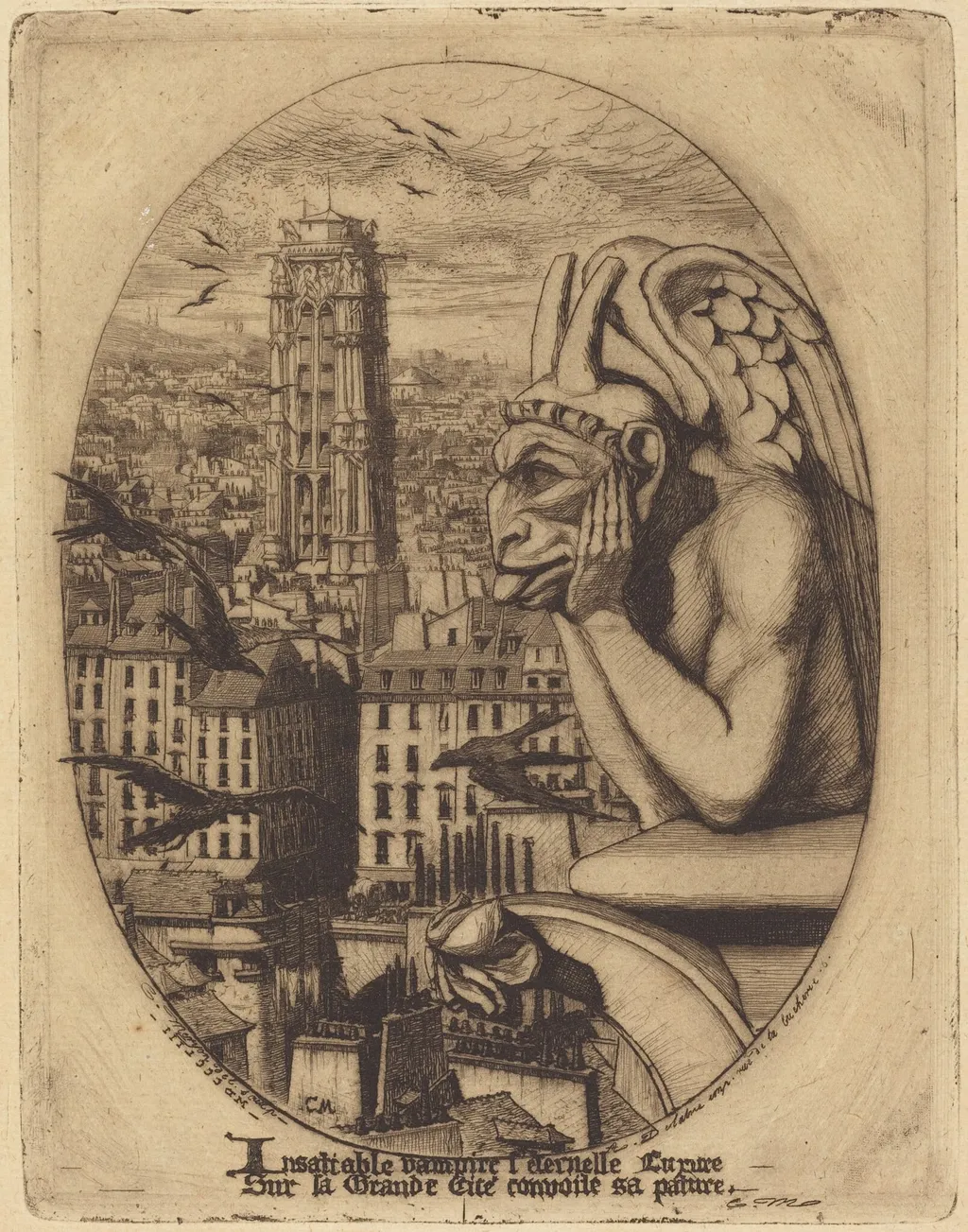
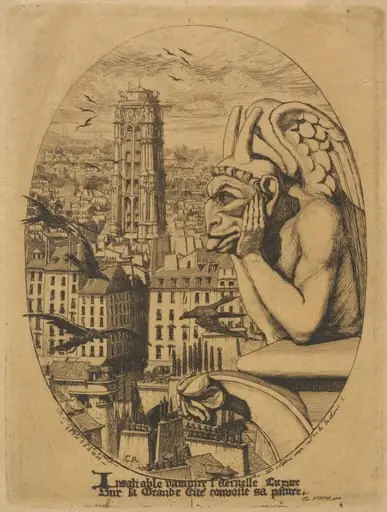
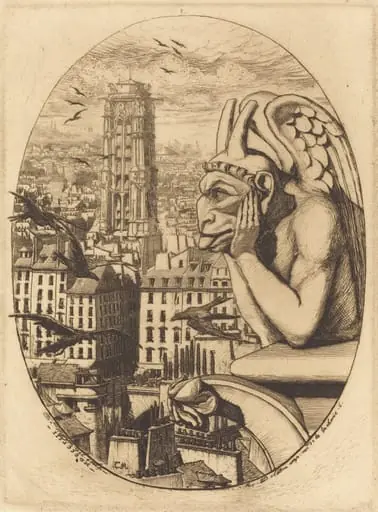
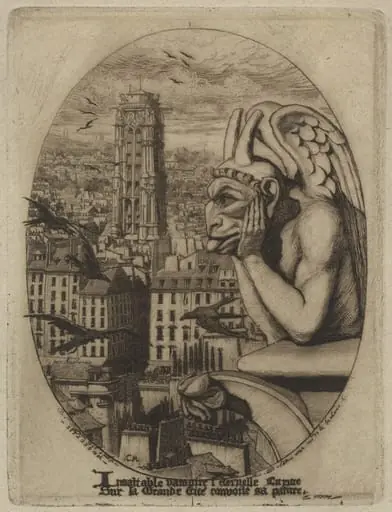
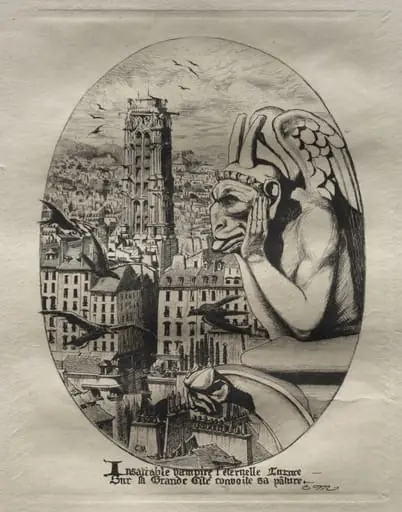
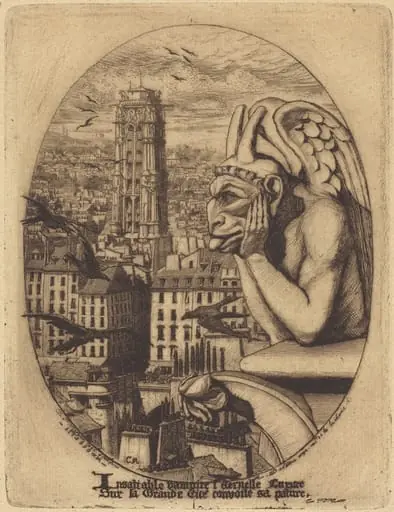
Le stryge (The Vampire) is an ink print by the Impressionist artist Charles Meryon. It dates from 1853 and is held in the collection of the National Gallery of Art.
- Inscription
- Inscribed:"CM" lower left composition, in plate, artist's hand. "C. Meryon del. sculp. / -MDCCCLIII-" lower left margin, in plate, artist's hand. "A. Delâtremimp. rue de la bucherie.6." lower right margin, in plate, artist's hand. "Insatiable vampire l'éternelle Luxure / Sur la Grande Cité convoite sa pâture." lower center margin, in plate, artist's hand. "C.M" lower right margin, in plate, artist's hand. "190" lower left margin, graphite, unknown hand. "D-W - 23 IV of 8" lower center margin, graphite, unknown hand. "2" [encircled] lower right margin, graphite, unknown hand. "L.D. 23 IV" verso, lower left sheet, graphite, unknown hand. "c. 7729" verso, lower center sheet, graphite, unknown hand. "22" verso, lower right margin, graphite, unknown hand. "Murr" verso, lower right margin, graphite, unknown hand.
- Markings
- Marked:"LRJ" verso, black stamped ink, (Lugt 1760b). "National Gallery of Art" verso, black stamped ink, (Lugt 1932d). (Charles W. Dowdeswell collector's stamp) verso, black stamped ink, (Lugt 690).
About this work
Overview
His near-total reliance on etching stemmed from a lifelong color blindness, which led him to explore tone and line with exceptional precision.
Charles Meryon created Le stryge (The Vampire) in 1853 as an etching on green laid paper, one of many works in which he transformed Paris into a haunting, introspective landscape. His near-total reliance on etching stemmed from a lifelong color blindness, which led him to explore tone and line with exceptional precision. The print stands as a singular example of his ability to merge architectural realism with psychological unease.
Subject & Meaning
The image depicts a dense urban skyline dominated by a towering clock tower, beneath which a massive hand cradles a hybrid face, part skeletal, part living. This figure, neither fully human nor entirely monstrous, evokes themes of decay and surveillance. The title suggests the supernatural, yet the horror lies not in fantasy but in the city’s oppressive weight, as if architecture itself has become a living, consuming force.
Technique & Style
Meryon employed fine, controlled etching lines to render both the intricate textures of Gothic buildings and the eerie, sculptural form of the central hand and face. The green paper subtly enhances the somber mood, while the contrast between the detailed foreground and the atmospheric background creates depth without perspective. His technique avoids washes or tone, relying solely on incised lines to suggest shadow, texture, and movement.
History & Provenance
Produced during Meryon’s most prolific period, Le stryge was part of his series Les Mouchards, later renamed Paris: Etchings. Though initially overlooked, the print gained recognition in the late 19th century among Symbolist artists and writers drawn to its psychological intensity. It entered major collections in the 20th century, including the Musée d'Orsay, where it remains a key example of French printmaking.
Context
Meryon worked amid Paris’s rapid modernization under Haussmann’s renovations, yet his prints ignored progress, focusing instead on neglected alleys, crumbling facades, and isolated towers. Le stryge reflects a counter-narrative to the city’s official image, channeling Romantic and Gothic sensibilities into a visual language that anticipated Symbolism. His work stood apart from contemporaries who celebrated industrialization.
Legacy
Meryon’s influence extended to later printmakers and writers drawn to urban alienation, including Aubrey Beardsley and Charles Baudelaire. Le stryge became a touchstone for artists exploring the uncanny in architecture. Its precise, line-driven aesthetic helped define etching as a medium capable of profound emotional expression, securing Meryon’s place as a pivotal figure in 19th-century graphic art.
Own this work as a print
Artist & collection
Artist
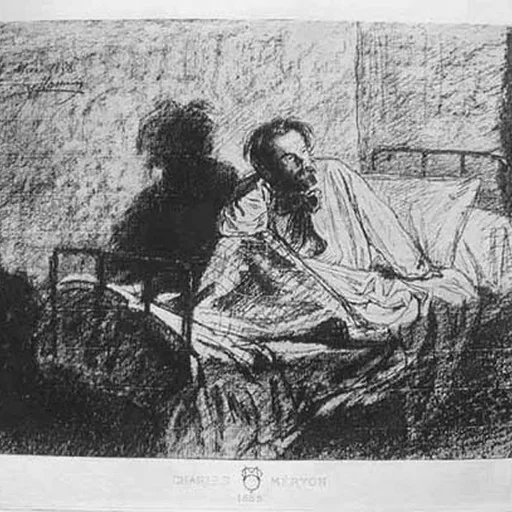
Charles Meryon (sometimes Méryon, 23 November 1821 – 14 February 1868) was a French artist who worked almost entirely in etching, as he had colour blindness.