Artwork
Royal Palace, Toledo
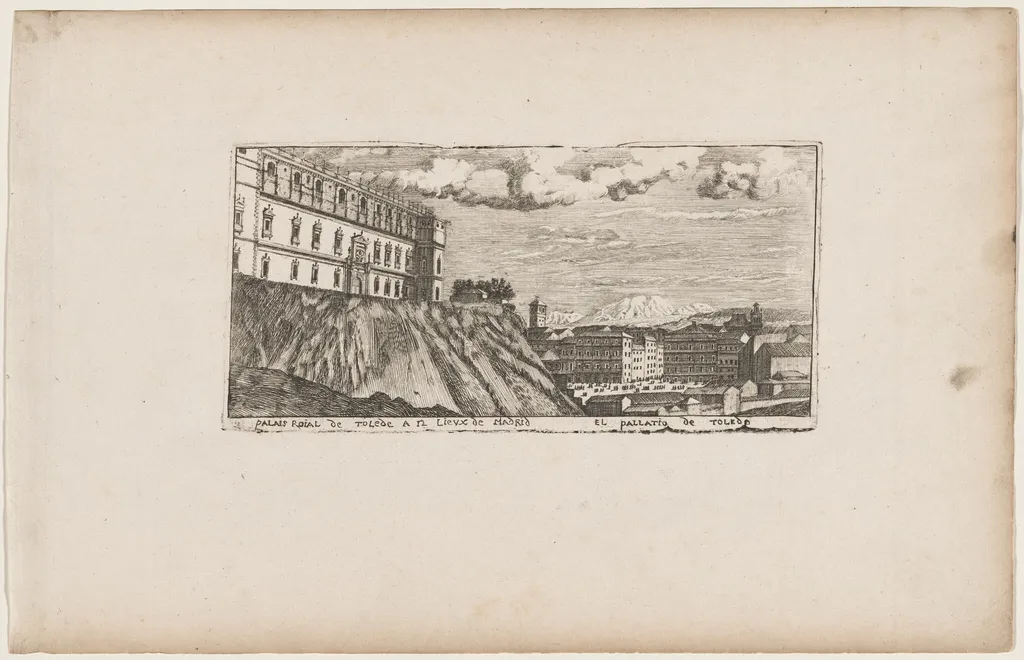
Royal Palace, Toledo is an ink print by the Baroque artist Louis Meunier. It is held in the collection of the National Gallery of Art.
About this work
Overview
Created around 1664, this etching by Louis Meunier depicts the Royal Palace of Toledo on a rugged hill overlooking the Tagus River.
Created around 1664, this etching by Louis Meunier depicts the Royal Palace of Toledo on a rugged hill overlooking the Tagus River. Rendered in monochrome on laid paper, the work captures the palace’s imposing silhouette against a turbulent sky. Sharp, incised lines define architectural details and natural textures, characteristic of etching’s precision. The composition emphasizes verticality and scale, anchoring the viewer’s gaze on the structure’s dominance over the landscape.
Subject & Meaning
The subject is the Royal Palace of Toledo, a historic seat of Spanish monarchy. Meunier presents it not as a lived-in residence but as a monumental symbol of authority, perched above the river and clustered dwellings. The inclusion of a distant tower and modest homes suggests a hierarchy of power and place.
The crashing waves and stormy clouds may imply the passage of time or the volatility of political power, though no explicit narrative is stated.
Technique & Style
Meunier employed etching to achieve fine, controlled lines that model form and texture. The roughness of the hillside, the sheen of wet stone, and the layered clouds are rendered through varying line density and cross-hatching. The flat roof and tall windows of the palace are sharply defined, contrasting with the softer, more fluid treatment of the river and sky. The composition is tightly framed, focusing attention on architectural grandeur without extraneous detail.
History & Provenance
The print was made in the mid-17th century and entered the collection of the National Gallery of Art in Washington, D.C., where it remains today. Its origin as a standalone print suggests it may have been produced for scholarly or topographical interest rather than commercial sale. No record of earlier ownership or exhibition history is widely documented, indicating it was likely preserved within private or institutional collections over centuries.
Context
During the 1660s, etching was a favored medium for documenting architecture across Europe, particularly in regions with rich historical legacies like Spain. Toledo, once a capital of the Visigothic kingdom and later a center of Habsburg power, attracted artists interested in its layered past. Meunier’s work aligns with a broader trend of topographical prints that valued accuracy and atmospheric detail over idealization.
Legacy
Though not widely reproduced or studied today, the etching contributes to a quiet archive of 17th-century Spanish architectural observation. It reflects the period’s interest in recording landmarks with technical clarity and restrained emotion. As a surviving example of Meunier’s output, it offers insight into how foreign artists interpreted Spain’s monumental heritage during a time of imperial decline.
Own this work as a print
Artist & collection

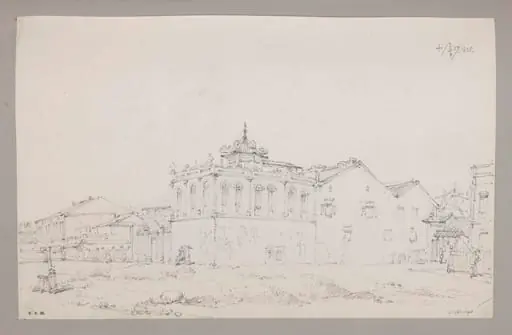
- Chinqua's house, with entrance to China Street, Canton
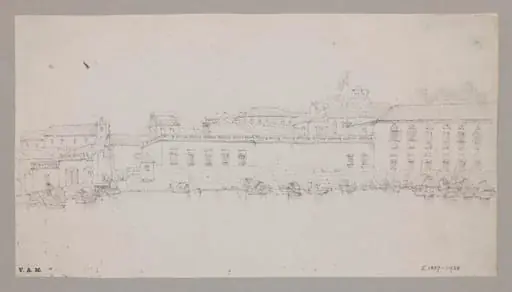 Buildings flanking the Inner Harbour, Macau
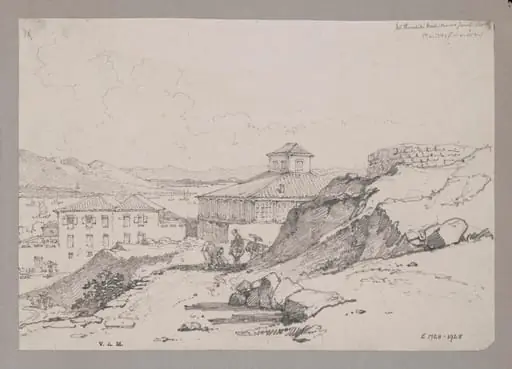 The Rev. Mr. Vatchell's house (formerly Mr. Thornhill's), Macao
 Chungqua's premises seen from the portico of the East India Company's 'factory' at Guangzhou (Canton)
 Italian Buildings on a Hillside
 Part of Macao Bay, looking west
 L'ancien Louvre d'après une peinture de Zeeman, 1651 (The Old Louvre, from a Painting by Zeeman, 1651)
 The Mortuary, Paris
 Ruined Circular Temple
 Un Tir aux Bastions
 Hill-head, near Lasswade
 Preparatory drawing for a Panorama of Paris from the Seine