Artwork
Bathers
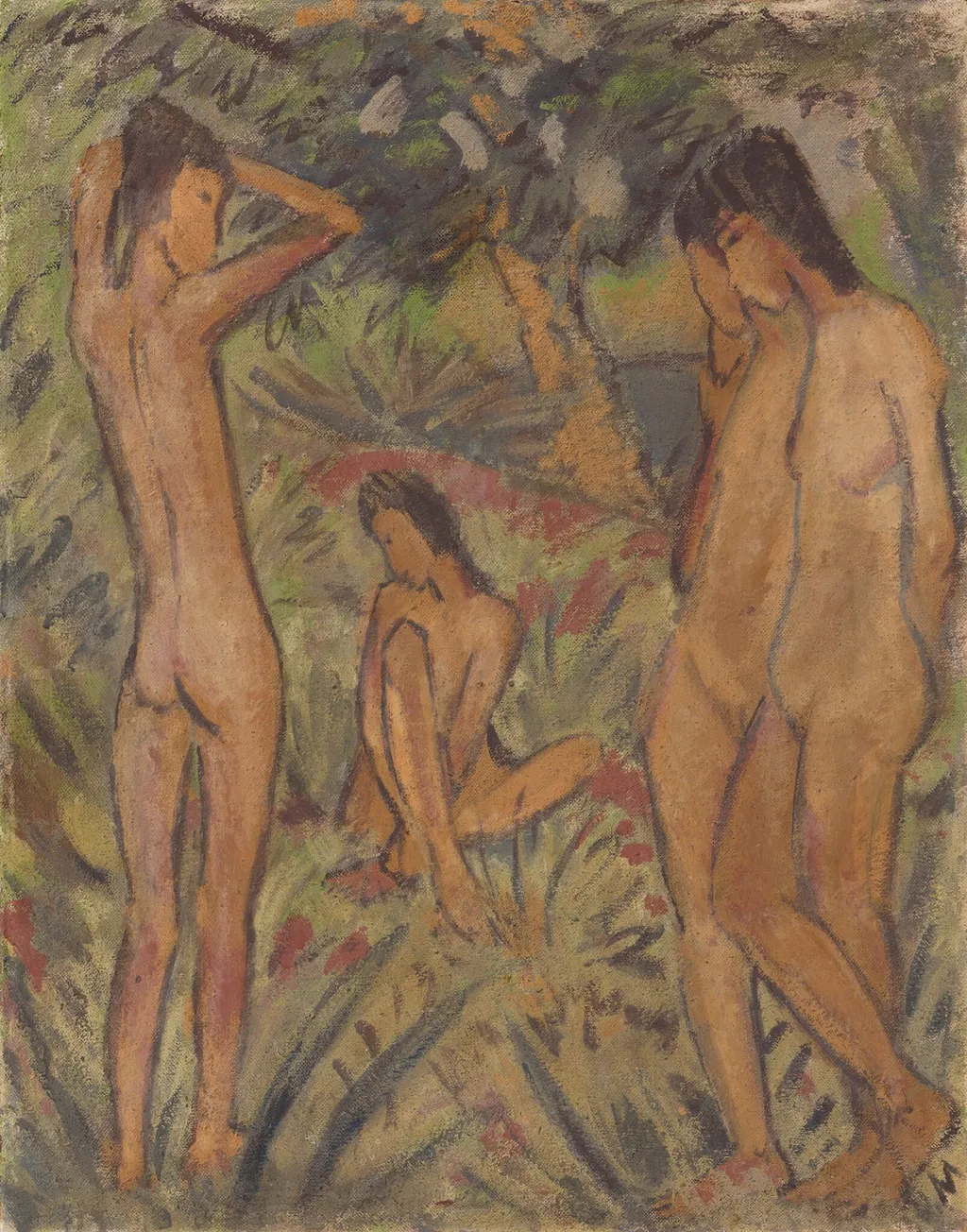
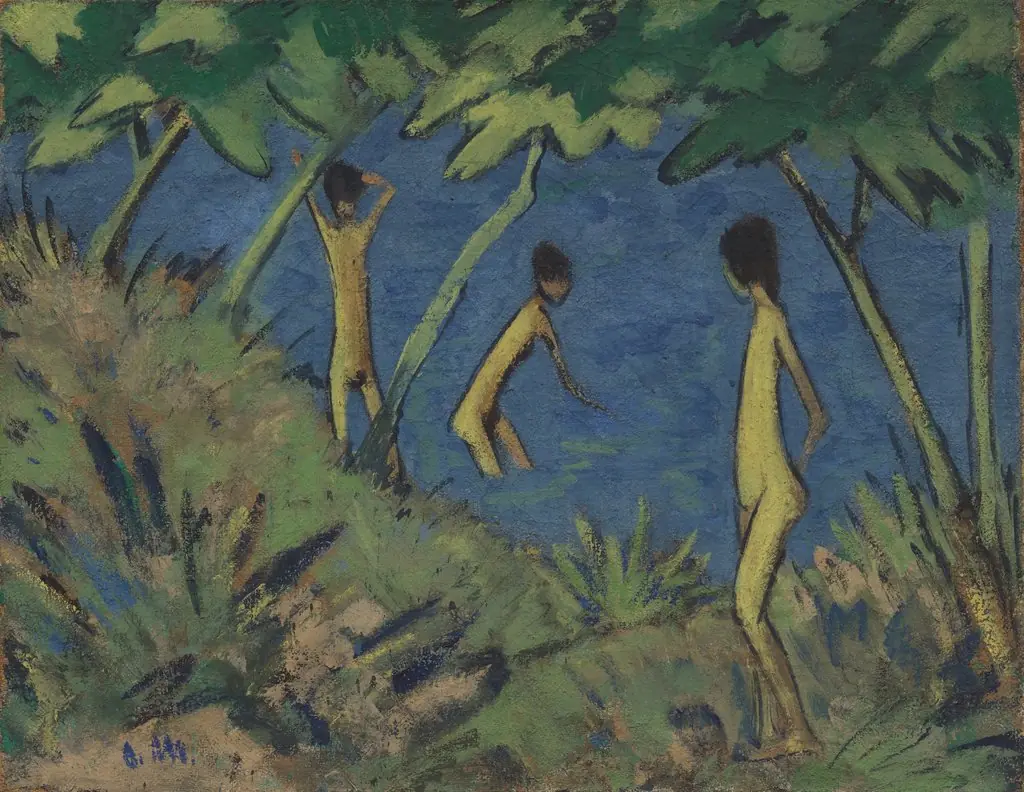
Bathers is a distemper painting by Otto Mueller. It dates from 1916 and is held in the collection of the National Gallery of Art.
About this work
Overview
Its acquisition by the National Gallery of Art significantly strengthened the museum's holdings of German Expressionist painting.
Bathers is a 1916 painting by the German Expressionist artist Otto Mueller, executed in distemper on burlap and measuring 120.7 by 95.3 centimeters. The work is held in the collection of the National Gallery of Art in Washington, D.C., where it is displayed in the East Building Mezzanine, Gallery E217. It was gifted to the museum in 2020 by Arnold A. Saltzman and Joan R. Saltzman of Sands Point, New York, and bears the accession number 2020.112.3. The painting exemplifies Mueller's lifelong preoccupation with the nude in landscape, a theme that occupied him throughout his career and distinguished him as one of the most lyrical painters of the Die Brücke movement. Its acquisition by the National Gallery of Art significantly strengthened the museum's holdings of German Expressionist painting.
Subject & Meaning
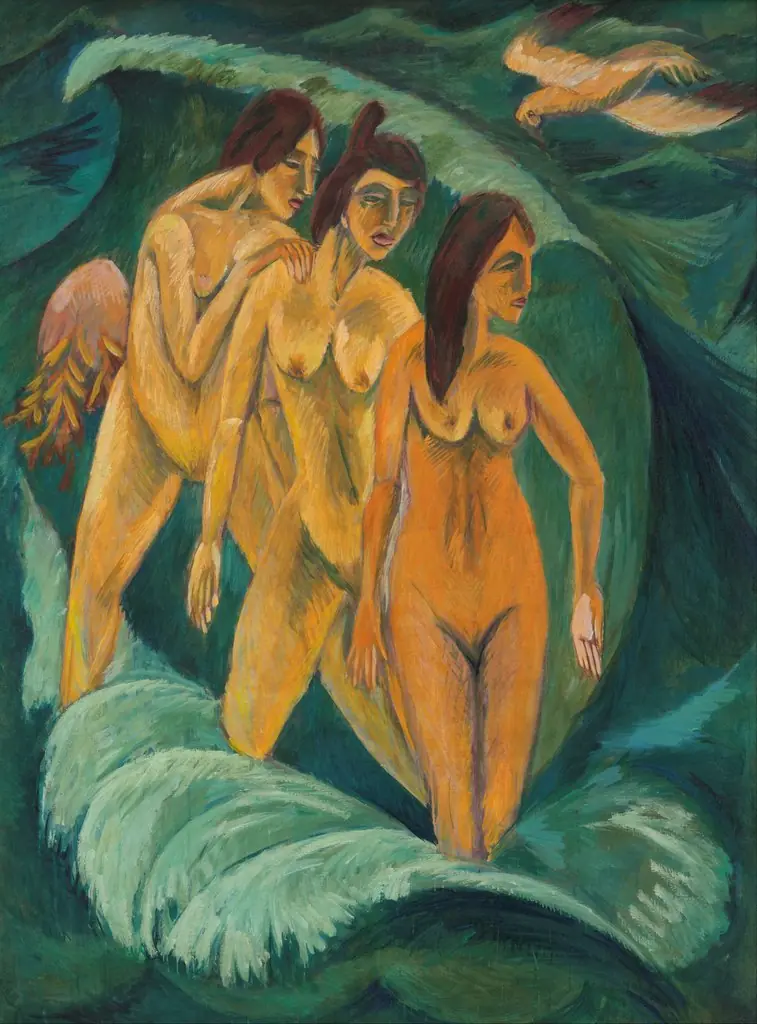
The painting depicts three nude female figures in a compressed landscape setting. The figure on the left stands with both arms raised to her head, while the figure on the right stands with bowed head and one arm hanging down. Between and behind them, a smaller seated figure bends forward with hands near her feet. The background suggests foliage and trees. This arrangement of bathers in nature embodies Mueller's central artistic theme: the unity of humans and nature. The arcadian, idyllic quality of the scene reflects his pursuit of harmonious simplification, drawing on Symbolist and primitive art influences. The figures' poses and their integration into the landscape suggest a timeless, ritualistic quality rather than narrative specificity. Red accents that appear sporadically in the grass and foliage add subtle chromatic punctuation to the otherwise earthy palette, perhaps evoking vitality or latent eroticism within the natural setting.
Technique & Style
Mueller executed Bathers in distemper on burlap, a medium and support combination he favored throughout his career. The distemper technique, using pigment bound with animal glue or size rather than oil, produces the characteristically matte and textured surface visible in the work. The burlap support contributes to the coarse, unrefined physicality of the painting. Visually, the palette is muted and earthy, dominated by warm ochre and sienna tones for the bodies against cooler greens and browns in the surroundings. The brushwork is visible, sketchy, and unblended, with dark paint outlines defining the figures. There is little conventional modeling of light and shadow; forms are deliberately flattened and simplified. This approach reflects Mueller's admiration for Egyptian art and his desire to achieve a harmonious simplification of form, color, and contour. The composition is notably compressed, with the figures filling most of the frame, creating an intimate, almost claustrophobic relationship between viewer and subject that intensifies the work's emotional immediacy.
History & Provenance
The painting was created in 1916, during a complex period in Mueller's life. He had volunteered for military service in the First World War, serving between 1916 and 1917, which makes this work a product of a brief window between his enlistment and active deployment. The painting was exhibited in 1917 at the Grosse Deutsche Kunstausstellung in Düsseldorf, where it appeared as number 669 in the catalogue. Following this early exhibition, the work passed into the collection of Arnold A. Saltzman and Joan R. Saltzman of Sands Point, New York. The Saltzmans held the painting for decades before gifting it to the National Gallery of Art in 2020. During their ownership, it was included in the exhibition German Expressionist Paintings from the Saltzman Family Collection at the National Gallery of Art from 2001 to 2002, which preceded its eventual donation by nearly two decades.
Context
Otto Mueller was born sketches born in Liebau, Silesia in 1874, trained initially as a lithographer in Görlitz and Breslau before studying at the Dresden Academy of Art between 1896 and 1898. He moved to Berlin in 1908, where his style shifted toward Expressionism. In 1910, he joined the Neue Sezession and subsequently became a member of Die Brücke, the Dresden-based group that included Ernst Ludwig Kirchner, Max Pechstein, and Erich Heckel. He exhibited with them at the Blaue Reiter exhibition in Munich and the Cologne Sonderbund exhibition in 1912. After Die Brücke dissolved in 1913, Mueller maintained close associations with Kirchner and Heckel. He became professor at the Breslau Academy in 1920, where he taught until his death in 1930. Mueller's work, including this painting, was later targeted by the Nazi regime; in 1937, over 357 of his works were seized from German museums as degenerate art, and additional works were looted from Jewish collectors. His posthumous reputation suffered under the Nazi cultural purge, though his significance within German Expressionism has been increasingly recognized in subsequent scholarship.
Legacy
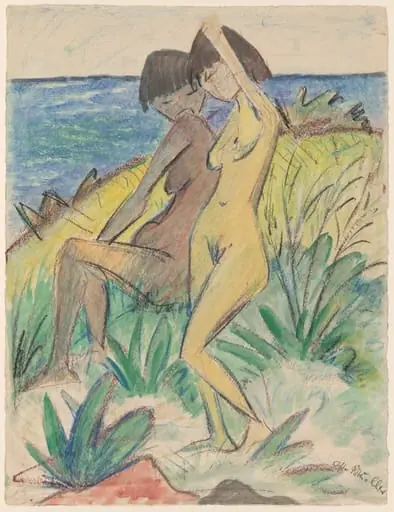
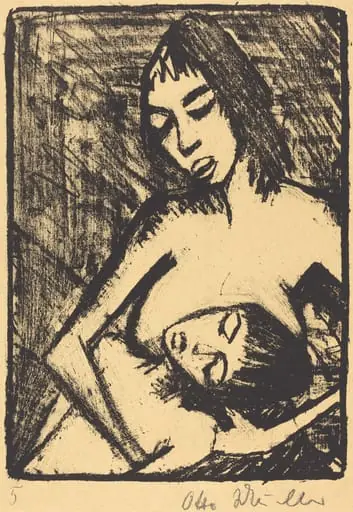
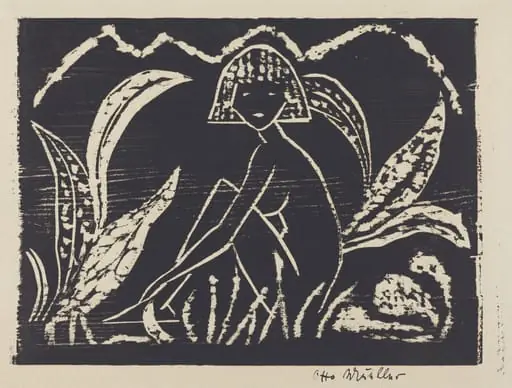
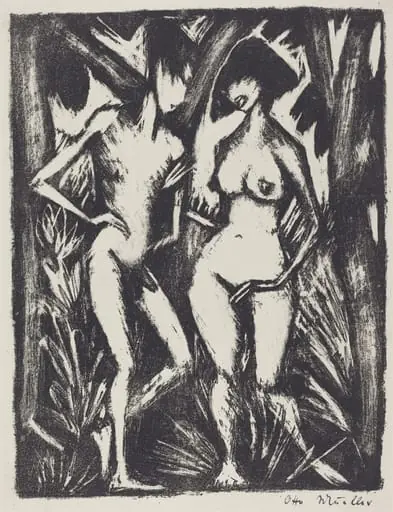
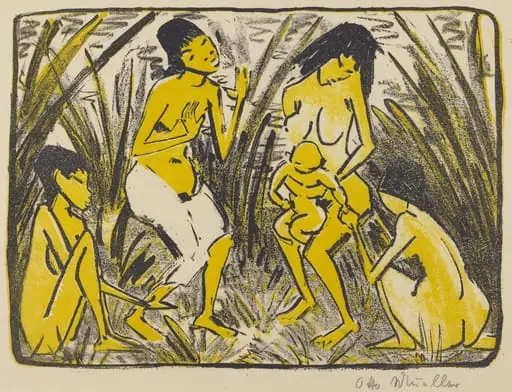
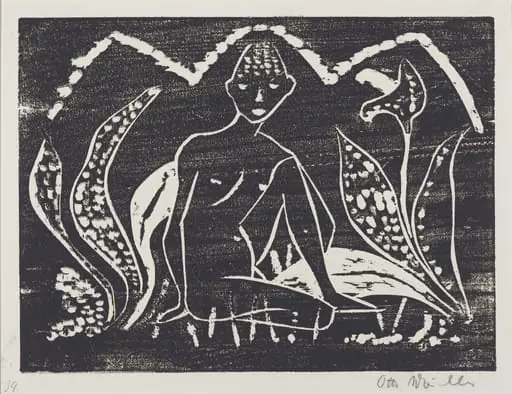
Mueller's Bathers occupies a significant position within the broader corpus of German Expressionist nude painting. The artist returned to the bather motif repeatedly throughout his career, producing variations in painting, drawing, and print media. A lithograph titled Bathers dated 1920 exists in the collection of the Los Angeles County Museum of Art, demonstrating the persistence and adaptability of this theme across media. The National Gallery of Art also holds a related work, a pen and ink with color crayons drawing of Bathers acquired through Lessing J. Rosenwald in 1950-1951, which provides comparative insight into Mueller's graphic treatment of the subject. The Detroit Institute of Arts holds a later work, Two Bathers from between 1928 and 1930, executed in crayon, pastel, watercolor, and brush and black ink, showing the longevity of Mueller's engagement with paired and grouped nude figures. The 2020 gift of the 1916 Bathers to the National Gallery of Art ensures the painting's continued visibility and scholarly attention within the most important collection of American public art, where it serves as a representative example of Mueller's distinctive contribution to Expressionist figuration and his enduring exploration of the human form in nature.
Own this work as a print
Artist & collection

Artist
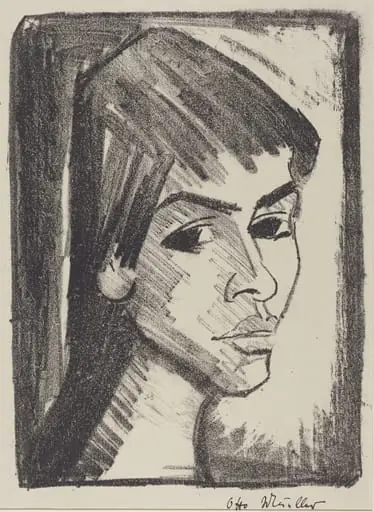
Otto Mueller (16 October 1874 – 24 September 1930) was a German painter and printmaker of the Die Brücke expressionist movement.