Artwork
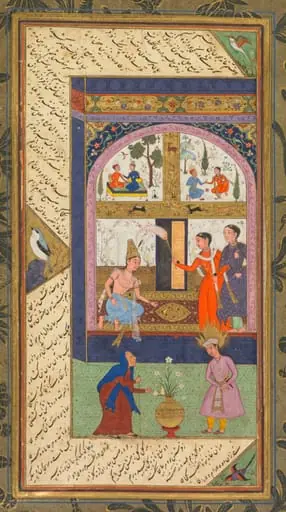
Zulaykha in her palace and as an elderly woman with Joseph (recto), from a Panj Ganj (Five Treasures) of Abd al- Rahman Jami (Persian, 1414–1492)
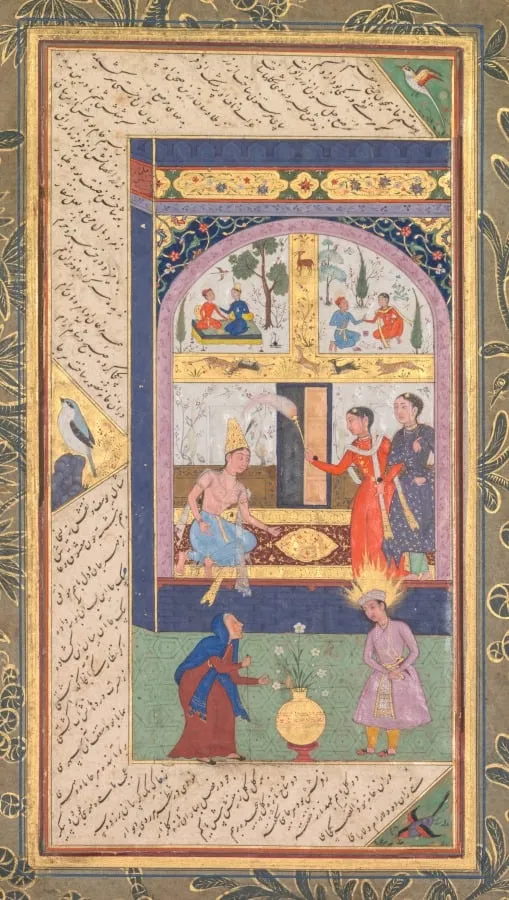
Zulaykha in her palace and as an elderly woman with Joseph (recto), from a Panj Ganj (Five Treasures) of Abd al- Rahman Jami (Persian, 1414–1492) is an unspecified painting by the Baroque artist Mushfiq. It dates from 1605 and is held in the collection of the Cleveland Museum of Art. The diptych presents two moments from the Persian narrative of Zulaykha and Joseph.
- Accession no.
- 2013.315.1.a
- Credit line
- Gift in honor of Madeline Neves Clapp; Gift of Mrs. Henry White Cannon by exchange; Bequest of Louise T. Cooper; Leonard C. Hanna Jr. Fund; From the Catherine and Ralph Benkaim Collection
About this work
Overview
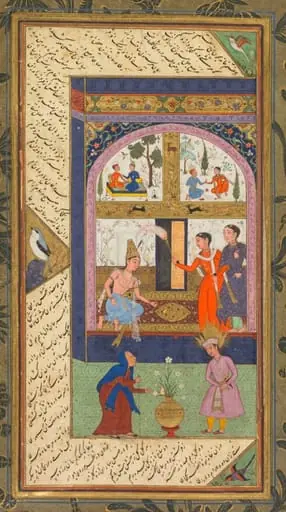
The diptych presents two moments from the Persian narrative of Zulaykha and Joseph. In the lower panel an aged Zulaykha leans on a staff beside a golden vessel of white narcissus, while the upper panel shows her youthful self awaiting Joseph in a richly decorated interior.
Subject & Meaning
The work visualises the legendary love‑story in which Zulaykha, despite being married to Potiphar, becomes enamoured of Joseph. Joseph’s steadfast virtue, indicated by his golden halo, leads him to reject her, and only after her husband’s death does she regain her beauty, symbolised by the narcissus pot.
Technique & Style
Executed in the refined miniature tradition of Mughal‑influenced Persian painting, the composition employs delicate brushwork and a luminous palette. The juxtaposition of two temporal states, youth and old age, relies on subtle shifts in colour and line to convey the passage of time.
History & Provenance
The piece originates from a Panj Ganj (Five Treasures) manuscript compiled by the 15th‑century Persian poet‑scholar Abd al‑Rahman Jami (1414–1492). It was likely produced in a courtly workshop that catered to patrons interested in literary illustrations.
Context
Zulaykha’s tale adapts the biblical account of Joseph into a Persian moral framework, emphasizing themes of chastity, patience, and the redemptive power of virtue. Such narratives were popular in Persian literary circles and often served as didactic exempla.
Legacy
The painting exemplifies the cross‑cultural exchange between Persian manuscript art and the visual vocabulary of Mughal India, illustrating how biblical stories were re‑interpreted within Islamic artistic traditions.
Artist & collection
Artist
Mushfiq was a sub-imperial Mughal painter who worked in the atelier of Abd-ur-Rahim Khan-i-Khanan (also called Abdul Rahim Khan-I-Khana), commander-in-chief of the Mughal army in the late 16th/early 17th century.

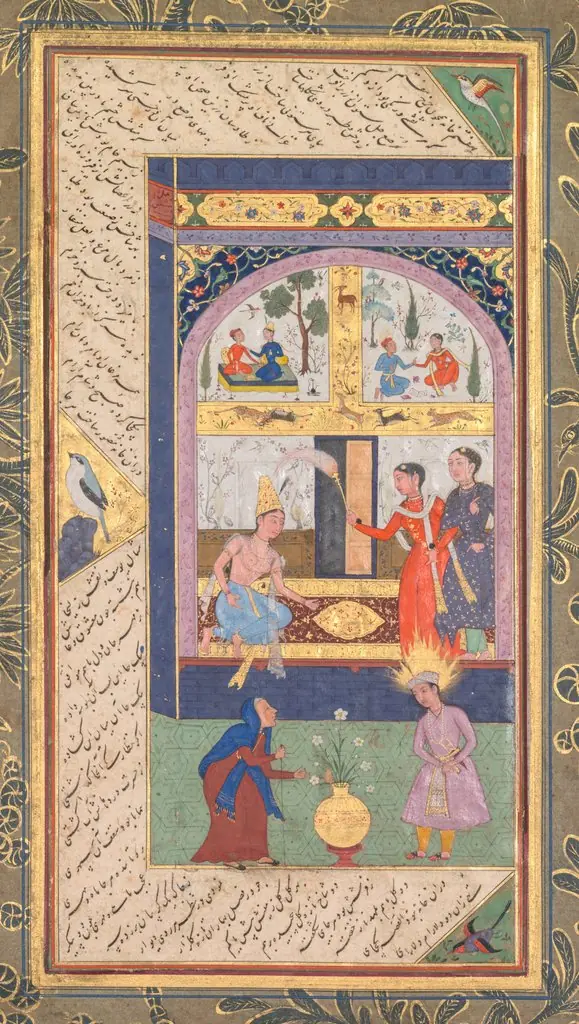 Zulaykha in her palace and as an elderly woman with Joseph (recto), from a Panj Ganj (Five Treasures) of Abd al- Rahman Jami (Persian, 1414–1492)
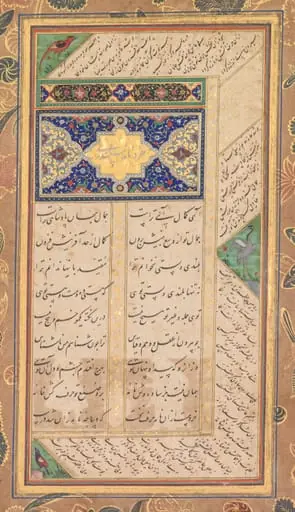 Illuminated page (verso), from a Panj Ganj (Five Treasures) of Abd al- Rahman Jami (Persian, 1414–1492) with two Persian masnavis: Yusuf va Zulaykha (Joseph and Zulaykha) and Khirad-nama-i Iskandari (Alexander’s Book of Wisdom)
- Zulaykha in her palace and as an old woman with Joseph, from a Panj Ganj (Five Treasures) of Abd al-Rahman Jami (Persian, 1414–1492); verso from a Panj Ganj of Abd al-Rahman Jami (Persian, 1414–1492), with two masnavis: Yusuf va Zulaykha (Joseph and Zulaykha) and Khirad-nama-i Iskandari (Alexander’s Book of Wisdom)
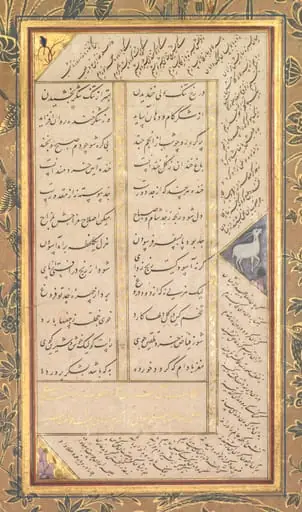 Page from a Panj Ganj (Five Treasures) of Abd al-Rahman Jami (Persian, 1414–1492), with two Persian
masnavis: Yusuf va Zulaykha (Joseph and Zulaykha) and Subhat al-abrar (Rosary of the Righteous) (verso)
Page from a Panj Ganj (Five Treasures) of Abd al-Rahman Jami (Persian, 1414–1492), with two Persian
masnavis: Yusuf va Zulaykha (Joseph and Zulaykha) and Subhat al-abrar (Rosary of the Righteous) (verso)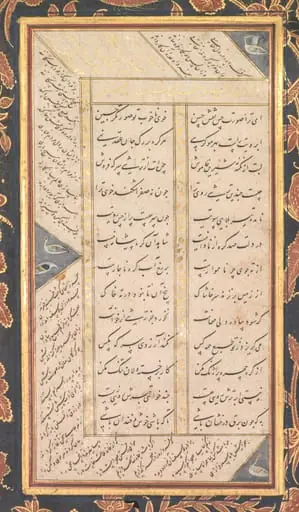 Folio B: Folio from the "Five Treasures" (Panj Ganj) of Jami (recto)
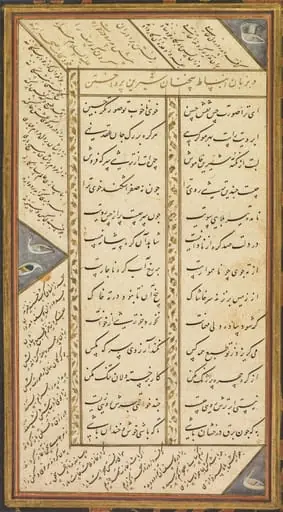 Page from the Panj Ganj (Five Treasures) of Abd al-Rahman Jami (Persian, 1414–1492), with two Persian masnavis (narrative poems): Yusuf va Zulaykha (Joseph and Zulaykha) and Subhat al-abrar (Rosary of the Righteous)
 Folios A and B from the "Five Treasures" (Panj Ganj) of Jami
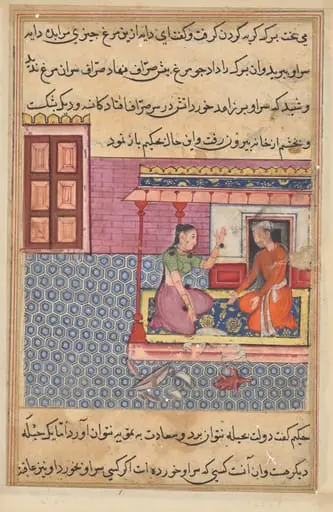 The pious man’s wife offers the seven-colored bird as food to her lover, but not finding its head, he breaks the pot and bowl in anger, from a Tuti-nama (Tales of a Parrot): Fifty-second Night
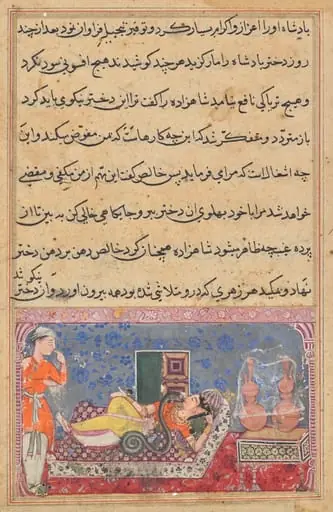 Khalis repays the prince for his kindness by changing into a snake and sucking the poison from the king’s daughter, from a Tuti-nama (Tales of a Parrot): Eighteenth Night
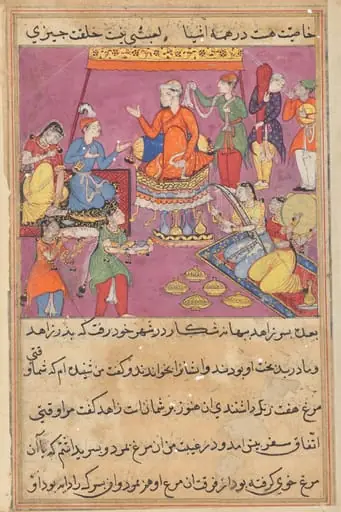 The king gives his daughter in marriage to the pious man’s son, from a Tuti-nama (Tales of a Parrot): Fifty-second Night
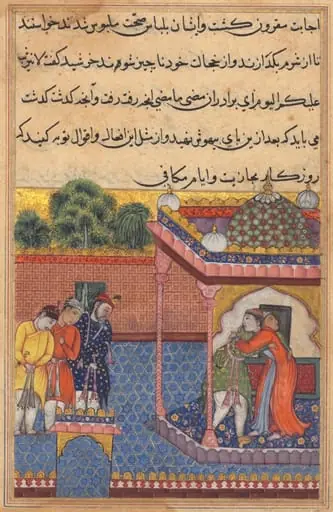 Khurshid reunited with her husband Utarid, from a Tuti-nama (Tales of a Parrot): Thirty-second Night
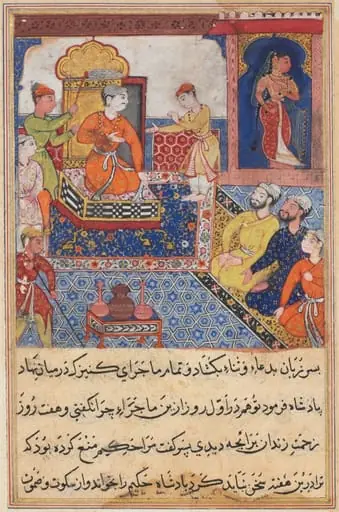 The young prince recounts his experiences to his father, the king, from a Tuti-nama (Tales of a Parrot): Eighth Night