Artwork
Casă între pomi
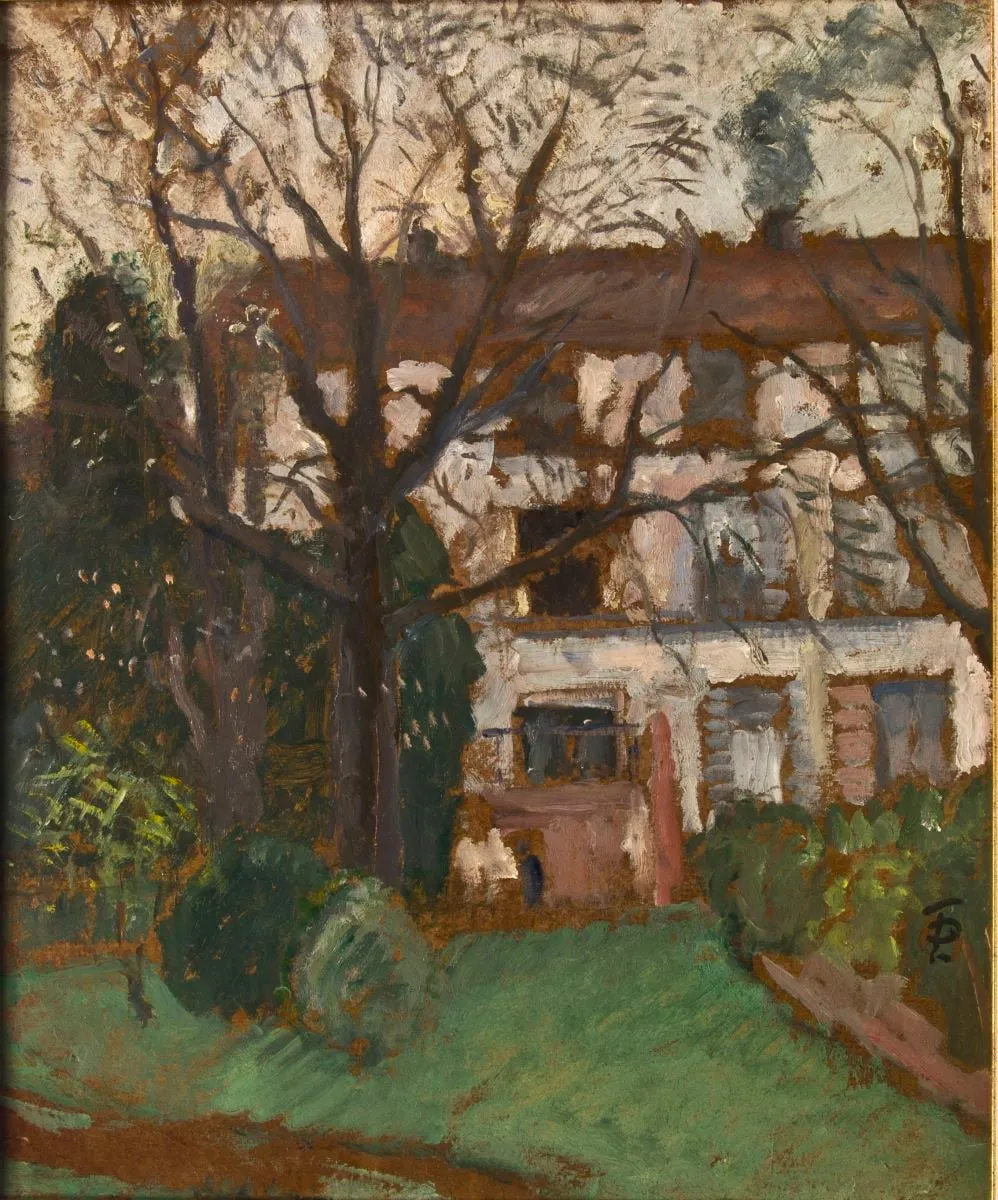
Casă între pomi is a print by Theodor Pallady. It dates from 1921 and is held in the collection of the National Museum of Art of Romania.
About this work
Overview
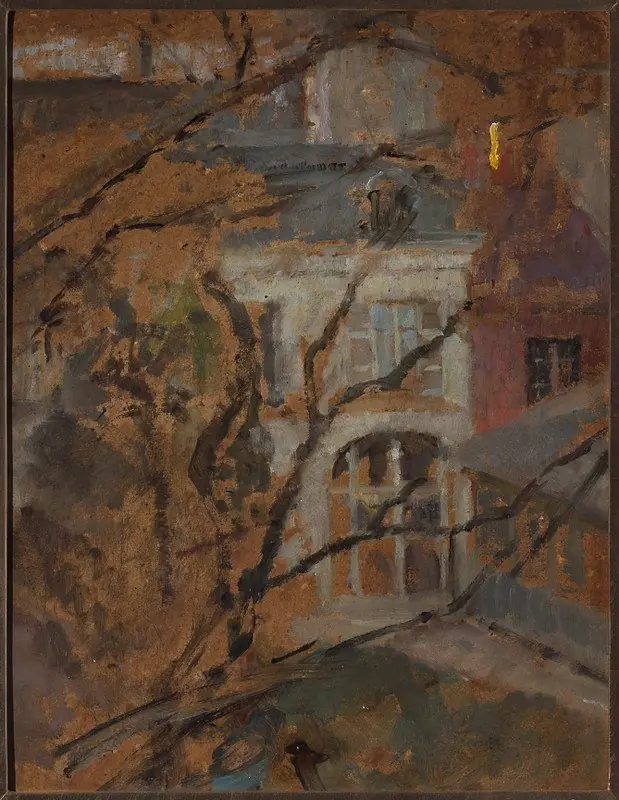
The composition centers on the house, whose rough walls display a textured surface of faded white and brown tones, suggesting age and exposure to the elements.
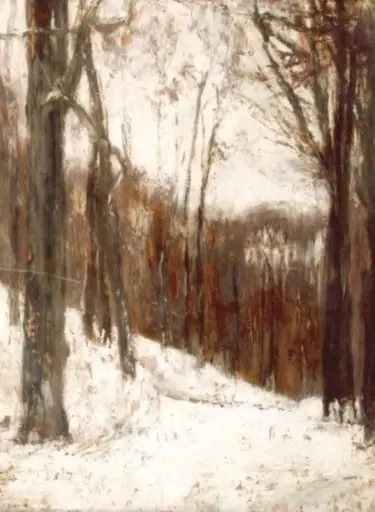
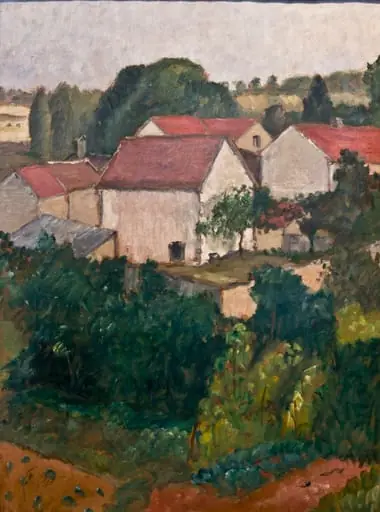
Created in 1921, 'Casă între pomi' (House Among Trees) is a landscape painting by the Romanian artist Theodor Pallady. The work depicts a modest, weathered dwelling partially obscured by a dense arrangement of bare trees and tangled branches, characteristic of the late autumn or early spring season. The composition centers on the house, whose rough walls display a textured surface of faded white and brown tones, suggesting age and exposure to the elements.
A narrow path winds through the foreground vegetation, guiding the viewer's eye toward the structure's dark, recessed doorway. Pallady employs a muted palette dominated by greens, browns, and grays, utilizing a restrained chromatic range to evoke a quiet, contemplative atmosphere. This piece reflects Pallady's mature style, which often synthesizes the structural clarity of Cézanne with a distinctively Romanian sensitivity to rural life and light.
Painted during the interwar period, the work exemplifies the artist's focus on simple architectural forms integrated into the natural landscape, moving away from the more decorative influences of his earlier years toward a more solid, geometric treatment of space and form.
Subject & Meaning
The painting presents a solitary house that appears abandoned or forgotten, its rough walls and faded paint suggesting neglect. The encroaching trees, with their tangled branches, act as silent sentinels, framing the structure and reinforcing a sense of quiet seclusion. The scene may evoke themes of transience, the passage of time, and the relationship between human habitation and the natural environment.
Technique & Style
Pallady employs a thick, impasto application of paint, creating pronounced, uneven brushstrokes that convey a spontaneous, almost sketch‑like quality. The texture of the surface adds tactile depth to the foliage and the house’s weathered surfaces. The overall handling is deliberately raw, avoiding smooth finishes in favor of a more immediate, expressive rendering of the landscape.
History & Provenance
Created circa 1921, Casă între pomi belongs to the later period of Pallady’s career, when he explored more rustic and atmospheric subjects. While specific ownership records are limited, the work has been documented in catalogues of Pallady’s oeuvre and is referenced in exhibitions focusing on early 20th‑century Romanian art.
Context
The early 1920s in Romania were marked by a renewed interest in national identity and rural motifs. Pallady’s choice of a modest, rural house aligns with contemporary artistic trends that sought to capture everyday scenes and the quiet dignity of the countryside, reflecting broader European movements toward realism and expressive brushwork.
Artist & collection