Artwork
Eleazar Burned by Antiochus
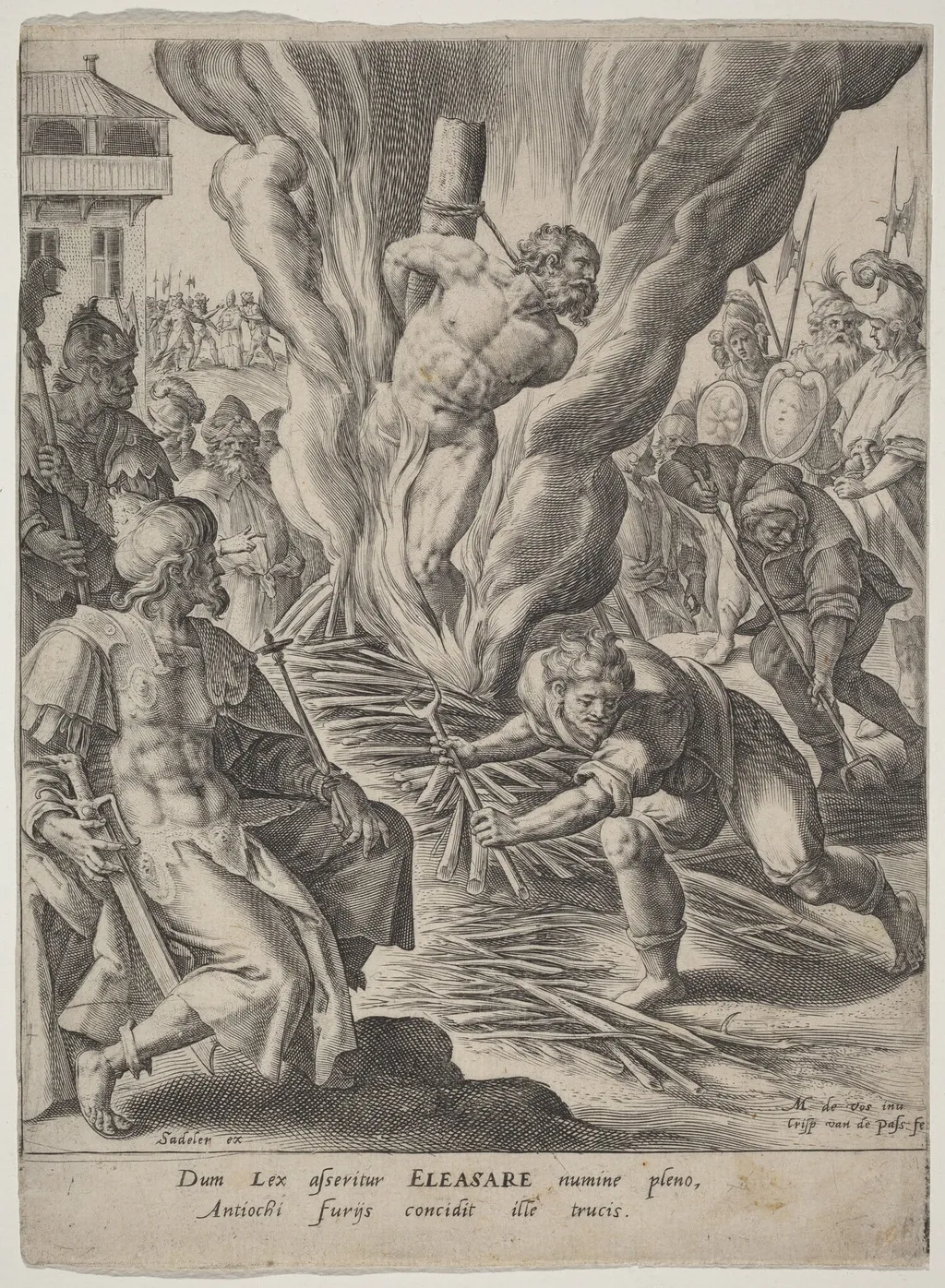
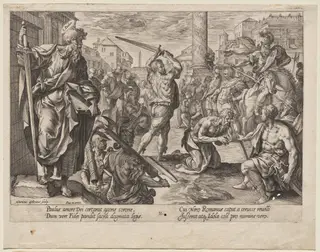
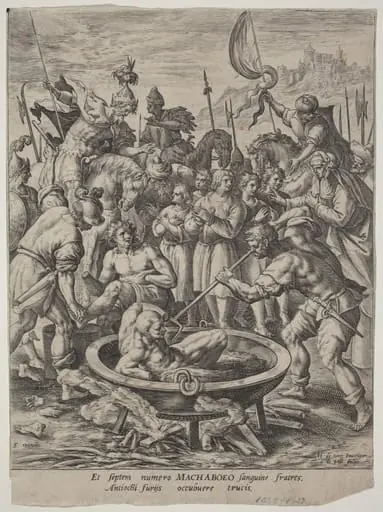
Eleazar Burned by Antiochus is an ink print by the Renaissance artist Crispijn van de Passe I. It dates from 1591 and is held in the collection of the National Gallery of Art.
- Inscription
- Inscribed:lower left in image: Sadeler ex; lower right in image: M de Vos inv / Crisp va de pass fe; lower center in plate: Dum Lex asservitur Elasare numine pleno. / Aniochi furijs concidit ille trucis
About this work
Overview
Crispijn van de Passe I’s 1591 engraving titled Eleazar Burned by Antiochus presents a tumultuous tableau rendered on laid paper.
Crispijn van de Passe I’s 1591 engraving titled Eleazar Burned by Antiochus presents a tumultuous tableau rendered on laid paper. Central to the composition is a half‑clothed figure being seized by a group, while surrounding characters, a spear‑wielding woman, a sword‑bearing bearded man, and a bustling crowd, amplify the scene’s drama. The work is executed as a print, employing fine linear incisions to convey depth and motion.
Subject & Meaning
The image illustrates the biblical episode in which King Antiochus IV Epiphanes orders the execution of Eleazar, a Jewish martyr. The chaotic arrangement of figures, the gestures of aggression and observation, and the inclusion of a distant building suggest a public spectacle of persecution. The Latin inscription at the bottom reinforces the narrative’s historical and religious context, inviting viewers to contemplate themes of faith, oppression, and martyrdom.
Technique & Style
Van de Passe achieved the composition through meticulous engraving on a copper plate, later transferred to laid paper. His use of sharply defined lines creates intricate textures, from the musculature of the central figure to the delicate rendering of clothing folds. Cross‑hatching builds tonal variation, while the contrast between dense foreground and more subdued background elements generates a sense of spatial depth and kinetic energy.
History & Provenance
The print was produced in the late sixteenth century, a period when van de Passe’s workshop was active in the Netherlands and England, catering to a market for illustrated biblical and historical subjects. Surviving copies are held in several European collections, reflecting the work’s circulation among collectors of religious prints and its role in disseminating scriptural narratives during the Reformation era.
Context
Created amid the religious upheavals of the late 1500s, the engraving aligns with a broader trend of visualizing martyrdom to reinforce confessional identities. Van de Passe’s choice of a dramatic, almost theatrical composition mirrors contemporary printmakers who sought to engage viewers emotionally, using vivid detail to underscore moral lessons drawn from sacred history.
Own this work as a print
Artist & collection

Artist
Crispijn van de Passe I (1564–1637) was an artist, born in Arnemuiden.