Artwork
Der rasende Herkules (Raging Hercules)
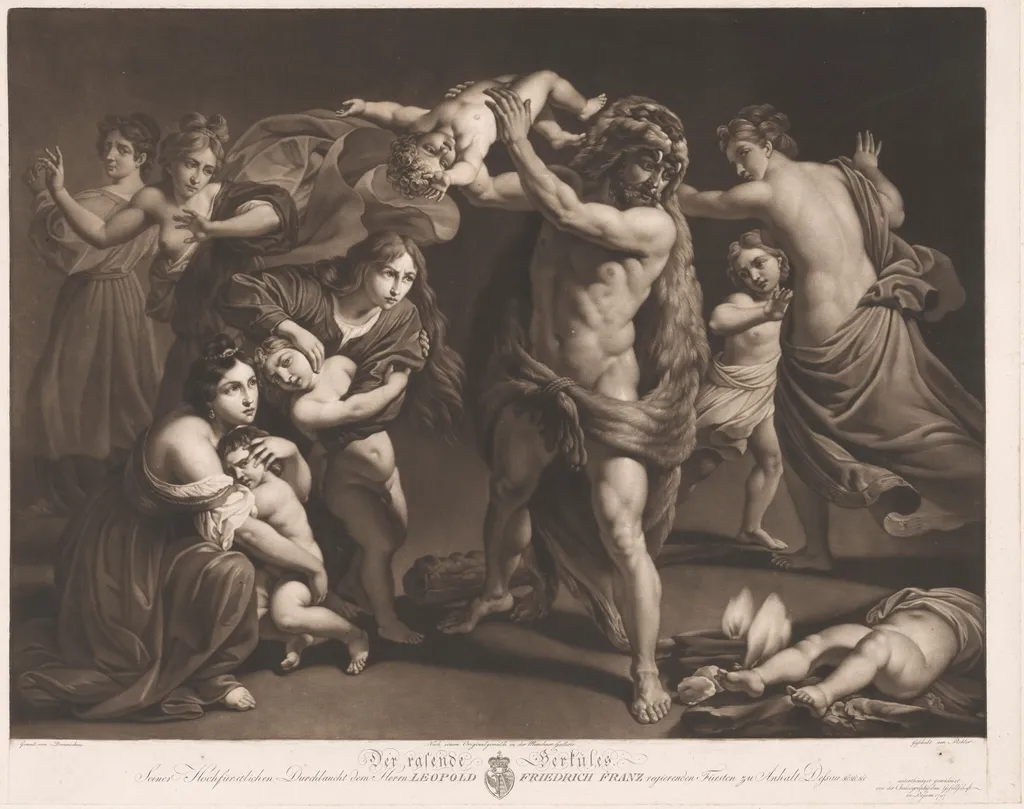
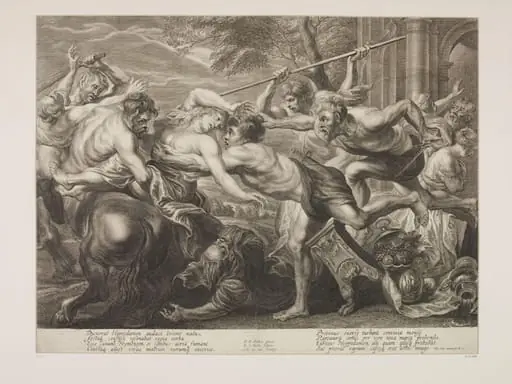
Der rasende Herkules (Raging Hercules) is an ink print by the Romanticist artist Johann Peter Pichler. It dates from 1797 and is held in the collection of the National Gallery of Art.
- Inscription
- Inscribed:lower left in plate: Gemalt von Dominichino.; lower center in plate: Nach einem Originalgemälde in der Münchner Gallerie / Der rasende Herkules / Seiner Hochsfürstlichen Durchlaucht dem Herrn LEOPOLD FRIEDRICH FRANZ regierenden Fürsten zu Anhalt Dessau & & & ; lower right in plate: Geschabt von Pichler / unterthänigst gewidmet / von der Chalcographischen Gesellschaft / in Dessau 1797; by later hand, lower left in graphite: 4279E / I im II; by later hand, upper right in graphite: HERAKLES
About this work
Overview
Johann Peter Pichler’s 1797 mezzotint, Der rasende Herkules, captures a moment of violent emotion from classical myth. Executed in ink on laid paper and later mounted on a support, the print belongs to the National Gallery of Art in Washington, D.C. Its technique emphasizes tonal depth through the mezzotint process, allowing for rich contrasts that heighten the scene’s psychological intensity.
Subject & Meaning
One child lies motionless on the ground, another woman crouches in terror beside him, while others attempt to escape.
The print illustrates Hercules in a fit of madness, a moment from myth after he was driven insane by Hera. Surrounded by fleeing women and children, he embodies uncontrollable fury. One child lies motionless on the ground, another woman crouches in terror beside him, while others attempt to escape.
The scene reflects themes of divine punishment and the fragility of order in the face of primal rage.
Technique & Style
Pichler employed mezzotint, a labor-intensive print method that renders subtle gradations of tone. The dark, velvety background isolates the figures in stark relief, while the play of light across Hercules’ musculature and the women’s garments enhances their emotional states. The composition is tightly focused, with no extraneous detail, directing attention to the confrontation at its center.
History & Provenance
Created in 1797, the print was likely produced for a European audience familiar with classical narratives. It entered the collection of the National Gallery of Art in Washington, D.C., where it remains today. The paper has been laid down onto a backing, a common conservation practice of the period to stabilize fragile prints.
Context
In late 18th-century Europe, mythological subjects were frequently revisited in visual art as vehicles for exploring human emotion and moral consequence. Pichler’s work aligns with a broader interest in dramatic, psychologically charged scenes, influenced by Enlightenment thought and the revival of classical antiquity in art and literature.
Legacy
Though not widely reproduced or celebrated in popular culture, Der rasende Herkules stands as a refined example of late Baroque-influenced printmaking in the German-speaking world. Its emotional gravity and technical precision reflect the continued relevance of myth as a framework for depicting human vulnerability and violence.
Own this work as a print
Artist & collection