Artwork
Oostzijdse Mill along the River Gein by Moonlight
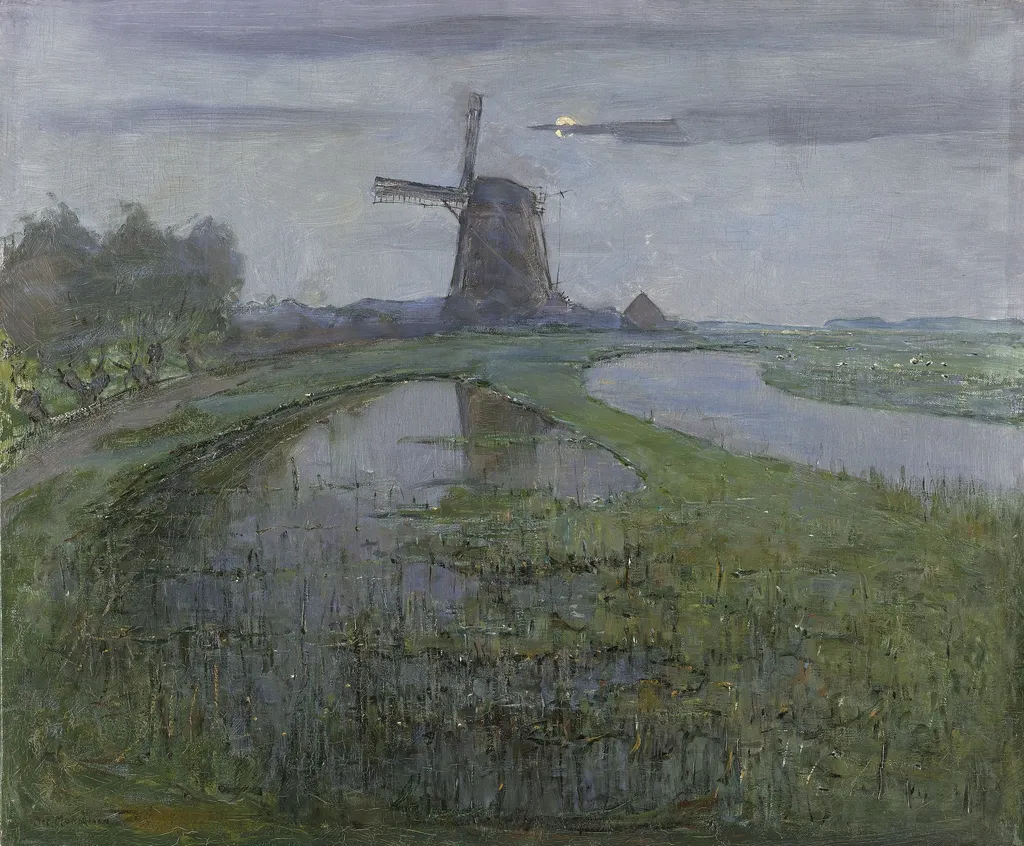
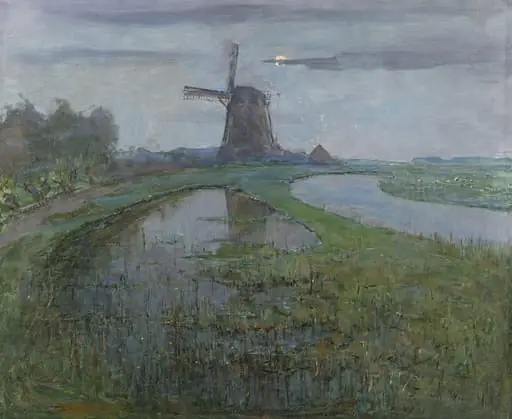
Oostzijdse Mill along the River Gein by Moonlight is an oil painting by the Post-Impressionist artist Piet Mondrian. It dates from 1903 and is held in the collection of the Rijksmuseum.
About this work
Subject & Meaning
The composition captures a rural Dutch setting at night, emphasizing the interplay of moonlight, aquatic plants, and the silhouette of the mill against the sky.
The painting depicts the Oostzijdse Mill situated along the Gein river near Abcoude, rendered as a nocturnal landscape. Created in 1903 during Mondrian's early residence in Amsterdam, the work features the windmill, moon, sky, clouds, and pollard willows reflecting in the wetland water. It represents one of the artist's first night scenes and is part of a series where he painted this specific mill more than twenty times.
The composition captures a rural Dutch setting at night, emphasizing the interplay of moonlight, aquatic plants, and the silhouette of the mill against the sky. This subject matter highlights Mondrian's initial focus on traditional landscape realism before his later abstract evolution.
Technique & Style
The work is an oil painting on canvas, measuring approximately 63 × 75.4 cm, created in the Netherlands in 1903. Mondrian applied thin layers of oil paint to render the moonlit surface of the River Gein, using delicate brushwork to suggest the shimmering reflection and the subtle gradations of night sky. The canvas support provides a smooth ground on which the mill, willow, and wetland are outlined with fine linear detail, while broader tonal washes model the surrounding atmosphere.
The composition is balanced by the vertical axis of the windmill against the horizontal sweep of water, emphasizing a quiet, nocturnal landscape. The painting is signed in the lower left corner and has been part of the Rijksmuseum collection since 2005.
History & Provenance
Oostzijdse Mill along the River Gein by Moonlight was painted in 1903, during Mondrian’s early Amsterdam period (1893‑1905), and is signed ‘Piet Mondriaan’ in the lower left. The work was probably acquired in 1904 as a wedding gift for Carl Christian and Ragnhild Kallenbach Pedersen‑Sarauw of Aabenraa, remaining in their family until 2000 when it was auctioned at Bruun Rasmussen in Copenhagen for 268,676 euro. After a brief stay in a Danish private collection (2000‑2004), it reappeared at Rasmussen in 2004, selling for 174,590 euro.
In 2005 the Rijksmuseum purchased the painting from Simonis & Buunk in Ede for 495,000 euro, with support from the BankGiro Loterij and the Rijksmuseum Fonds.
The painting is held in the Rijksmuseum, Amsterdam. It entered the museum’s collection in 2005 when it was purchased from the dealer Simonis & Buunk for €495,000 with support from the BankGiro Loterij and the Rijksmuseum Fonds. Before that, the work had been in the Pedersen‑Sarauw family, sold at Bruun Rasmussen in 2000 for €268,676, re‑auctioned in 2004 for €174,590, and then held in a Danish private collection until the 2005 sale.
The cited sources do not list an inventory or accession number for the piece, nor do they mention any exhibition history.
Legacy
The painting is recognized as one of Mondrian’s earliest night landscapes and as an early exploration of the Oostzijdse Molen motif, a theme he revisited over twenty times. Its status as a pioneering nocturnal scene contributed to the narrative of Mondrian’s transition toward his later abstract language. The work’s provenance, including a high‑profile sale to the Rijksmuseum in 2005 supported by the BankGiro Loterij, elevated its visibility within Dutch art history, though the acquisition sparked debate over its significance relative to his mature oeuvre.
Overview
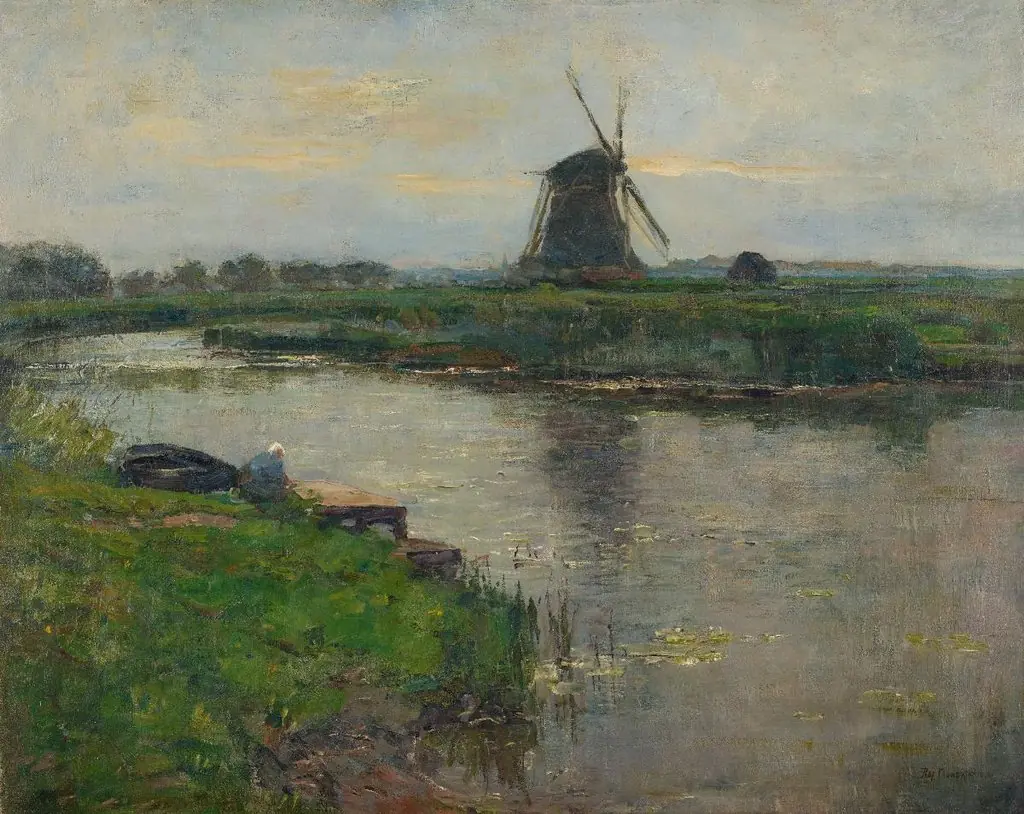
This painting, titled Oostzijdse Mill along the River Gein by Moonlight, is an oil on canvas work. It captures a solitary dark windmill positioned beside a broad, calm river as twilight descends. The composition emphasizes a serene, somewhat melancholic atmosphere, with subtle light effects illuminating the landscape.
The artist employs a distinctive approach to paint application, contributing to the work's overall visual character and emotional resonance.
Own this work as a print
Artist & collection

Artist
Pieter Cornelis Mondriaan (Dutch:; 7 March 1872 – 1 February 1944), known after 1911 as Piet Mondrian (, US also; Dutch: ), was a Dutch painter and art theoretician, who is regarded as one of the greatest artists of the 20th century.