Artwork
A Windmill on a Polder Waterway, Known as ‘In the Month of July’
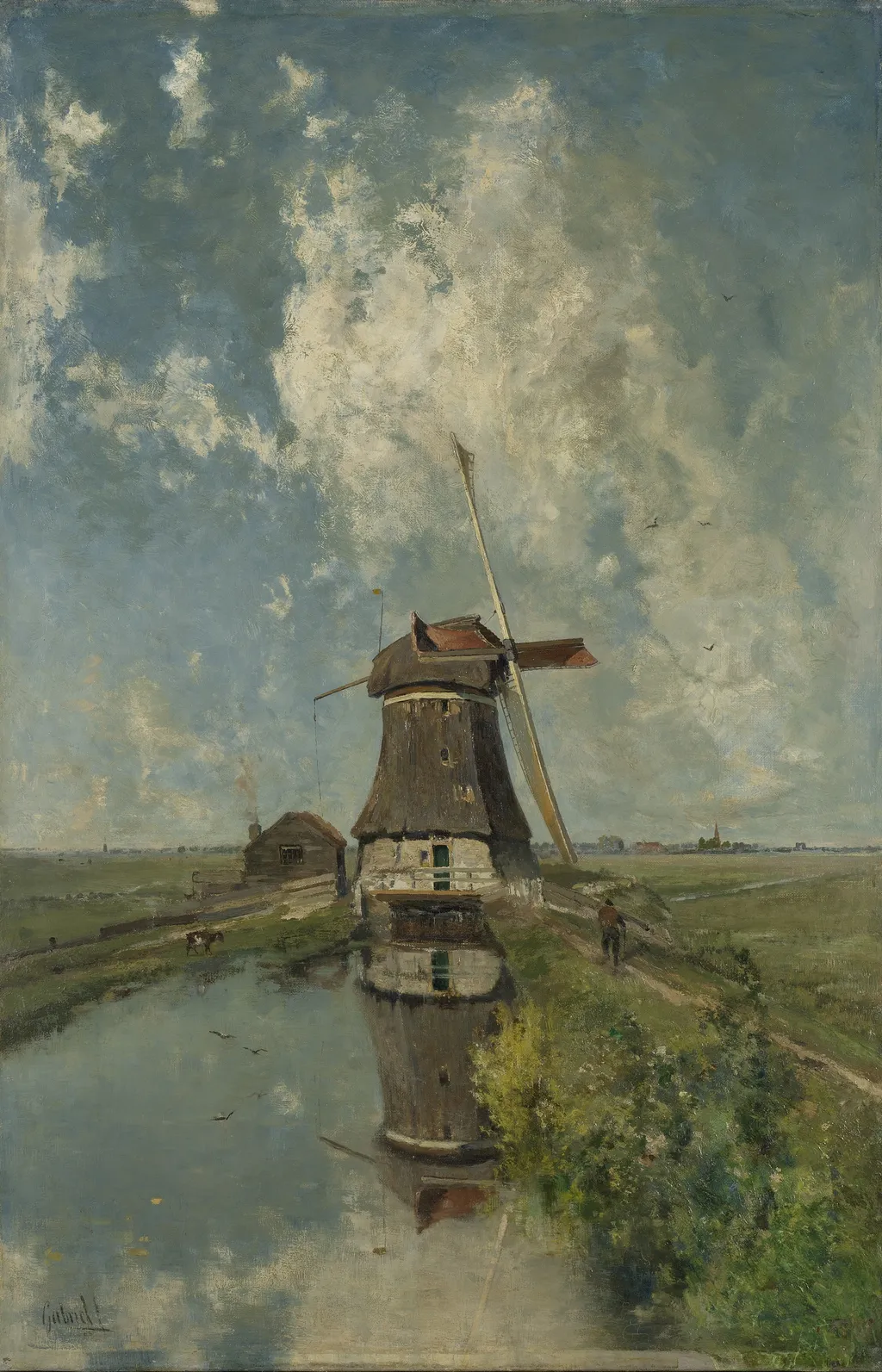
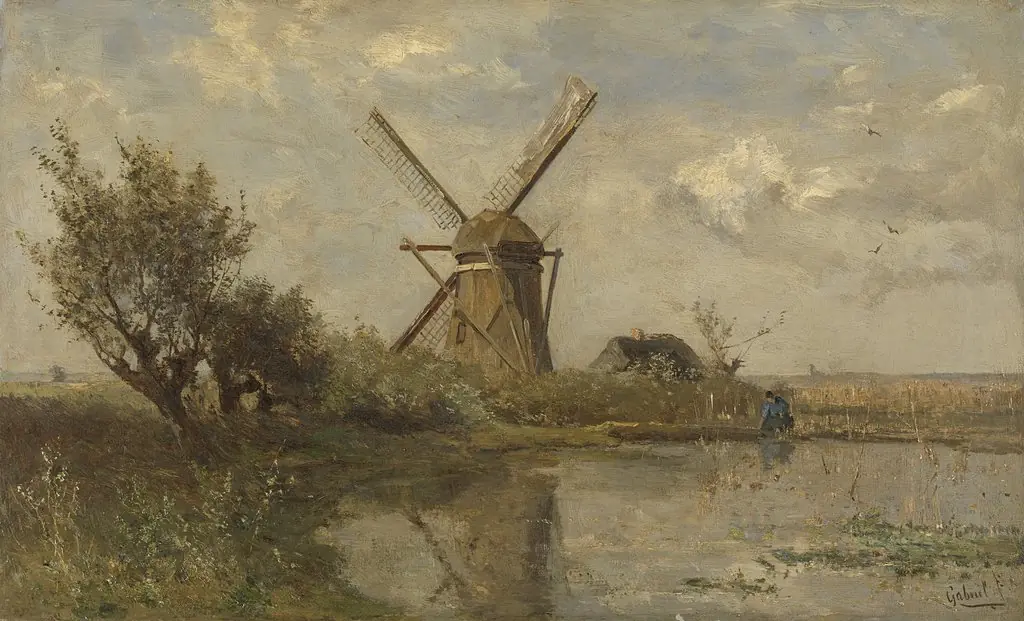
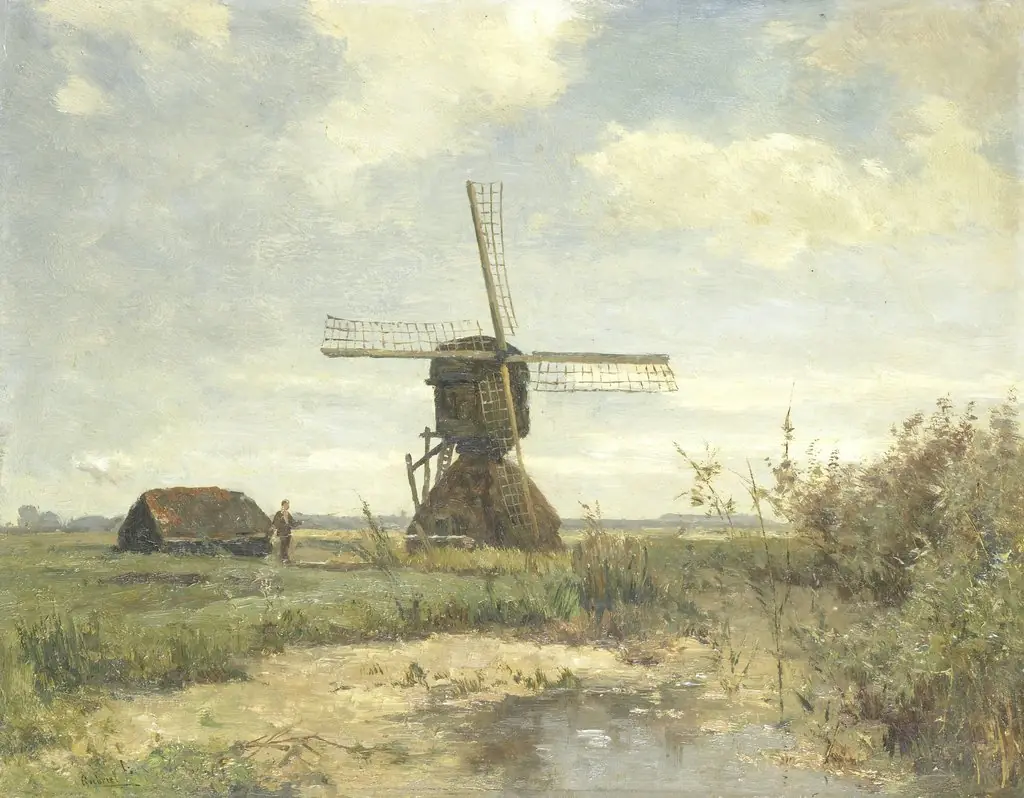
A Windmill on a Polder Waterway, Known as ‘In the Month of July’ is an oil painting by the Impressionist artist Paul Joseph Constantin Gabriël. It dates from 1895 and is held in the collection of the Rijksmuseum.
About this work
A windmill stands at the centre, its sails still against a July sky, the whole scene doubled in the glassy polder water below. Paul Joseph Constantin Gabriël signed it 'Gabriel f,' and the Rijksmuseum bought it in August 1889, the summer it was painted. His insistence that the country is saturated with colour shows in the bright grass, heavy clouds, and sunlit mill on the canal.
Subject & Meaning
The painting depicts a windmill beside a polder waterway on a bright July day, with a man walking along a path, goats grazing, and a house with a chimney in the distance; the scene is bathed in summer light with dramatic clouds reflected in the canal, an effect the writer Nescio later termed 'de dubbele lucht' (the double sky). The subject exemplifies the quintessentially Dutch repertoire that defined Gabriël, who actively sought nostalgia for a vanishing rural world; many windmills were losing their function to steam power, and the Hague School painters viewed this transformation with melancholy. The title itself, 'In the Month of July', anchors the scene in a specific season of fullness, yet the underlying symbolism points to loss and the passage of time, capturing a mood of wistful remembrance for a disappearing landscape.
Technique & Style
The handling is characterized by a vigorous, powerful brushstroke that reveals the influence of Impressionism.
The work is executed in oil paint on a linen canvas support, measuring 102 by 66 centimeters. The handling is characterized by a vigorous, powerful brushstroke that reveals the influence of Impressionism. While adhering to the Hague School’s focus on atmospheric mood, Gabriël deviates from its typical gray tonalities with a notably bright, clear, and contrasting palette.
Formally, the composition exhibits a strong geometric structure: vertical, horizontal, and diagonal lines are emphasized, with the dark doorway of the windmill precisely marking the horizontal midpoint, lending a near-mathematical order that prefigures later modernist principles.
History & Provenance
Paul Joseph Constantin Gabriël painted this work circa 1889, shortly after settling in Scheveningen in 1884 following a long stay in Brussels. The painting was acquired by the Rijksmuseum in August 1889, the same year it was created, and has remained in the museum's collection ever since. Museum records date the work to 1889.
Context
Paul Joseph Constantin Gabriël settled in Scheveningen in 1884 after years in Brussels, at the height of the Hague School's commercial success. Painted circa 1889, In de maand juli exemplifies his nostalgic Holland repertoire, focusing on a windmill, a symbol of a vanishing rural world amid industrialization. The work combines Hague School 'stemming' (mood) with an unusually bright, contrasting palette influenced by Impressionism.
Its strong geometric composition, with precise vertical and horizontal lines, prefigures modernist principles; Piet Mondrian was deeply fascinated by the painting, copying it multiple times in increasingly simplified forms. The Rijksmuseum acquired the work in August 1889, cementing its art-historical significance as a prime example of late Hague School landscape painting.
Legacy
The painting's pronounced geometric structure, emphasizing vertical, horizontal, and diagonal lines, is seen as a precursor to the ordering principles later pursued by 20th-century modernists. This quality deeply fascinated Piet Mondrian, who repeatedly copied the work in his early years, each time rendering it in a more simplified form. Its acquisition by the Rijksmuseum in August 1889 secured its place in a major national collection, cementing its reputation as a representative example of the Hague School and a work of enduring interest for its compositional clarity.
Overview
Paul Joseph Constantin Gabriël's "A Windmill on a Polder Waterway, Known as ‘In the Month of July’" is an oil painting from approximately 1889. It depicts a windmill beside a polder canal during the height of summer. The composition features a house on the left and a figure approaching the mill on the right, with the entire scene strikingly mirrored in the calm water below. The artist signed it "Gabriel f," and the Rijksmuseum acquired it in August of the same year.
Own this work as a print
Artist & collection
Artist
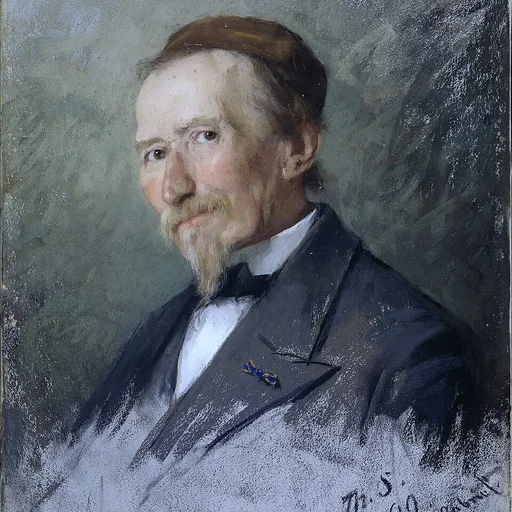
Paul Joseph Constantin Gabriël
Paul Joseph Constantin Gabriël or Paul Gabriël (5 July 1828 – 23 August 1903) was a painter, draftsman, watercolorist, and etcher who belonged to the Hague School.