Artwork
The Coach of Mangkoe Nagoro IV
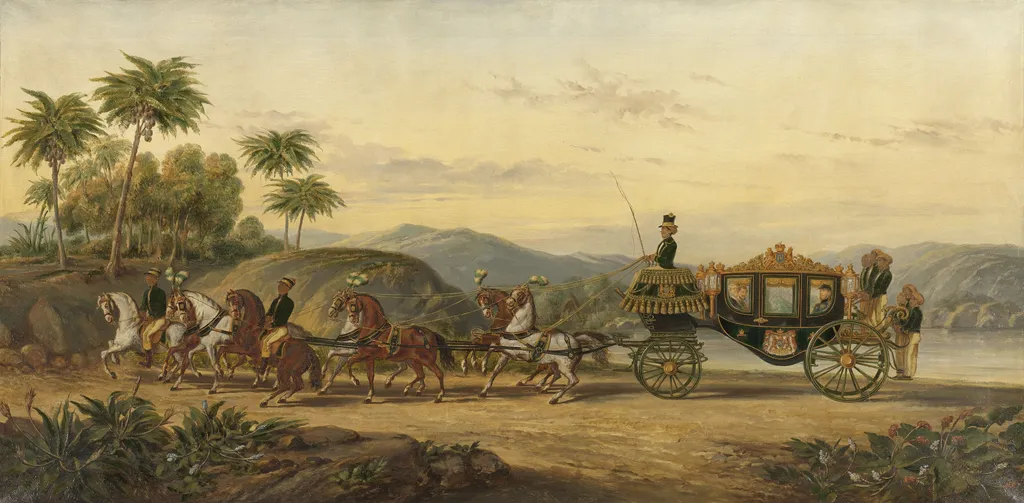
The Coach of Mangkoe Nagoro IV is an oil painting by the Realist artist Pieter Alardus Haaxman. It dates from 1870 and is held in the collection of the Rijksmuseum.
About this work
Subject & Meaning
The painting depicts the Golden Coach of Surakarta, drawn by a horse and set against a backdrop of trees.
The painting depicts the Golden Coach of Surakarta, drawn by a horse and set against a backdrop of trees. The coach itself is the central subject, presented as an emblem of Javanese royal regalia associated with Mangkunegara IV, the ruler of Surakarta under whose authority the ceremonial vehicle was maintained. By isolating the gilded carriage within a natural landscape, the composition frames the coach as both a functional conveyance and a symbol of princely authority, linking the Dutch colonial observer Pieter Alardus Haaxman's 1870 record to the broader iconographic tradition of portraying Indonesian royal power through its most ornate ceremonial objects.
The work thus functions as a visual document of Mangkunegaran sovereignty, with the horse and surrounding foliage serving to situate the gilded coach within a specific Javanese courtly context rather than treating it as a mere object of curiosity.
Technique & Style
Created in 1870, The Coach of Mangkoe Nagoro IV is an oil painting executed on a canvas support. The work measures 160.7 centimeters in width and depicts the Golden Coach of Surakarta alongside horses and trees. As an oil-on-canvas piece by Pieter Alardus Haaxman, the medium allows for the detailed rendering of the carriage and its surrounding natural elements within the composition.
History & Provenance
The Coach of Mangkoe Nagoro IV is held in the collection of the Rijksmuseum, where it is recorded under the accession number SK-A-1870. The work has been part of the museum's exhibition schedule, featuring in displays focused on 19th-century Dutch painting and colonial-era material culture.
Context
The painting The Coach of Mangkoe Nagoro IV by Pieter Alardus Haaxman was created in 1870 and is part of the Rijksmuseum collection in Amsterdam. It depicts the Golden Coach of Surakarta associated with Mangkunegara IV, alongside a horse and a tree. The work is executed in oil on canvas and measures 160.7 centimeters in width.
It is classified as a painting within the broader output of Haaxman, who was active during the late 19th century and known for his historical and ethnographic subjects.
The piece has been discussed in scholarly contexts as an example of colonial-era artistic representations of Javanese royalty, reflecting both European artistic conventions and Indonesian court symbolism. Its presence in a major national museum underscores its significance in Dutch cultural memory and ongoing debates about heritage and representation.
Overview
Pieter Alardus Haaxman's 1870 oil on canvas, titled The Coach of Mangkoe Nagoro IV, presents a ceremonial carriage traversing a rural landscape. The work is part of the Rijksmuseum collection and records a moment of Javanese aristocratic transport, emphasizing the vehicle's ornate design and the surrounding environment.
Artist & collection

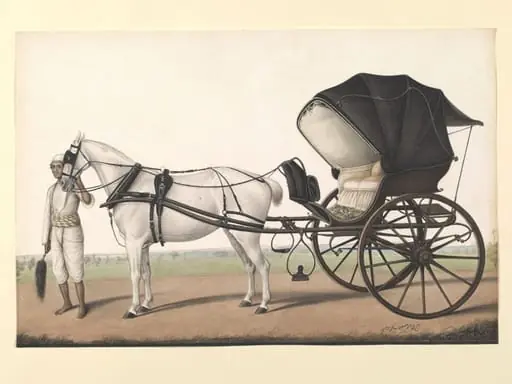 A groom with a horse and carriage
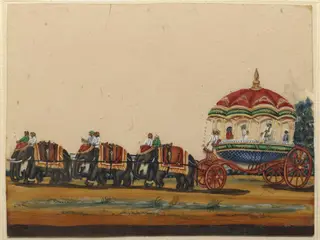 A carriage drawn by six elephants
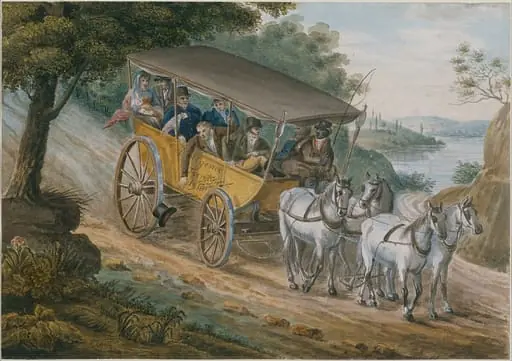 Travel by Stagecoach Near Trenton, New Jersey
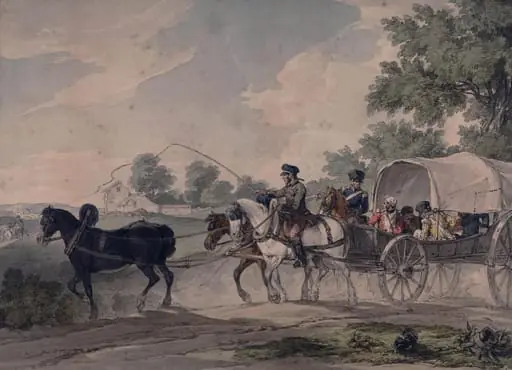 A Belgian Waggon Conveying Wounded from the Field after the Battle of Waterloo
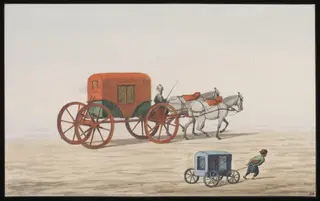 Araba or carriage, and a small araba for children
 Arabas, or carriages
 A closed carriage drawn by bullocks
 Ousreff Pasha returning to Joannina
 Λιμάνι της Πάρου
 False Bay from Wynberg Hill, Cape of Good Hope
 Un alto en la pulpería
- De koets van Mangkoe Nagoro IV