Artwork
Battle of the Nudes
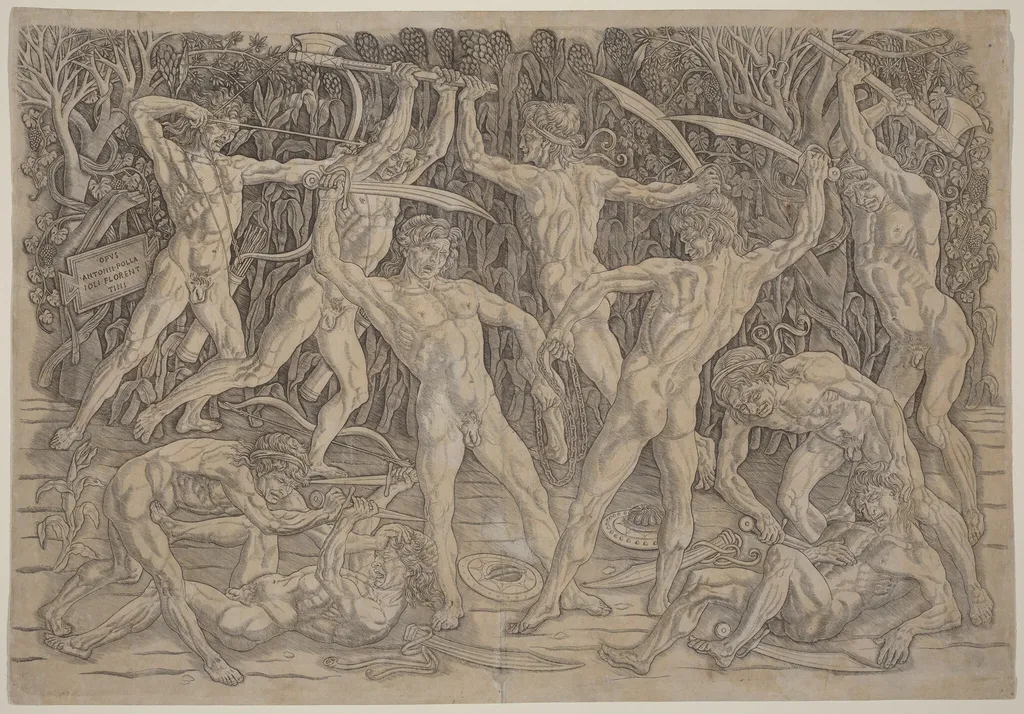
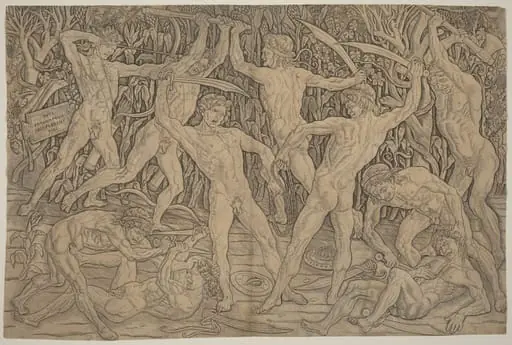
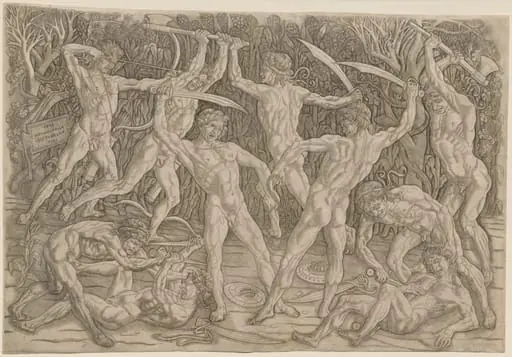
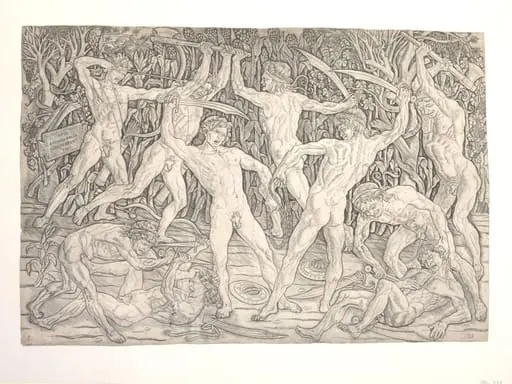
Battle of the Nudes is an ink print by the High Renaissance artist Antonio del Pollaiuolo. It dates from 1472 and is held in the collection of The Nelson-Atkins Museum of Art.
About this work
Technique & Style
Antonio del Pollaiuolo's Battle of the Nudes is a line engraving on laid paper, executed using a burin technique associated with niello work.
Antonio del Pollaiuolo's Battle of the Nudes is a line engraving on laid paper, executed using a burin technique associated with niello work. The engraved surface is exceptionally large for the Quattrocento, with dimensions recorded around 38.1–42.4 cm in height and 56.7–61 cm in width. The print depicts ten nude men fighting in pairs with swords, axes, bows, and daggers against a dense, non-perspectival vegetal backdrop.
Formally, the work is characterized by a classicizing style with fiercely grimacing figures whose musculature is exaggerated and strongly emphasized, appearing almost flayed in extreme contraction. The composition relies on rhythmic contour lines linking the figures, and the two central warriors represent the same figure viewed from front and back, reflecting the concept of varietas. Pollaiuolo employed an effective and largely original return-stroke engraving technique to model the bodies with delicate subtlety.
The plate exists in two states; the unique first-state impression (Cleveland Museum of Art) is considered the finest, while the second state exists in roughly forty-nine impressions, many showing significant plate wear.
History & Provenance
The Battle of the Nudes was engraved in Florence by Antonio del Pollaiuolo, with scholarly estimates for its date ranging from the early 1460s to the mid-1470s; the Italian Wikipedia entry dates it to circa 1460–1465, while the English and French sources settle on the broader span of 1465–1475. The plate bears the prominent Latin signature "OPVS ANTONII POLLAIOLI FLORENTINI" on a tablet at the left, making it the first print to be signed with the artist's full name rather than initials.
A copy of the print is recorded in 1468 in the possession of Francesco Squarcione at Padua, demonstrating that impressions were already circulating in Pollaiuolo's lifetime. The engraving exists in two states: the unique first-state impression, recognized only in 1967, is held by the Cleveland Museum of Art, which acquired it from the Liechtenstein collection. About forty-nine impressions survive from the second state, with the finest held by the Fogg Art Museum at Harvard.
The National Gallery of Art impression in Washington, D.C. passed through the collection of W.G. Russell Allen (1882–1955) of Boston before entering the museum as a gift in 1941.
Multiple impressions of the engraving are held across various institutions. The Cleveland Museum of Art holds the unique first-state impression, acquired from the Liechtenstein collection in 1967. The National Gallery of Art in Washington, D.C. holds a second-state impression gifted by W.G. Russell Allen in 1941.
Other impressions reside in the Metropolitan Museum of Art, the Cincinnati Art Museum, the Museum Boijmans Van Beuningen, and the Nelson-Atkins Museum of Art. The finest second-state impression is at the Fogg Art Museum at Harvard. Additional copies are located in the Gabinetto dei Disegni e delle Stampe in Florence and the Biblioteca Marucelliana, the latter of which was exhibited in Ferrara during a 2016–2017 show commemorating the 500th anniversary of Orlando Furioso.
Context
Antonio del Pollaiuolo’s Battle of the Nudes occupies a pivotal place in Renaissance printmaking and anatomical inquiry. Early commentators such as Vasari emphasized the artist’s modern grasp of the nude, crediting him with systematic dissection to render musculature with unprecedented clarity and placing each muscle in its correct position within the figure. This anatomical ambition, combined with the print’s large scale and prominent signature, distinguished it from earlier Italian engravings and aligned it with the period’s turn toward empirical study of the human body.
Scholars have long debated the work’s narrative meaning, with proposals ranging from classical gladiatorial combat to a social allegory of class conflict drawn from fourteenth-century legal treatises. Recent readings suggest the print’s iconography may reflect contemporary debates about nobility and reprisals, identifiable through variations in armor and weaponry among the combatants. Regardless of subject, the composition’s emphasis on dynamic poses and varied viewpoints, evident in the paired front-and-back figures at center, functioned as a technical repertory for artists, influencing figures as diverse as Mantegna and Raphael.
The print’s technical and thematic innovations secured its status as one of the most significant old master engravings. Its large dimensions and advanced burin technique, often linked to the goldsmith’s niello practice, underscored Pollaiuolo’s engagement with both artistic tradition and contemporary scientific curiosity.
Legacy
The Battle of the Nudes is recognized as one of the most significant old master prints of the Italian Renaissance, securing Antonio del Pollaiuolo extraordinary fame that extended well beyond Tuscany into Northern Europe. Its primary legacy lies in its function as a visual repository of anatomical poses; the print's depiction of strained, muscular figures in varied athletic positions was likely intended to provide other artists with models to copy. This influence is evident in direct imitations, including a drawing attributed to Raphael and Jacopo de' Barbari's Battle Between Satyrs and Men.
The work also impacted major commissions, influencing Perugino's Combat Between Love and Chastity and Michelangelo's Battle of Cascina. Copies in engraving and woodcut appeared shortly after its creation, such as one by Johannes of Frankfurt around 1490, while an early copy was recorded in the possession of Francesco Squarcione in Padua by 1468.
Overview
Antonio del Pollaiuolo’s print, commonly titled Battle of the Nudes, is a large engraving measuring roughly 42 by 61 centimetres. Executed in the latter half of the 1460s, the work presents a crowded melee of ten male figures, five of whom wear simple headbands while the others are completely unclothed. The combatants are shown in pairs, each brandishing a sword, dagger or shield, set against a densely vegetated backdrop.
Subject & Meaning
The composition captures a moment of violent confrontation, emphasizing the physicality of the human body in motion. By contrasting the banded figures with the fully nude participants, the artist draws attention to the anatomy and muscular tension of the fighters, suggesting an interest in the study of the human form as well as the drama of conflict.
Own this work as a print
Artist & collection

Artist
Antonio del Pollaiuolo wasn’t just a painter, he started as a goldsmith, making fancy jewelry in Florence.

![Battle of the Sea Gods [left half], by Andrea Mantegna](https://artifactworldgallery.com/img/andrea-mantegna--battle-of-the-sea-gods-left-half--2510247af42f8c24-w320.webp)