Artwork
The God Izanagi and Goddess Izanami
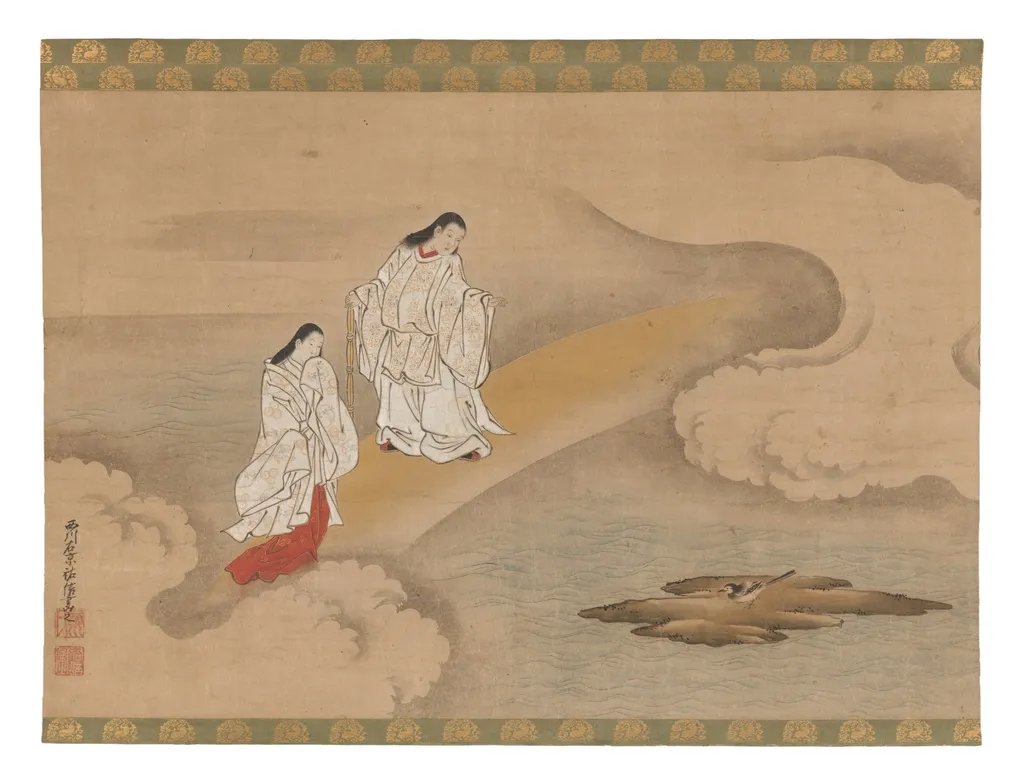
The God Izanagi and Goddess Izanami is an unspecified painting by the Rococo painting artist Nishikawa Sukenobu. It dates from 1725 and is held in the collection of the Metropolitan Museum of Art.
About this work
Subject & Meaning
Its signature identifies the artist as Nishikawa Sukenobu (西川祐信), with additional seals confirming his name and authorship.
The painting depicts the primordial Japanese creator deities Izanagi and Izanami on the heavenly floating bridge (Ame-no-ukihashi) as they prepare to form the first island. According to the myth, Izanagi stirs the primordial salt sea with the heavenly spear Ame-no-nuboko, causing droplets to fall and solidify into Onogoroshima, where a Sekirei (mistaken for a crane) appears and draws their attention, marking the moment of creation.
The composition shows Izanagi holding the spear aloft after drawing it from the water, with Izanami covering her mouth in surprise, both gazing toward the emerging island where the bird rests. Sukenobu renders the scene with delicate colors and fine linework typical of his ukiyo-e style, though this subject departs from his usual depictions of beauties.
The work is part of a hanging scroll (kakemono) now held by the Metropolitan Museum of Art, measuring 125.5 cm in length and 74.7 cm in width. Its signature identifies the artist as Nishikawa Sukenobu (西川祐信), with additional seals confirming his name and authorship.
Technique & Style
The work is a colored ink painting (farbige Tuschmalerei) by Nishikawa Sukenobu, executed in 1725. Sukenobu rendered the scene with delicate coloration and fine linework (zarte Farben und feine Linienführung), reflecting the graceful figural style for which he was known in his ukiyo-e depictions of beautiful women.
The painting is mounted as a hanging scroll (掛け物, kakemono), with the central painted panel flanked above and below by borders and framed by a mounting decorated with colorful floral and striped patterns. The support is a single sheet of paper, measuring 125.5 cm in length and 74.7 cm in width. The scroll is held flat by two cylindrical rods at top and bottom, the lower rod being thicker and heavier than the upper to keep the scroll smooth against the wall, with two long cords attached to the upper rod for tying the rolled scroll closed. The mounting itself may be a later addition.
A signature along the left edge reads "Nishikawa Ukyō Sukenobu kore [o] gaku no" ("Nishikawa Ukyō Sukenobu painted this"), accompanied by two square seals bearing slightly variant inscriptions identifying the artist and his clan name.
History & Provenance
Created in 1725 by the Japanese artist Nishikawa Sukenobu, this colored ink painting depicts the creation myth of Izanagi and Izanami. The work's original title is not recorded, though it bears a signature identifying the creator as Nishikawa Ukyō Sukenobu along with corresponding seals. The piece is executed on a paper scroll that has been mounted as a hanging scroll (kakemono), featuring decorative floral and striped borders around the central image.
While the painting itself dates to the early eighteenth century, the surrounding mounting may represent a later addition. The artwork is currently held in the collection of the Metropolitan Museum of Art in New York.
The painting The God Izanagi and Goddess Izanami by Nishikawa Sukenobu is held in the collection of the Metropolitan Museum of Art in New York. Created in 1725, the work is a colored ink painting on paper mounted as a hanging scroll. While the museum is identified as the current location, the provided sources do not specify an accession number or inventory code for the piece.
The original title of the work is not recorded, with the current title being a modern designation. The sources confirm the artwork's presence in the museum's holdings but do not list any specific exhibition history or dates of public display.
Context
The painting depicting the Japanese creator deities Izanagi and Izanami was executed in 1725 by Nishikawa Sukenobu, a Kyoto-based artist renowned for bijin-ga (pictures of beautiful women). The work belongs to a hanging scroll (kakemono) in the Metropolitan Museum of Art and visualizes the myth of the world's origin as described in the Kojiki and Nihonshoki, focusing on the moment Izanagi raises the heavenly spear and the first island emerges from the salt spray. Sukenobu’s composition shows the pair on the celestial bridge, with Izanami covering her mouth in surprise and Izanagi holding the spear that has just generated the island, while a Sekirei (heron) appears as a fertility symbol.
The piece combines delicate coloration and fine linework, contrasting with Sukenobu’s typical subjects, and bears his signature identifying him as the creator.
Legacy
The work depicting Izanagi and Izanami has influenced subsequent representations of Japanese creation myths in ukiyo-e and modern visual culture, often cited for its delicate coloration and narrative precision. Scholars highlight its role in shaping the visual language of mythic couples, particularly the motif of the celestial bridge and the emergence of Onogoroshima, which appears in later woodblock prints and scholarly analyses of Edo-period mythological art. The painting's inclusion in the Metropolitan Museum of Art collection has increased its visibility in Western academic discourse, where it is referenced as an early example of mythological subject matter rendered with ukiyo-e aesthetics.
Its legacy is primarily documented in specialized art history literature focusing on Japanese mythological imagery and the oeuvre of Nishikawa Sukenobu.
Overview
Created in 1725 by the Edo‑period painter Nishikawa Sukenobu, this work portrays the mythic pair Izanagi and Izanami. Executed on paper with ink and subtle pigments, the image is part of the Metropolitan Museum of Art’s collection. The composition places the two deities on a gently curving path, set against a tranquil sky and water backdrop that lends depth to the scene.
Own this work as a print
Artist & collection

- Genji Monogatari
 Beauties at the Seashore
 Beauties at the Seashore
 井手の玉川|Jewel River at Ide (Ide no Tamagawa)
 Section of Jin'o-ji Engi Emaki (Konin Shonin E-den)
 Illustrated Legends of the Origins of the Kumano Shrines (Kumano engi emaki)
 Three scenes from festivals of the twelve months
 Genji Monogatari
 Untitled
 秋夜長物語絵巻断簡|The Final Scene from A Long Tale for an Autumn Night (Aki no yonaga monogatari)
 Untitled
 名繪集珍 冊 唐周昉士女吟詩圖