Artwork
Self-Portrait
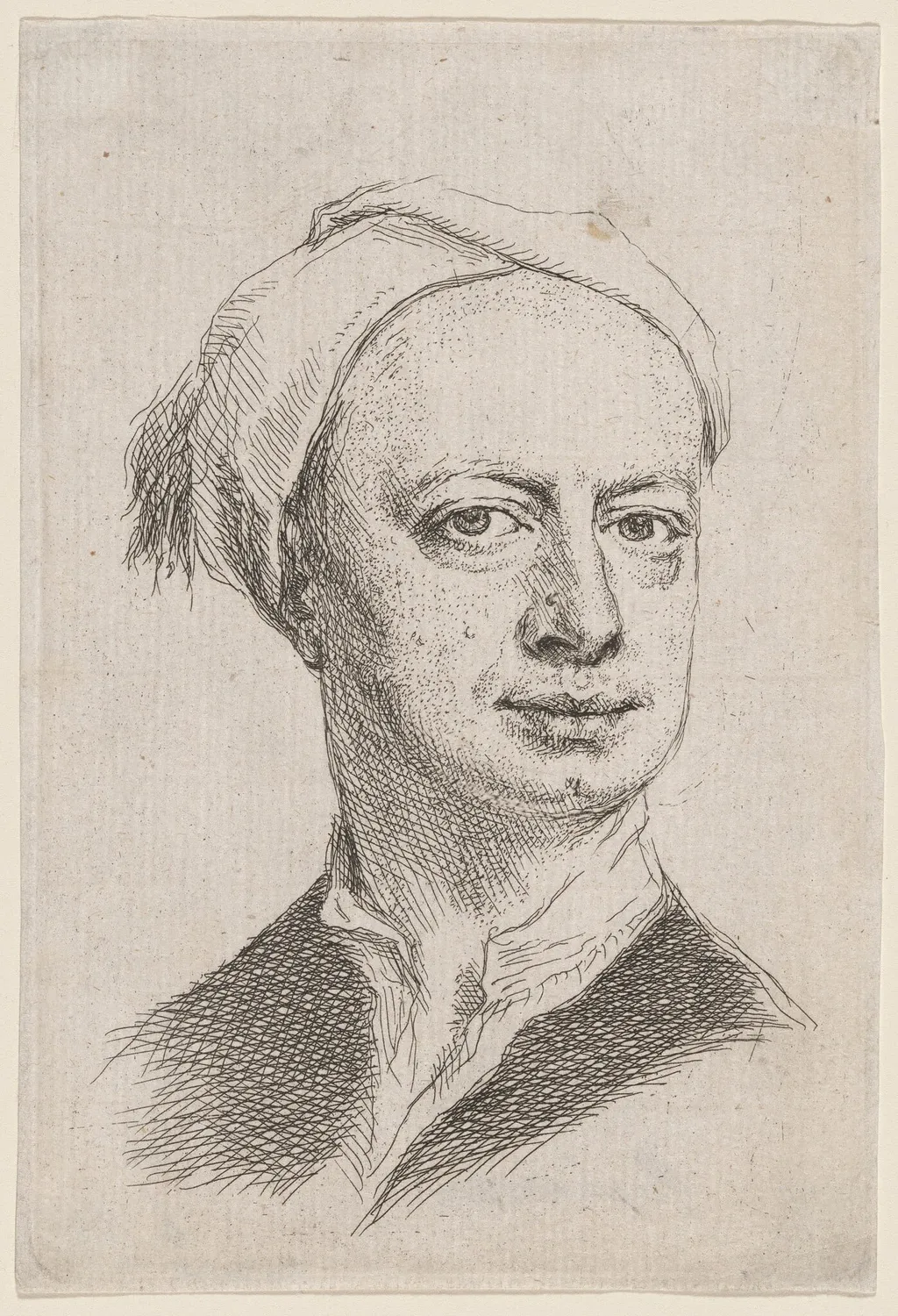
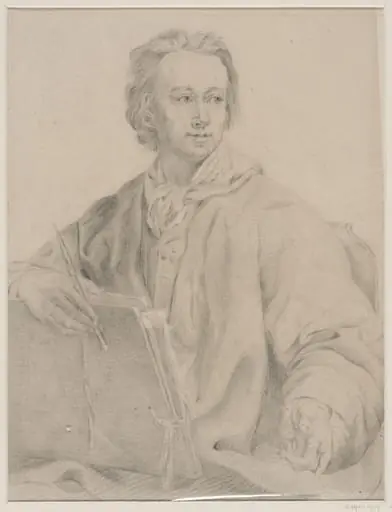
Self-Portrait is an ink print by the Baroque artist Richardson, Jr., Jonathan. It is held in the collection of the National Gallery of Art. This etching, created around 1740 by Jonathan Richardson, Jr.
- Inscription
- Inscribed:by later hand, lower center verso in graphite: Richardson 6
About this work
Overview
The surface is defined by delicate, irregular marks rather than smooth contours, reflecting a hand-engraved approach common in mid-18th-century printmaking.
This etching, created around 1740 by Jonathan Richardson, Jr., presents a profile view of the artist’s own face. Executed on laid paper, the work is a modest yet precise study in line and tone. The image captures only the head and upper shoulders, with the collar of a dark garment barely visible.
The surface is defined by delicate, irregular marks rather than smooth contours, reflecting a hand-engraved approach common in mid-18th-century printmaking.
Subject & Meaning
The portrait is a personal record, not a formal commission. Richardson depicts himself in unadorned profile, avoiding idealization. The lack of ornamentation and the direct, unsmiling gaze suggest introspection rather than public presentation.
As an artist documenting his own likeness, he engages in a quiet act of self-examination, common among practitioners of the time who used prints to assert professional identity.
Technique & Style
The image employs drypoint, a technique in which a sharp needle scratches directly into the metal plate, leaving a burr that holds ink and creates soft, fuzzy lines. The hair and shadowed areas are rendered with dense, scratchy strokes, while the face is modeled with sparse, dotted hatching. Unlike etching, which uses acid to bite lines, drypoint relies on physical incision, yielding a tactile, intimate quality suited to private studies.
History & Provenance
Created circa 1740, the etching likely served as a personal keepsake or a reference for other artists. Richardson, Jr., was known for his writings on art theory and his role in London’s artistic circles, but few of his prints survive in large numbers. This impression is among the few extant examples of his graphic work, possibly passed through private collections before entering institutional holdings.
Context
In early 18th-century England, artists increasingly turned to prints to circulate their likenesses and ideas. While grand portraits were reserved for oil, etchings and drypoints offered a modest, reproducible medium for self-representation. Richardson’s work aligns with a broader trend among British artists who used printmaking to assert intellectual and professional presence beyond the confines of the academy.
Legacy
Though not widely reproduced or celebrated in his lifetime, Richardson’s etching remains a quiet testament to the artist’s engagement with self-portraiture as a reflective practice. It exemplifies how technical restraint and personal subjectivity could coexist in printmaking, influencing later generations who valued the intimacy of hand-drawn imagery over polished finish.
Own this work as a print
Artist & collection

![Head of a Gentleman [recto], by Joseph Ducreux](https://artifactworldgallery.com/img/joseph-ducreux--head-of-a-gentleman-recto--30a49475a608e388-w320.webp)