Artwork
Making the Splice between the Shore End and the Ocean Cable
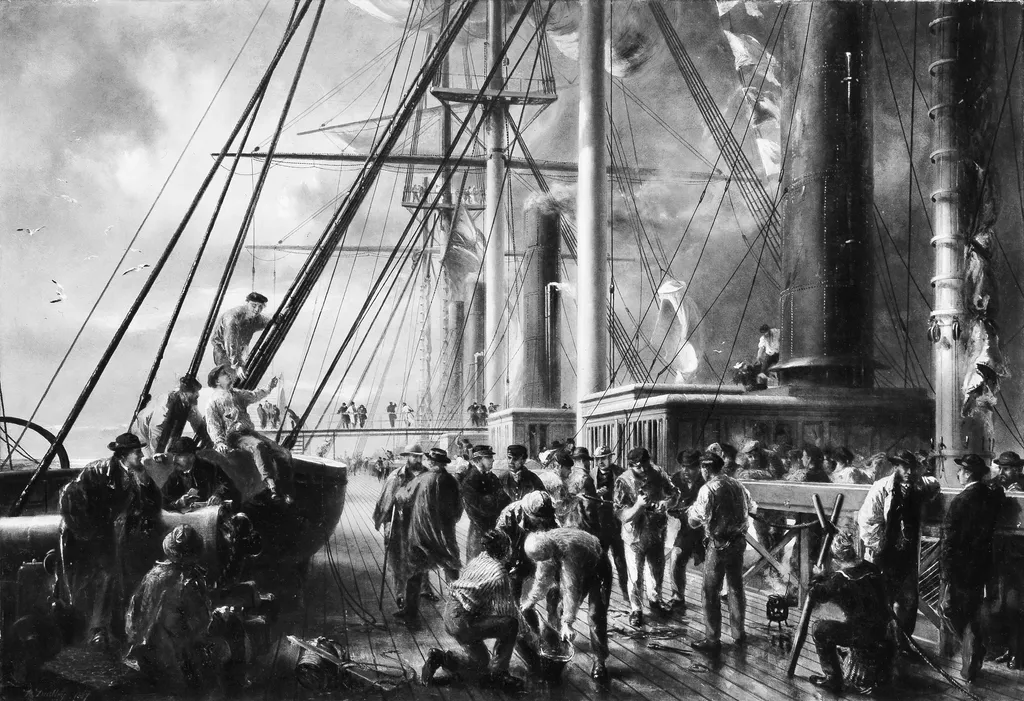
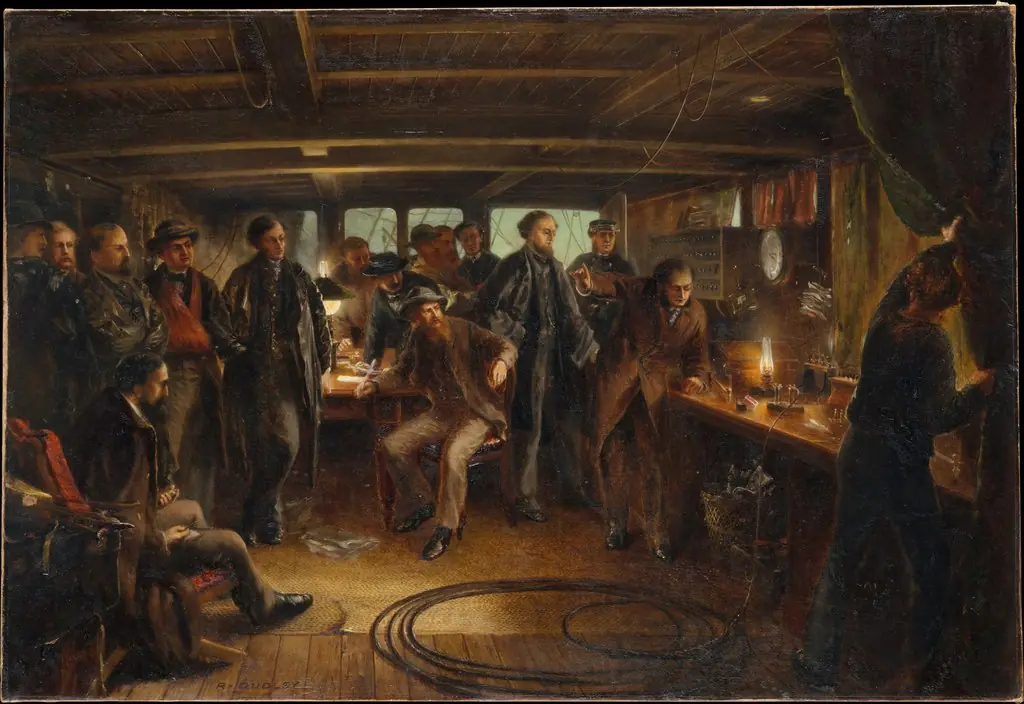
Making the Splice between the Shore End and the Ocean Cable is an oil painting by the Realist artist Robert Charles Dudley. It dates from 1866 and is held in the collection of the Metropolitan Museum of Art.
About this work
In the background, you can see the ship’s tall masts and a smokestack on land, with more people gathered on a platform.
This painting shows a busy ship deck with a crowd of men working together. Some are climbing ropes, others are handling thick cables, and a few stand near a large wooden spool. In the background, you can see the ship’s tall masts and a smokestack on land, with more people gathered on a platform.
The painting focuses on the moment when two ends of a long cable are joined, one from the ship, one from shore. This was a big deal in 1866, as it helped connect the first successful transatlantic telegraph line.
Next, look up transatlantic telegraph cable to see how this changed communication forever.
Subject & Meaning
The painting depicts the historic moment of joining the shore end to the transatlantic telegraph cable aboard a ship in 1866. The subject centers on the technical and human effort required to complete the first successful transatlantic telegraph link, featuring men engaged in the delicate process of splicing the cable. Iconographically, the work emphasizes the intersection of maritime labor and technological progress, portraying the cable as a symbol of global connectivity.
The scene represents the triumph of engineering over vast oceanic distances, capturing a pivotal achievement in communication history. The presence of the ship and the focused activity of the crew underscore the collaborative nature of this monumental endeavor.
Technique & Style
The work titled Making the Splice between the Shore End and the Ocean Cable is executed in oil paint on canvas, a conventional support for 19th‑century maritime subjects. Dudley’s technique involves fine brushwork that renders the ship’s rigging and the coiled telegraph cable with crisp detail, while the surrounding sky and sea are laid down in layered washes to suggest depth and atmospheric perspective. The canvas measures approximately 57.8 cm by 84.5 cm, providing a horizontal format that emphasizes the linear progression of the cable toward the horizon.
The composition balances realistic documentation with a modest romanticism, highlighting the technological achievement through careful attention to material texture and spatial arrangement. The painting is housed in the Metropolitan Museum of Art, where its condition remains stable under standard museum conservation practices.
History & Provenance
The painting Making the Splice between the Shore End and the Ocean Cable was created by Robert Charles Dudley in 1866, as indicated by both the artist’s date and the Wikidata record. The work depicts the critical moment of joining the shore-end and deep-sea sections of the first successful transatlantic telegraph cable, a technological milestone completed in 1866. By 2024, the painting was in the collection of the Metropolitan Museum of Art, where it is catalogued as an oil on canvas measuring 57.8 cm in height and 84.5 cm in width.
The painting is held by the Metropolitan Museum of Art, New York, where it is inventoried as accession number 1975.1.238. It was first publicly exhibited in 1866, the same year as its creation, and has since been displayed at the museum as part of its permanent collection.
Overview
Robert Charles Dudley's oil painting, Making the Splice between the Shore End and the Ocean Cable, dates from 1866. This work captures a pivotal moment in technological history: the connection of the first successful transatlantic telegraph line. The canvas, now housed at The Metropolitan Museum of Art, presents a detailed scene of maritime industry, focusing on the intricate process of joining the massive communication cable.
Context
The successful laying of the transatlantic telegraph cable in 1866 marked a profound shift in global communication. Before this feat, messages between Europe and North America relied on ships, taking weeks to deliver. Dudley's painting commemorates the culmination of years of effort and multiple failed attempts to bridge this vast distance electronically.
The completion of the cable dramatically reduced communication time, fostering closer political, economic, and social ties between continents.
Own this work as a print
Artist & collection

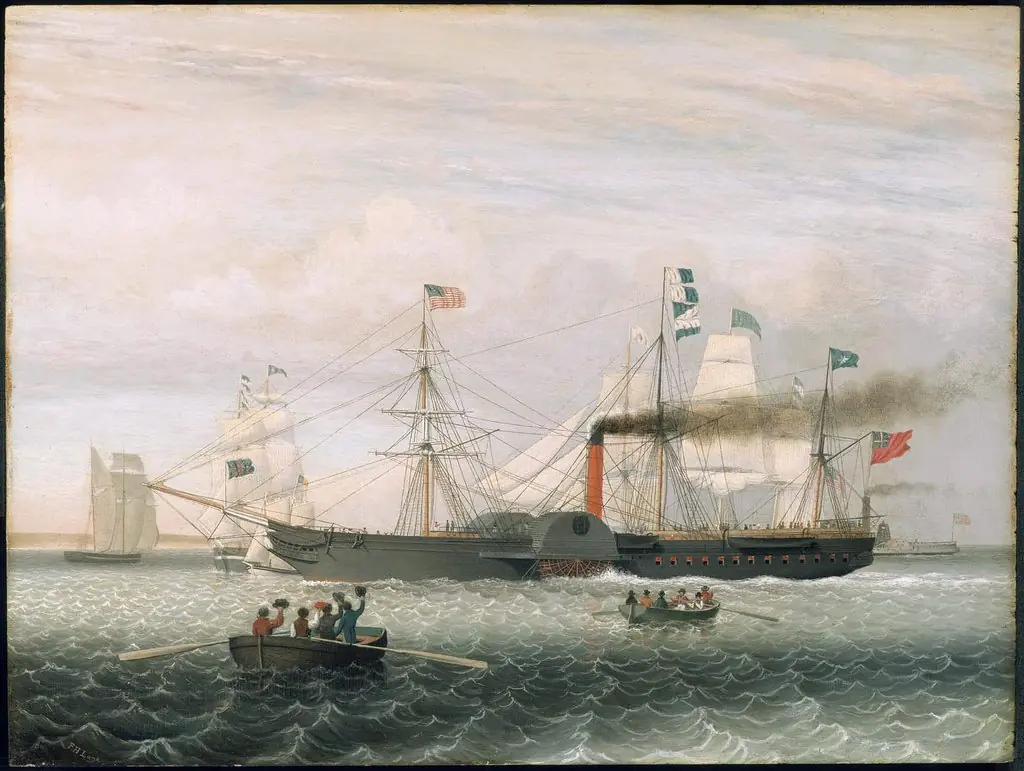 The Britannia Entering Boston Harbor
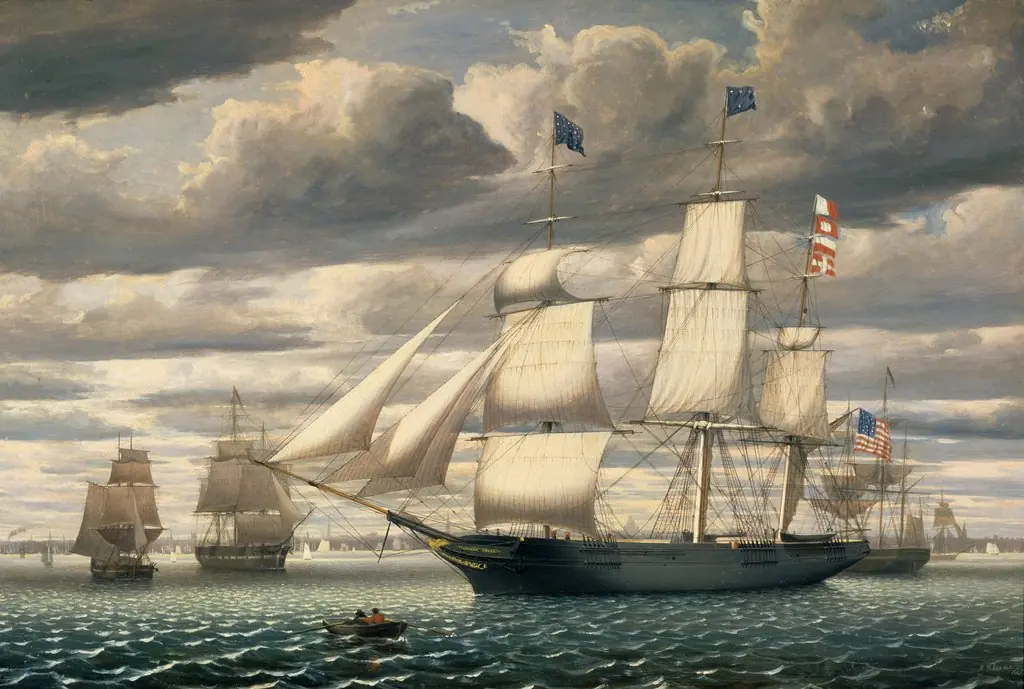 Ship Southern Cross in Boston Harbor, 1851
 Den danske eskadre under sejl på Københavns rhed
 The United States Frigate "President" Engaging the British Squadron, 1815
 The Harbour at Nieuwe Diep in North Holland
 Den danske eskadre under sejl på Københavns rhed
 An Emigrant Ship, Dublin Bay, Sunset
 The Starboard Battery and the Deck of the Corvette "Najaden"
 New York Bay and Harbor
 The Harbour at Nieuwe Diep in North Holland
 South Sea Whale Fishing II