Artwork
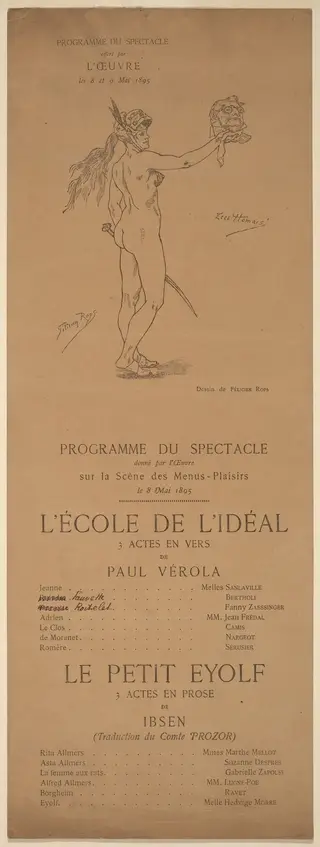
L'Ecole de l'idéal; Le Petit Eyolf
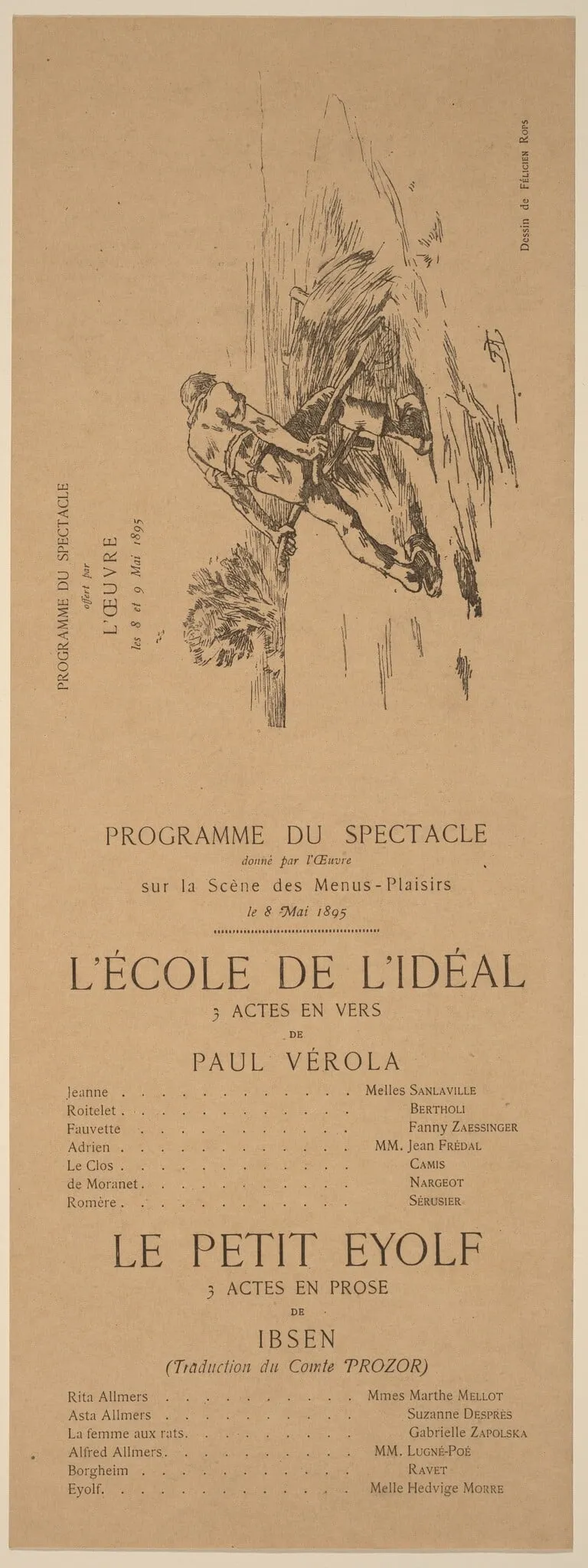
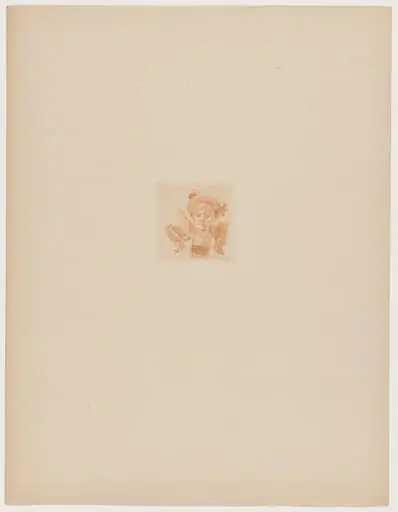
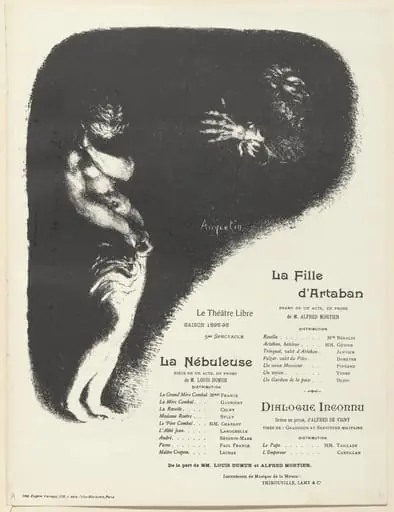
L'Ecole de l'idéal; Le Petit Eyolf is a print by the Impressionist artist Félicien Rops. It dates from 1895 and is held in the collection of the National Gallery of Art.
- Inscription
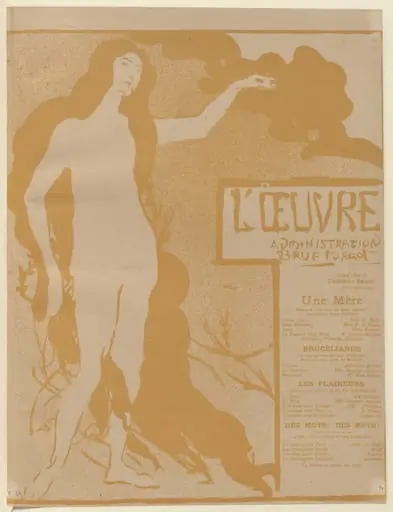
- Inscribed:lower right in plate: FR; lower right printed: Dessin de FÉLICIEN ROPS; upper center printed: PROGRAMME DU SPECTACLE / offert par / L'OEUVRE / le 8 et 9 Mai 1895; across left side printed: PROGRAMME DU SPECTACLE / donné par l'OEuvre / sur la Scène des Menus-Plaisirs / le 8 Mai 1895 / L'ÉCOLE DE L'IDÉAL / 3 ACTES EN VERS DE PAUL VÉROLA... / LE PETIT EYOLF / 3 ACTED EN PROSE / DE / IBSEN...
About this work
The title, "L'Ecole de l'idéal; Le Petit Eyolf," is written in large letters at the bottom, with the names of the actors listed below.
This image is a poster for a theatrical performance, featuring a sketch of a man climbing a tree. The title, "L'Ecole de l'idéal; Le Petit Eyolf," is written in large letters at the bottom, with the names of the actors listed below. The background is a light brown color, with some darker shading around the edges.
The sketch of the man climbing the tree is rendered in a loose, expressive style, with bold lines and minimal detail. The overall effect is one of energy and movement, as if the man is about to leap from the tree at any moment.
The poster appears to be from the late 19th century, and its style is reminiscent of Impressionist art. For more information on this style, you can explore the movement of Impressionism.
Overview
Created in 1895, L'Ecole de l'idéal; Le Petit Eyolf is a print produced by Belgian artist Félicien Rops. Executed with a photomechanical technique on light‑brown wove paper, the work functions as a theatrical poster, announcing a performance and listing the cast. Its composition centers on a dynamic sketch of a man ascending a tree, rendered with bold, gestural lines that convey a sense of motion.
Subject & Meaning
The central figure, a man climbing a tree, suggests ambition or ascent, resonating with the title’s reference to an "school of the ideal" and the play’s name, Le Petit Eyolf. By foregrounding this energetic pose, the image hints at themes of youthful striving and artistic aspiration, aligning the visual narrative with the theatrical content it promotes.
Technique & Style
Rops employed a photomechanical process, a method that reproduces photographic detail through printing, on a light‑brown wove paper substrate. The figure is drawn in a loose, expressive manner, with strong contour lines and minimal shading, echoing the vigor of late‑19th‑century Impressionist poster art while retaining Rops’s characteristic emphasis on line.
History & Provenance
The print emerged from Rops’s involvement with the avant‑garde Les XX circle in Paris, a group that championed innovative visual approaches. Though Rops was better known for his paintings, illustrations, and intaglio prints, this work illustrates his foray into commercial poster design during the fin de siècle, a period when he received limited public acclaim despite his technical reputation.
Context
Produced at a time when theatrical advertising increasingly adopted artistic designs, the poster reflects the broader trend of integrating fine‑art aesthetics into mass‑produced graphics. Rops’s background in caricature and Symbolist circles informed the work’s energetic yet slightly satirical tone, situating it within the cultural ferment of late 19th‑century Paris.
Artist & collection
Artist
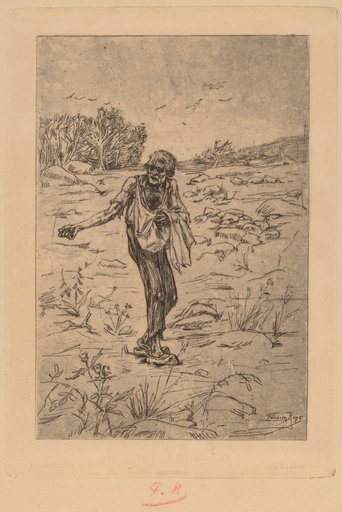
Félicien Victor Joseph Rops (French: ; 7 July 1833 – 23 August 1898) was a Belgian artist associated with Symbolism, Decadence, and the Parisian fin de siècle, and was a member of the Les XX group.

![Les chaises [lower half], by Gabriel de Saint-Aubin](https://artifactworldgallery.com/img/gabriel-de-saint-aubin--les-chaises-lower-half--64ee3834eccfb109-w320.webp)