Artwork
L'Ecole de l'idéal; Le Petit Eyolf
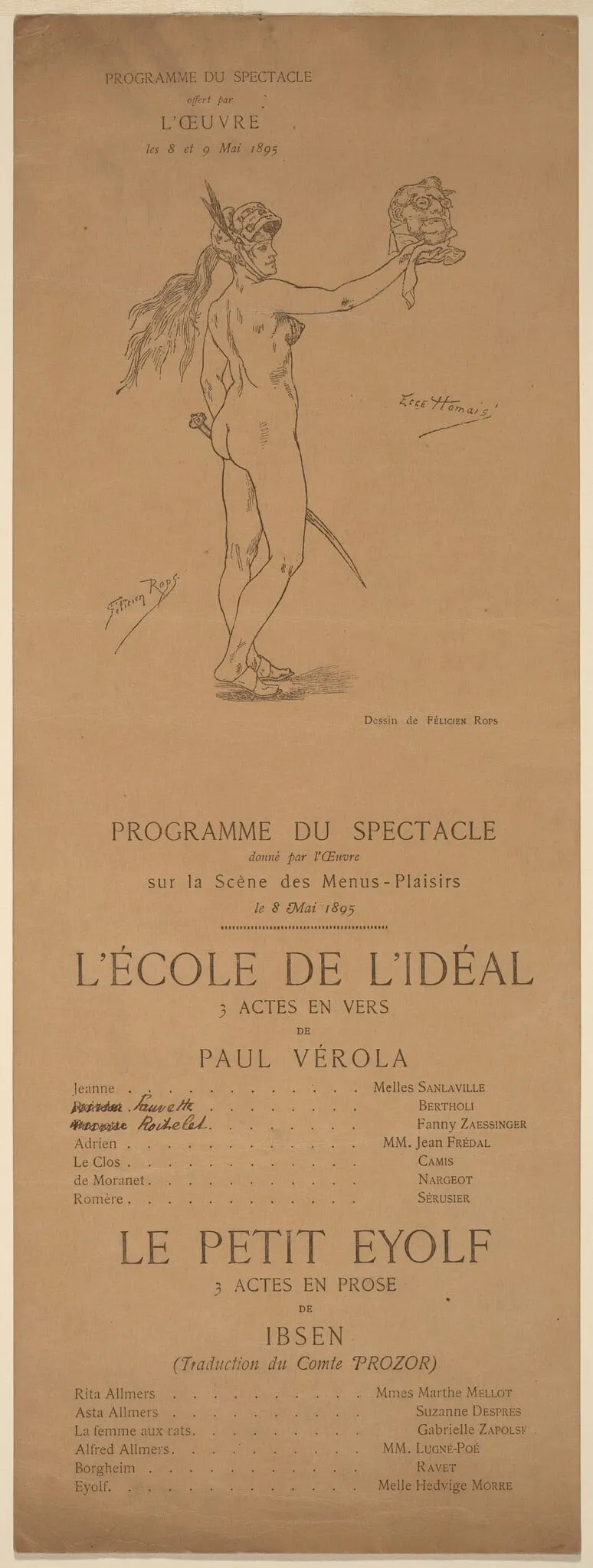
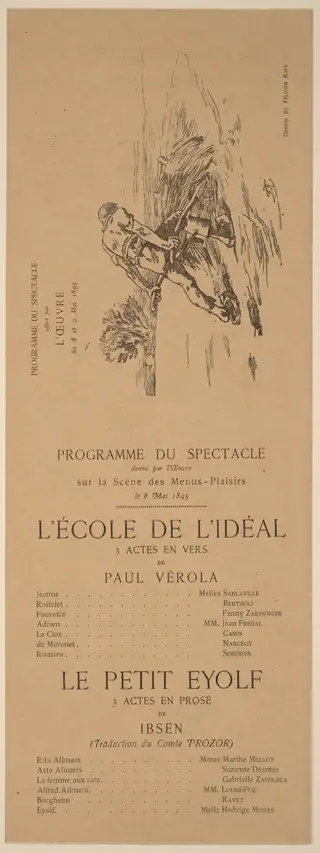
L'Ecole de l'idéal; Le Petit Eyolf is a print by the Impressionist artist French 19th Century. It dates from 1895 and is held in the collection of the National Gallery of Art. The work is a photomechanical print executed on light‑brown wove paper.
- Inscription
- Inscribed:center left in plate: Félicien Rops; center right in plate: Ecce Homais; upper left printed: PROGRAMME DU SPECTACLE / offert par / L'OEUVRE / les 8 et 9 Mai 1895; lower center printed: Dessin de FÉLICIEN ROPS / PROGRAMME DU SPECTACLE / donné par l'OEuvre / sur la scène des Menus-Plaisirs / le 8 Mai 1895 / L'ÉCOLE DE L'IDÉAL / 3 ACTES EN VERS / DE / PAUL VÉROLA... / LE PETIT EYOLF / 3 ACTES EN PROSE / DE / IBSEN...
About this work
The program is written in French and includes the title "L'Ecole de l'idéal; Le Petit Eyolf" and the artist's name, Paul Verola.
The image shows a program for a performance, featuring a drawing of a woman holding a mask. The woman is nude, with long hair and a feathered headpiece. She stands on one leg, with the other leg bent behind her. The mask she holds is a grotesque face with a large nose and mouth.
The program is written in French and includes the title "L'Ecole de l'idéal; Le Petit Eyolf" and the artist's name, Paul Verola. The text is arranged in a decorative font, with some words and phrases underlined or italicized.
The program appears to be from the late 19th century, based on the style of the drawing and the typography. It may have been created for a theatrical performance or an art exhibition. To learn more about the artistic movement that influenced this piece, look up Impressionism.
Overview
The work is a photomechanical print executed on light‑brown wove paper. It presents a program sheet for a performance titled “L’Ecole de l’idéal; Le Petit Eyolf,” attributed to Paul Verola. The composition combines a decorative French text with a central illustration of a nude female figure holding a grotesque mask.
Subject & Meaning
At the heart of the image stands a partially draped woman, her long hair crowned by a feathered headpiece. She balances on one leg while the other is bent behind her, suggesting movement or dance. In her hands she bears a mask featuring an exaggerated nose and mouth, evoking themes of theatricality, disguise, and perhaps the contrast between ideal beauty and grotesque reality.
Technique & Style
The piece employs a photomechanical process, a method that reproduces photographic detail through printing techniques, allowing fine line work and tonal variation. The drawing’s line quality and the stylized typography reflect late‑19th‑century aesthetic trends, merging illustrative realism with ornamental lettering.
History & Provenance
The program appears to originate from the final decades of the 1800s, as indicated by its drawing style and typographic conventions. While specific details of its original performance or exhibition remain unclear, the inclusion of the artist’s name, Paul Verola, suggests it was produced for a public presentation, possibly theatrical or artistic in nature.
Context
During the period in which this print was created, French cultural life was marked by a fascination with symbolism and the interplay between the ideal and the absurd. Programs such as this one often served both as informational guides and as artistic objects, reflecting the era’s integration of visual art with performance.
Artist & collection

Artist
This sculptor liked to keep sharp tools in the studio and blunt ones in his pocket, his niece recalled finding him absentmindedly whittling a stick while talking philosophy.