Artwork
The Temptation of Christ
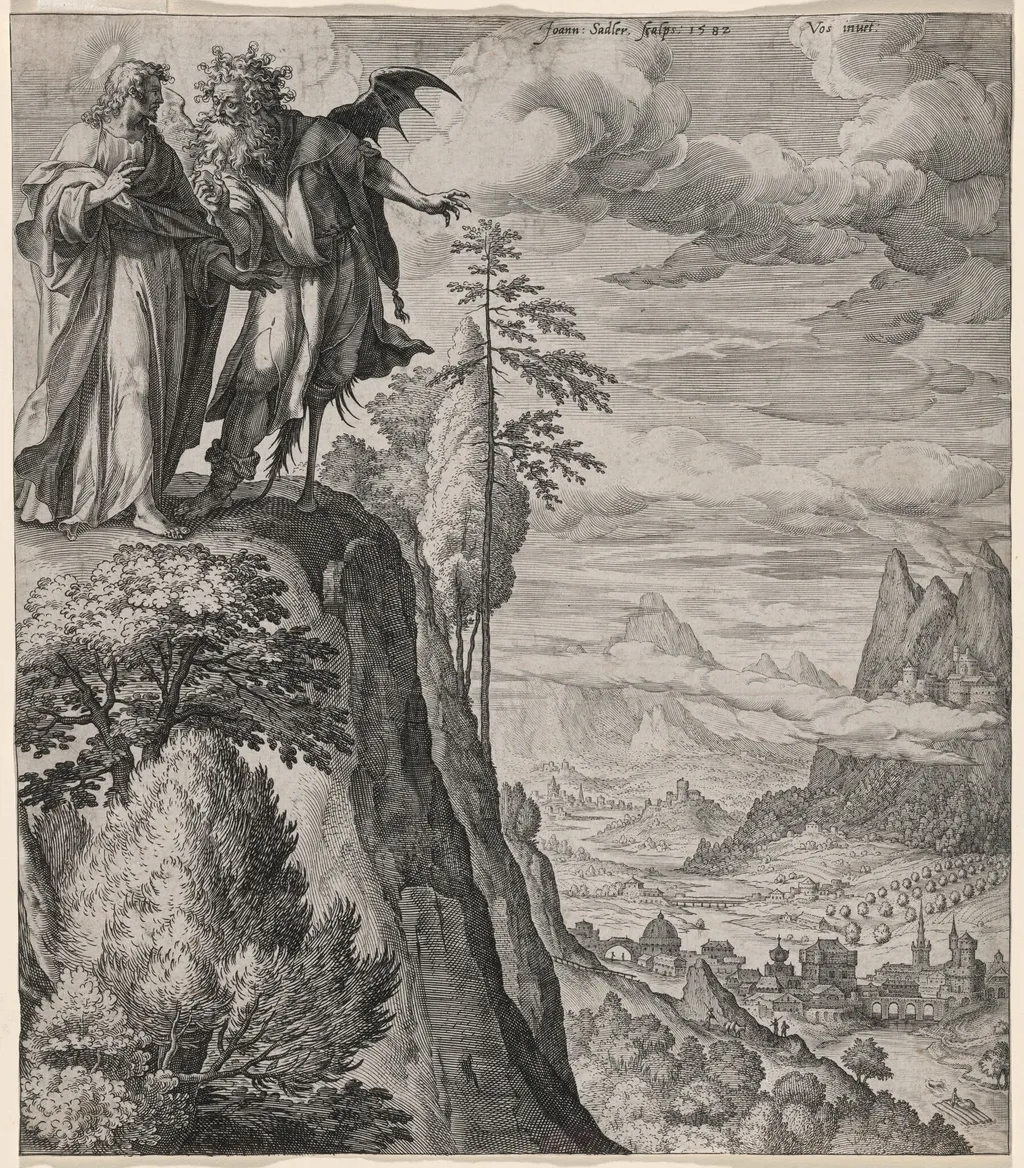
The Temptation of Christ is an ink print by the Renaissance artist Jan Sadeler I. It dates from 1582 and is held in the collection of the National Gallery of Art.
- Inscription
- Inscribed:upper right, in plate: Joann: Sadler. Scalps: 1582; upper right, in plate: Vos inuet:; verso, top right, in graphite by a later hand: 63.926; top center, in graphite by a later hand: 239L .16; verso, lower left, in graphite by a later hand: APG 17474
- Markings
- Marked:none
About this work
Overview
Jan Sadeler I's 1582 engraving, The Temptation of Christ, depicts the biblical narrative of Christ's trial in the wilderness.
Jan Sadeler I's 1582 engraving, The Temptation of Christ, depicts the biblical narrative of Christ's trial in the wilderness. The composition centers on two figures atop a rugged, rocky precipice: Christ, robed and holding a staff, stands in profile facing the left, while the Devil, distinguished by a pointed hat, wings, and a serpentine tail, gestures toward a distant landscape. The artist utilizes fine, precise burin lines to render the textures of the rock face and the drapery of the garments, creating a stark contrast between the spiritual serenity of the central figure and the grotesque physicality of the tempter.
Below the figures, a detailed panoramic view of a town and a winding river fills the valley, illustrating the third temptation where Satan offers Christ dominion over the kingdoms of the world. Executed on laid paper, this work exemplifies Sadeler's mastery of reproductive engraving, translating complex painterly compositions into intricate linear forms. Created during the height of the Flemish Renaissance, the print reflects the Counter-Reformation's emphasis on clear religious iconography and moral instruction.
As a significant example of Sadeler's output in the late 16th century, it demonstrates his role in disseminating religious imagery across Europe through the medium of print.
Subject & Meaning
The composition depicts a holy figure in flowing robes, staff in hand, confronting a demonic opponent distinguished by a pointed hat, wings, and a long tail. The demon’s clawed hand gestures toward a distant town nestled in a valley, suggesting a threat to the earthly realm.
Technique & Style
Sadeler employs intricate line work to model light and shadow across the rocky hillside, creating a dramatic chiaroscuro effect. The fine hatching characteristic of engraving allows subtle tonal variations, while the laid‑paper texture adds depth to the atmospheric background.
History & Provenance
Created in 1582, the print reflects Sadeler’s activity in the flourishing print market of the Low Countries. It entered the National Gallery of Art’s holdings through acquisition in the 20th century, where it remains on display as part of the museum’s European prints collection.
Context
The image belongs to a broader tradition of visualizing Christ’s temptation in the wilderness, a theme popular among Renaissance artists. Sadeler’s rendition aligns with contemporary devotional prints intended for private contemplation and the spread of biblical narratives.
Own this work as a print
Artist & collection

 Christ and the Woman of Samaria
 The Parable of the Two Sons and the Unjust Husbandmen
 The Vision of Ezekiel
 Aeneid
 Landscape with a Penitent Magdalene
 The Baptism of Christ
 Three Travelers at the Foot of a High Rock
 Daniel in the Lion’s Den
 David with the Head of Goliath
 View of the River Rhine
 A Man Showing Mercury the Eagle of Jupiter
- The Temptation of Christ